| Citation: | WANG Wei, CHENG Mingfeng, LUO Xin, WANG Jinbao, ZOU Baoping, CAO Chunhui. Experimental Study on Directional Rock Fracture by Energy-Gathering Cutting under Dynamic Impact[J]. Chinese Journal of High Pressure Physics, 2026, 40(3): 035301. doi: 10.11858/gywlxb.20251114

|

| [1] |
闫军. 倾斜节理发育条件下凝灰岩地层隧道拱顶聚能控制爆破施工技术研究 [D]. 长沙: 中南大学, 2012.
YAN J. Research on over-or-under excavation control of tunnels in tuff layer with developed cutters [D]. Changsha: Central South University, 2012.
|
| [2] |
郭建, 李兵, 刘桂勇, 等. 钻爆法施工隧道超欠挖控制研究 [J]. 工程爆破, 2021, 27(1): 79–84. doi: 10.19931/j.EB.20210026
GUO J, LI B, LIU G Y, et al. Study on control of backbreak and underbreak in tunnel excavation by drilling-and-blasting [J]. Engineering Blasting, 2021, 27(1): 79–84. doi: 10.19931/j.EB.20210026
|
| [3] |
YANG J H, JIANG Q H, ZHANG Q B, et al. Dynamic stress adjustment and rock damage during blasting excavation in a deep-buried circular tunnel [J]. Tunnelling and Underground Space Technology, 2018, 71: 591–604. doi: 10.1016/j.tust.2017.10.010
|
| [4] |
GUAN X M, YANG N, ZHANG W J, et al. Vibration response and failure modes analysis of the temporary support structure under blasting excavation of tunnels [J]. Engineering Failure Analysis, 2022, 136: 106188. doi: 10.1016/j.engfailanal.2022.106188
|
| [5] |
刘增辉, 孔春艳, 吕瑞, 等. 锯片-冲击锤组合刀头联合破岩特性研究 [J]. 振动与冲击, 2024, 43(24): 301–311. doi: 10.13465/j.cnki.jvs.2024.24.033
LIU Z H, KONG C Y, LYU R, et al. Characteristics of rock breaking by a saw blade-impact hammer combination cutterhead [J]. Journal of Vibration and Shock, 2024, 43(24): 301–311. doi: 10.13465/j.cnki.jvs.2024.24.033
|
| [6] |
LU Y Y, HUANG F, LIU X C, et al. On the failure pattern of sandstone impacted by high-velocity water jet [J]. International Journal of Impact Engineering, 2015, 76: 67–74. doi: 10.1016/j.ijimpeng.2014.09.008
|
| [7] |
REN F S, FANG T C, CHENG X Z. Study on rock damage and failure depth under particle water-jet coupling impact [J]. International Journal of Impact Engineering, 2020, 139: 103504. doi: 10.1016/j.ijimpeng.2020.103504
|
| [8] |
张权, 何满潮, 郭山, 等. 煤基固废非爆炸性膨胀剂高效定向破岩机制及初步应用研究 [J]. 岩石力学与工程学报, 2025, 44(4): 898–911. doi: 10.3724/1000-6915.jrme.2024.0553
ZHANG Q, HE M C, GUO S, et al. Study on the mechanism and preliminary application of efficient directional rock breaking using a coal-based solid waste non-explosive expansive agent [J]. Chinese Journal of Rock Mechanics and Engineering, 2025, 44(4): 898–911. doi: 10.3724/1000-6915.jrme.2024.0553
|
| [9] |
ZHANG Q, HE M C, WANG J, et al. Non-explosive directional fracturing blasting using coal-based solid waste expanding agent [J]. Journal of Rock Mechanics and Geotechnical Engineering, 2025, 17(6): 3691–3710. doi: 10.1016/j.jrmge.2025.04.003
|
| [10] |
鞠明和, 陶泽军, 蔚立元, 等. 钢粒子迟滞重复冲击破岩硬岩损伤破裂特征研究 [J]. 岩土力学, 2024, 45(4): 1242–1255. doi: 10.16285/j.rsm.2023.0515
JU M H, TAO Z J, WEI L Y, et al. Damage and fracture characteristics of hard rocks caused by hysterisis and repeated impacts of steel particles [J]. Rock and Soil Mechanics, 2024, 45(4): 1242–1255. doi: 10.16285/j.rsm.2023.0515
|
| [11] |
魏建平, 蔡玉波, 刘勇, 等. 非刀具破岩理论与技术研究进展与趋势 [J]. 煤炭学报, 2024, 49(2): 801–832. doi: 10.13225/j.cnki.jccs.ST23.1199
WEI J P, CAI Y B, LIU Y, et al. Progress and trends in non-tool rock breaking theory and technology [J]. Journal of China Coal Society, 2024, 49(2): 801–832. doi: 10.13225/j.cnki.jccs.ST23.1199
|
| [12] |
孙南翔. 低阶煤热敏特性及其热力破碎机理研究 [D]. 北京: 中国矿业大学(北京), 2016.
SUN N X. Thermal sensitive characteristics and mechanism of thermal fragmentation of low rank coal [D]. Beijing: China University of Mining and Technology (Beijing), 2016.
|
| [13] |
程刚. 成孔液压涨裂破岩机理研究 [D]. 徐州: 中国矿业大学, 2018.
CHENG G. Research on rock breaking mechanism of hydraulic fracturing breaking rock [D]. Xuzhou: China University of Mining and Technology, 2018.
|
| [14] |
张琳, 胡少斌, 蔡余康, 等. 地应力对高温高压CO2热冲击破岩的影响研究 [J]. 地下空间与工程学报, 2024, 26(6): 1818–1829. doi: 10.20174/j.JUSE.2024.06.07
ZHANG L, HU S B, CAI Y K, et al. Study on the effect of in-situ stress on rock breaking by high temperature and high pressure CO2 thermal shock [J]. Chinese Journal of Underground Space and Engineering, 2024, 26(6): 1818–1829. doi: 10.20174/j.JUSE.2024.06.07
|
| [15] |
董学成, 熊继有, 王国华, 等. 振荡冲击器破岩机理数值模拟分析 [J]. 西南石油大学学报(自然科学版), 2014, 36(6): 160–167. doi: 10.11885/j.issn.1674-5086.2014.08.15.01
DONG X C, XIONG J Y, WANG G H, et al. Numerical simulation analysis of rock breaking mechanism for oscillation impacter [J]. Journal of Southwest Petroleum University (Science & Technology Edition), 2014, 36(6): 160–167. doi: 10.11885/j.issn.1674-5086.2014.08.15.01
|
| [16] |
李玮, 闫铁, 张志超, 等. 高频振动钻具冲击下岩石响应机理及破岩试验分析 [J]. 石油钻探技术, 2013, 41(6): 25–28. doi: 10.3969/j.issn.1001-0890.2013.06.005
LI W, YAN T, ZHANG Z C, et al. Rock response mechanism and rock breaking test analysis for impact of high frequency vibration drilling tool [J]. Petroleum Drilling Techniques, 2013, 41(6): 25–28. doi: 10.3969/j.issn.1001-0890.2013.06.005
|
| [17] |
祝效华, 刘伟吉, 石昌帅, 等. 重载冲击破岩提速机理实验 [J]. 石油学报, 2024, 45(10): 1529–1537. doi: 10.7623/syxb202410007
ZHU X H, LIU W J, SHI C S, et al. Experiment on the rock-breaking and speed-up mechanism under heavy-dutyimpac [J]. Acta Petrolei Sinica, 2024, 45(10): 1529–1537. doi: 10.7623/syxb202410007
|
| [18] |
胡思成, 管志川, 路保平, 等. 锥形齿旋冲及扭冲的破岩过程与破岩效率分析 [J]. 石油钻探技术, 2021, 49(3): 87–93. doi: 10.11911/syztjs.2021035
HU S C, GUAN Z C, LU B P, et al. Rock breaking process and efficiency analysis of conical cutting teeth under rotary and torsional impact [J]. Petroleum Drilling Techniques, 2021, 49(3): 87–93. doi: 10.11911/syztjs.2021035
|
| [19] |
LINDHOLM U S. Some experiments with the split Hopkinson pressure bar [J]. Journal of the Mechanics and Physics of Solids, 1964, 12(5): 317–335. doi: 10.1016/0022-5096(64)90028-6
|
| [20] |
ZHOU Y X, XIA K, LI X B, et al. Suggested methods for determining the dynamic strength parameters and mode-Ⅰ fracture toughness of rock materials [J]. International Journal of Rock Mechanics and Mining Sciences, 2012, 49: 105–112. doi: 10.1016/j.ijrmms.2011.10.004
|
| [21] |
谢磊, 李庆华, 徐世烺. 冲击荷载下免蒸养活性粉末混凝土分形特征研究 [J]. 工程力学, 2021, 38(3): 169–180. doi: 10.6052/j.issn.1000-4750.2020.05.0298
XIE L, LI Q H, XU S L. Experimental study on fractal characteristics of steam free reactive powder concrete under impact load [J]. Engineering Mechanics, 2021, 38(3): 169–180. doi: 10.6052/j.issn.1000-4750.2020.05.0298
|
| [22] |
李淼, 乔兰, 李庆文. 高应变率下预制单节理岩石SHPB劈裂试验能量耗散分析 [J]. 岩土工程学报, 2017, 39(7): 1336–1343. doi: 10.11779/CJGE201707021
LI M, QIAO L, LI Q W. Energy dissipation of rock specimens under high strain rate with single joint in SHPB tensile tests [J]. Chinese Journal of Geotechnical Engineering, 2017, 39(7): 1336–1343. doi: 10.11779/CJGE201707021
|
| [23] |
HONG L, ZHOU Z L, YIN T B, et al. Energy consumption in rock fragmentation at intermediate strain rate [J]. Journal of Central South University of Technology, 2009, 16(4): 677–682. doi: 10.1007/s11771-009-0112-5
|
| [24] |
CHEN C F, XU T, LI S H. Microcrack evolution and associated deformation and strength properties of sandstone samples subjected to various strain rates [J]. Minerals, 2018, 8(6): 231. doi: 10.3390/min8060231
|
| [25] |
ABOAYANAH K R, ABDELAZIZ A, HAILE B F, et al. Evaluation of damage stress thresholds and mechanical properties of granite: new insights from digital image correlation and GB-FDEM [J]. Rock Mechanics and Rock Engineering, 2024, 57(7): 4679–4706. doi: 10.1007/s00603-024-03789-7
|
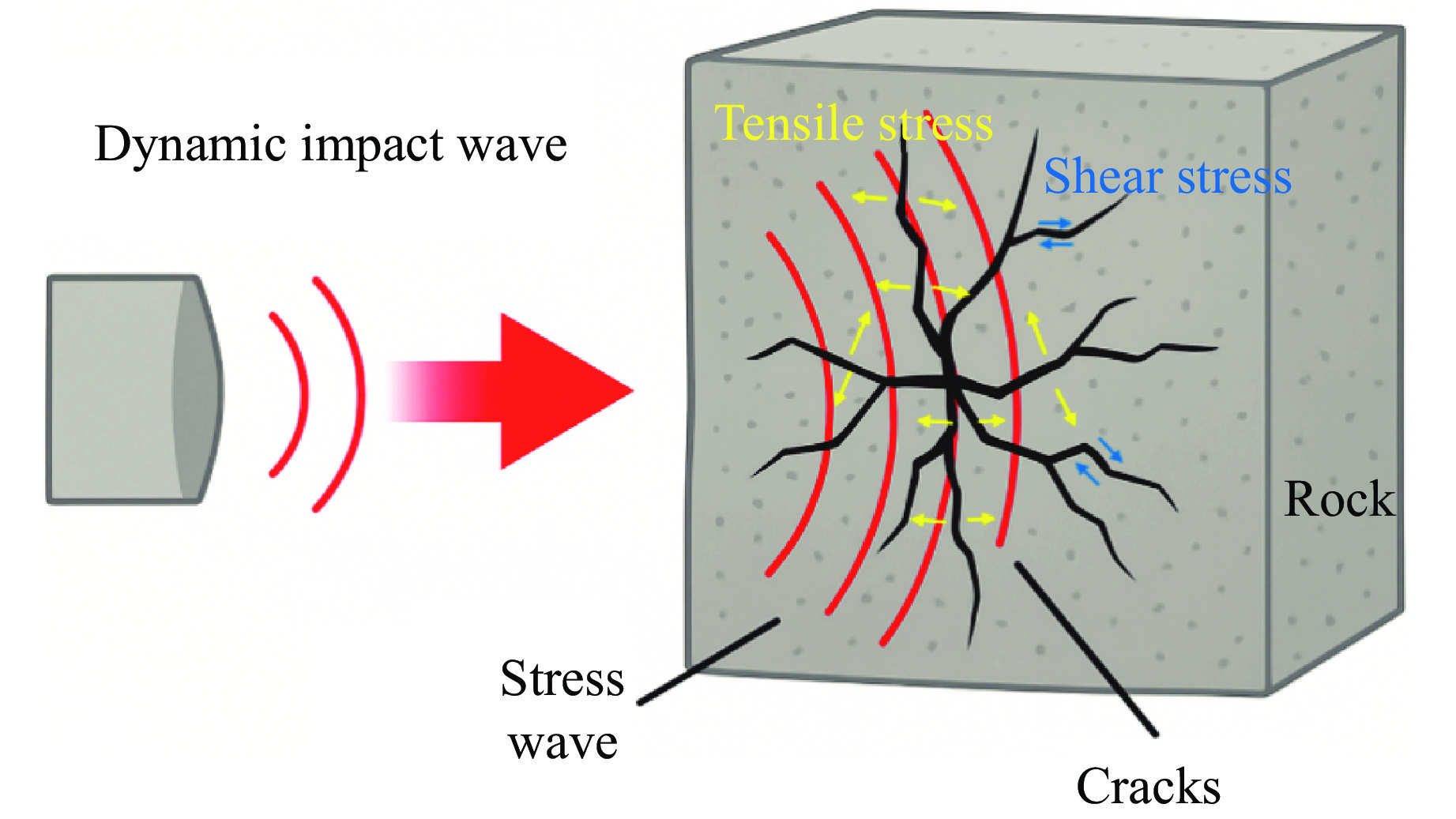
Figures(9) / Tables(1)
Website Copyright© Editorial Office of Chinese Journal of High Pressure Physics
Tel:0816-2490042 E-mail:gaoya@caep.cn
Supported by: Beijing Renhe Information Technology Co. Ltd support:
info@rhhz.net






 DownLoad: