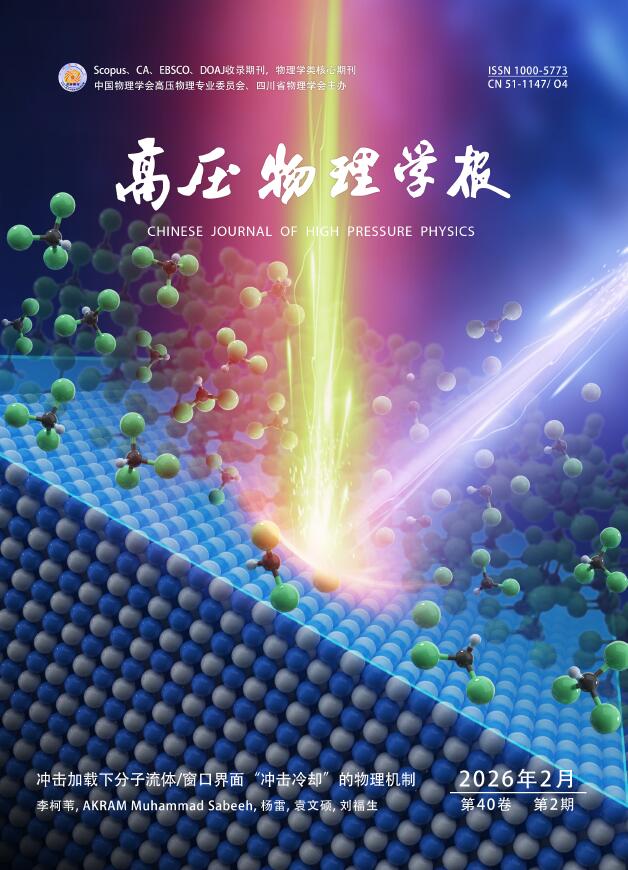
| Citation: | LI Kewei, AKRAM Muhammad Sabeeh, YANG Lei, YUAN Wenshuo, LIU Fusheng. Physical Mechanisms of “Shock Cooling” at the Molecular Fluid/Window Interface under Shock Loading[J]. Chinese Journal of High Pressure Physics, 2026, 40(2): 020101. doi: 10.11858/gywlxb.20251092

|

| [1] |
ZHANG L J, WANG Y C, LV J, et al. Materials discovery at high pressures [J]. Nature Reviews Materials, 2017, 2(4): 17005. doi: 10.1038/natrevmats.2017.5
|
| [2] |
SIKKA S K. Behaviour of materials under shock loading conditions [J]. Bulletin of Materials Science, 1992, 15(1): 35–46. doi: 10.1007/BF02745215
|
| [3] |
孙毅, 向士凯, 耿华运, 等. 自动校准的多相状态方程建模方法及其在锡中的应用 [J]. 高压物理学报, 2023, 37(2): 021301. doi: 10.11858/gywlxb.20220709
SUN Y, XIANG S K, GENG H Y, et al. Automated calibrated modeling method of multiphase equations of states: applied to tin [J]. Chinese Journal of High Pressure Physics, 2023, 37(2): 021301. doi: 10.11858/gywlxb.20220709
|
| [4] |
胡建波, 周显明, 谭华. 反向碰撞法测量Sn的高压卸载声速 [J]. 物理学报, 2008, 57(4): 2347–2351. doi: 10.3321/j.issn:1000-3290.2008.04.056
HU J B, ZHOU X M, TAN H. Measurements of release sound velocities of tin with reverse-impact method [J]. Acta Physica Sinica, 2008, 57(4): 2347–2351. doi: 10.3321/j.issn:1000-3290.2008.04.056
|
| [5] |
ZOU X Y, HUANG H W, YAO X H. Flexoelectric energy dissipating mechanism for multi-impact protection [J]. Applied Mathematics and Mechanics, 2025, 46(4): 699–710. doi: 10.1007/s10483-025-3235-6
|
| [6] |
NELLIS W J, RADOUSKY H B, HAMILTON D C, et al. Equation-of-state, shock-temperature, and electrical-conductivity data of dense fluid nitrogen in the region of the dissociative phase transition [J]. The Journal of Chemical Physics, 1991, 94(3): 2244–2257. doi: 10.1063/1.459895
|
| [7] |
RADOUSKY H B, ROSS M. Shock-induced cooling in high-density fluid nitrogen [J]. High Pressure Research, 1988, 1(1): 39–52. doi: 10.1080/08957958808202479
|
| [8] |
RADOUSKY H B, NELLIS W J, ROSS M, et al. Molecular dissociation and shock-induced cooling in fluid nitrogen at high densities and temperatures [J]. Physical Review Letters, 1986, 57(19): 2419–2422. doi: 10.1103/PhysRevLett.57.2419
|
| [9] |
LINDSEY R K, BASTEA S, LYU Y J, et al. Chemical evolution in nitrogen shocked beyond the molecular stability limit [J]. The Journal of Chemical Physics, 2023, 159(8): 084502. doi: 10.1063/5.0157238
|
| [10] |
CHEN Q F, ZHENG J, GU Y J, et al. Thermophysical properties of multi-shock compressed dense argon [J]. The Journal of Chemical Physics, 2014, 140(7): 074202. doi: 10.1063/1.4865129
|
| [11] |
ZHENG J, CHEN Q F, GU Y J, et al. Multishock compression properties of warm dense argon [J]. Scientific Reports, 2015, 5(1): 16041. doi: 10.1038/srep16041
|
| [12] |
ZHENG J, CHEN Q F, GU Y J, et al. Thermodynamics, compressibility, and phase diagram: shock compression of supercritical fluid xenon [J]. The Journal of Chemical Physics, 2014, 141(12): 124201. doi: 10.1063/1.4896071
|
| [13] |
LI J, ZHOU X M, LI J B. A time-resolved single-pass technique for measuring optical absorption coefficients of window materials under 100 GPa shock pressures [J]. Review of Scientific Instruments, 2008, 79(12): 123107. doi: 10.1063/1.3046279
|
| [14] |
周显明, 操秀霞, 李俊, 等. 氟化锂和蓝宝石单晶冲击消光及其对辐射测温的影响 [J]. 原子与分子物理学报, 2012, 29(3): 481–487. doi: 10.3969/j.issn.1000-0364.2012.03.018
ZHOU X M, CAO X X, LI J, et al. Shock-induced optical extinction in LiF and sapphire crystals and its significance in the radiant temperature determination [J]. Journal of Atomic and Molecular Physics, 2012, 29(3): 481–487. doi: 10.3969/j.issn.1000-0364.2012.03.018
|
| [15] |
CAO X X, WU Q, SOKOL M, et al. Superior optical transparency of nano-grain magnesium aluminate spinel at high shock pressure [J]. Applied Physics Letters, 2024, 124(5): 054102. doi: 10.1063/5.0181667
|
| [16] |
胡金彪, 谭华, 经福谦. 溴仿在冲击压缩下的光辐射及化学反应 [J]. 高压物理学报, 1996, 10(3): 220–226. doi: 10.11858/gywlxb.1996.03.009
HU J B, TAN H, JING F Q. Optic radiations and chemical reactions in bromoform under shock compressions [J]. Chinese Journal of High Pressure Physics, 1996, 10(3): 220–226. doi: 10.11858/gywlxb.1996.03.009
|
| [17] |
DE GIACOMO A, HERMANN J. Laser-induced plasma emission: from atomic to molecular spectra [J]. Journal of Physics D: Applied Physics, 2017, 50(18): 183002. doi: 10.1088/1361-6463/aa6585
|
| [18] |
ATREYA S K, MAHAFFY P R, NIEMANN H B, et al. Composition and origin of the atmosphere of Jupiter—an update, and implications for the extrasolar giant planets [J]. Planetary and Space Science, 2003, 51(2): 105–112. doi: 10.1016/S0032-0633(02)00144-7
|
| [19] |
HERSANT F, GAUTIER D, LUNINE J I. Enrichment in volatiles in the giant planets of the Solar system [J]. Planetary and Space Science, 2004, 52(7): 623–641. doi: 10.1016/j.pss.2003.12.011
|
| [20] |
MOUSIS O, LUNINE J I, PETIT J M, et al. Impact regimes and post-formation sequestration processes: implications for the origin of heavy noble gases in terrestrial planets [J]. The Astrophysical Journal, 2010, 714(2): 1418–1423. doi: 10.1088/0004-637X/714/2/1418
|
| [21] |
KUBO H, SAKURAI S, ASAKURA N, et al. High radiation and high density experiments in JT-60U [J]. Nuclear Fusion, 2001, 41(2): 227. doi: 10.1088/0029-5515/41/2/310
|
| [22] |
YOO C S, HOLMES N C, ROSS M, et al. Shock temperatures and melting of iron at Earth core conditions [J]. Physical Review Letters, 1993, 70(25): 3931–3934. doi: 10.1103/PhysRevLett.70.3931
|
| [23] |
谭华. 金属的冲击波温度测量(Ⅰ) ──高温计的标定和界面温度的确定 [J]. 高压物理学报, 1994, 8(4): 254–263. doi: 10.11858/gywlxb.1994.04.003
TAN H. Shock temperature measurements for metal (Ⅰ) ──calibration of pyrometers and data reduction for the temperature at the interface [J]. Chinese Journal of High Pressure Physics, 1994, 8(4): 254–263. doi: 10.11858/gywlxb.1994.04.003
|
| [24] |
施鑫辉, 杨雷, 杨雪, 等. 冲击点火反应过程中RDX基PBX炸药的热辐射特性 [J]. 高压物理学报, 2025, 39(1): 011301. doi: 10.11858/gywlxb.20240814
SHI X H, YANG L, YANG X, et al. Thermal radiation characteristics of RDX-based PBX explosives during shock-induced ignition reactions [J]. Chinese Journal of High Pressure Physics, 2025, 39(1): 011301. doi: 10.11858/gywlxb.20240814
|
| [25] |
KWIATKOWSKI C S, GUPTA Y M. Optical measurements to probe inelastic deformation in shocked brittle materials [J]. AIP Conference Proceedings, 2000, 505(1): 641–644. doi: 10.1063/1.1303555
|
| [26] |
王藩侯, 杨传路, 李西军, 等. 液氩多体作用势研究及其Hugoniot曲线的分子动力学模拟 [J]. 物理学报, 2000, 49(1): 114–118. doi: 10.3321/j.issn:1000-3290.2000.01.024
WANG F H, YANG C L, LI X J, et al. Studies on many-body interactions and molecular dynamics simulations for the Hugoniot curves of liquid argon [J]. Acta Physica Sinica, 2000, 49(1): 114–118. doi: 10.3321/j.issn:1000-3290.2000.01.024
|
| [27] |
SABEEH AKRAM M, FAN Z N, ZHANG M J, et al. Measuring the shock Hugoniot data of liquid nitrogen using a cryogenic system for shock compression [J]. Journal of Applied Physics, 2020, 128(22): 225901. doi: 10.1063/5.0029911
|
| [28] |
BOSLOUGH M B. A model for time dependence in shock-induced thermal radiation of light [J]. Journal of Applied Physics, 1985, 58(9): 3394–3399. doi: 10.1063/1.335756
|
| [29] |
BOEHLER R, ROSS M, BOERCKER D B. Melting of LiF and NaCl to 1 Mbar: systematics of ionic solids at extreme conditions [J]. Physical Review Letters, 1997, 78(24): 4589–4592. doi: 10.1103/PhysRevLett.78.4589
|
| [30] |
MENG C M, SHI S C, DONG S, et al. Experimental measurement for shock velocity-mass velocity relationship of liquid argon up to 46 GPa [J]. Chinese Physics Letters, 2003, 20(8): 1221–1222. doi: 10.1088/0256-307X/20/8/310
|
| [31] |
孟川民, 施尚春, 黄海军, 等. 33 GPa压力以下液氩冲击温度的实验测量 [J]. 高压物理学报, 2006, 20(3): 296–300. doi: 10.11858/gywlxb.2006.03.013
MENG C M, SHI S C, HUANG H J, et al. Experimental measurement for shock temperature of liquid argon up to 33 GPa [J]. Chinese Journal of High Pressure Physics, 2006, 20(3): 296–300. doi: 10.11858/gywlxb.2006.03.013
|
| [32] |
MCGIVERN W S, SORKHABI O, SUITS A, et al. Primary and secondary processes in the photodissociation of CHBr3 [J]. Journal of Physical Chemistry A, 2000, 104(45): 10085–10091. doi: 10.1021/jp0005017
|
| [33] |
ZHOU X M, NELLIS W J, LI J B, et al. Optical emission, shock-induced opacity, temperatures, and melting of Gd3Ga5O12 single crystals shock-compressed from 41 to 290 GPa [J]. Journal of Applied Physics, 2015, 118(5): 055903. doi: 10.1063/1.4928081
|

Figures(8) / Tables(2)
Website Copyright© Editorial Office of Chinese Journal of High Pressure Physics
Tel:0816-2490042 E-mail:gaoya@caep.cn
Supported by: Beijing Renhe Information Technology Co. Ltd support:
info@rhhz.net






 DownLoad:


