




Numerical Simulation on Anti-Penetration Performance of SiC/Ti-Alloy Interpenetrating TPMS Structures
-
摘要: 陶瓷/金属复合材料作为一种具有轻量化、高比强度、高吸能效率特性的抗冲击结构,被广泛应用于军事及航空航天领域。随着3D打印技术的发展,制造三周期极小曲面(triply periodic minimal surface,TPMS)的复杂点阵结构成为可能。设计了一种碳化硅(SiC)陶瓷与钛合金(TC4)复合的穿插式TPMS防弹结构,针对单弹侵彻与双弹侵彻工况,利用ABAQUS开展了数值模拟研究,对比了该结构与纯SiC的损伤破坏模式、侵彻深度和弹道极限速度。数值模拟结果表明:不同穿插式TPMS结构呈现出不同的损伤破坏模式,三维拓扑结构限制了裂纹在陶瓷内部的扩散,使靶板整体损伤弱于纯SiC靶;第2发弹丸侵彻造成的损伤沿首发弹丸侵彻区域继续发展,侵彻深度增加;相较于纯SiC靶板,3种穿插式TPMS靶板的侵彻深度更浅,弹道极限速度更高;当来袭子弹能够击穿靶板时,P型结构对低速弹的抗弹性能更优,D型结构对高速弹的抗弹性能更优。研究结果表明,等面密度下穿插式TPMS靶板相较于纯SiC具有更优的抗弹性能。研究结果可为新型轻质陶瓷装甲设计提供技术支撑和理论依据。Abstract: Ceramic/metal composite materials were widely used in national defense, military industry, and aerospace fields as lightweight impact-resistant structures with high specific strength and high energy absorption efficiency. With the development of 3D printing technology, it has become possible to fabricate complex lattice structures based on triply periodic minimal surfaces (TPMS). In this paper, an interpenetrating TPMS ballistic composite structure composed of silicon carbide (SiC) ceramic and titanium alloy (TC4) is designed. A series of numerical simulations are carried out under single-projectile and double-projectile penetration conditions using ABAQUS software. The damage modes, penetration depth, and ballistic limit velocity of the proposed structure and pure SiC target plate are compared and analyzed. The simulation results show that different interpenetrating TPMS structures exhibit distinct damage and failure modes. The three-dimensional topological configuration restrains crack propagation inside the ceramic, resulting in slighter overall damage than the pure SiC target plate. The damage caused by the second projectile further propagates along the penetration region of the first projectile, and accompanied by an increase in penetration depth. Compared with the pure SiC target plate, the three interpenetrating TPMS targets present smaller penetration depth and higher ballistic limit velocity. When the projectile can perforate the target plate, the primitive (P-type) structure shows better ballistic performance against low-velocity projectiles, while the diamond (D-type) structure is superior against high-velocity projectiles. It is demonstrated that the interpenetrating TPMS targets possess better ballistic performance than pure SiC at the same area density. The technical support and theoretical basis can be provided for the design of novel lightweight ceramic armor in this study.
-
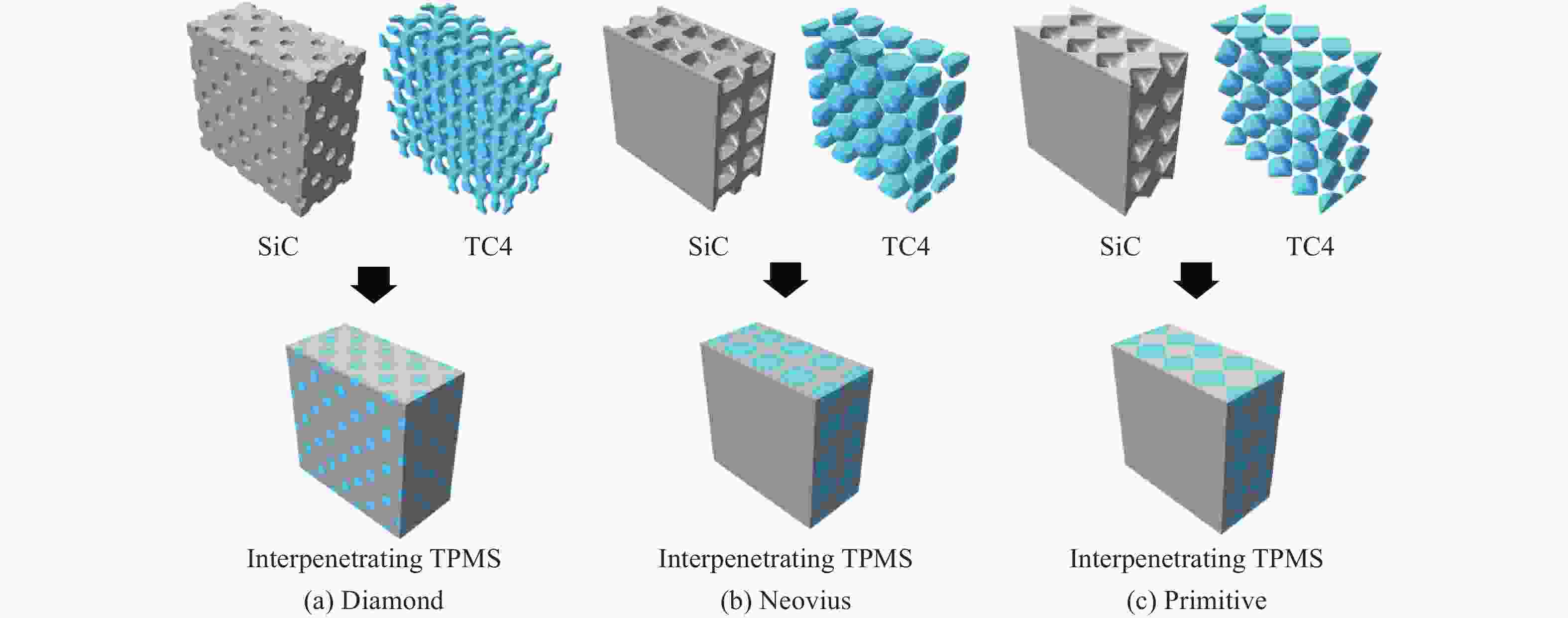
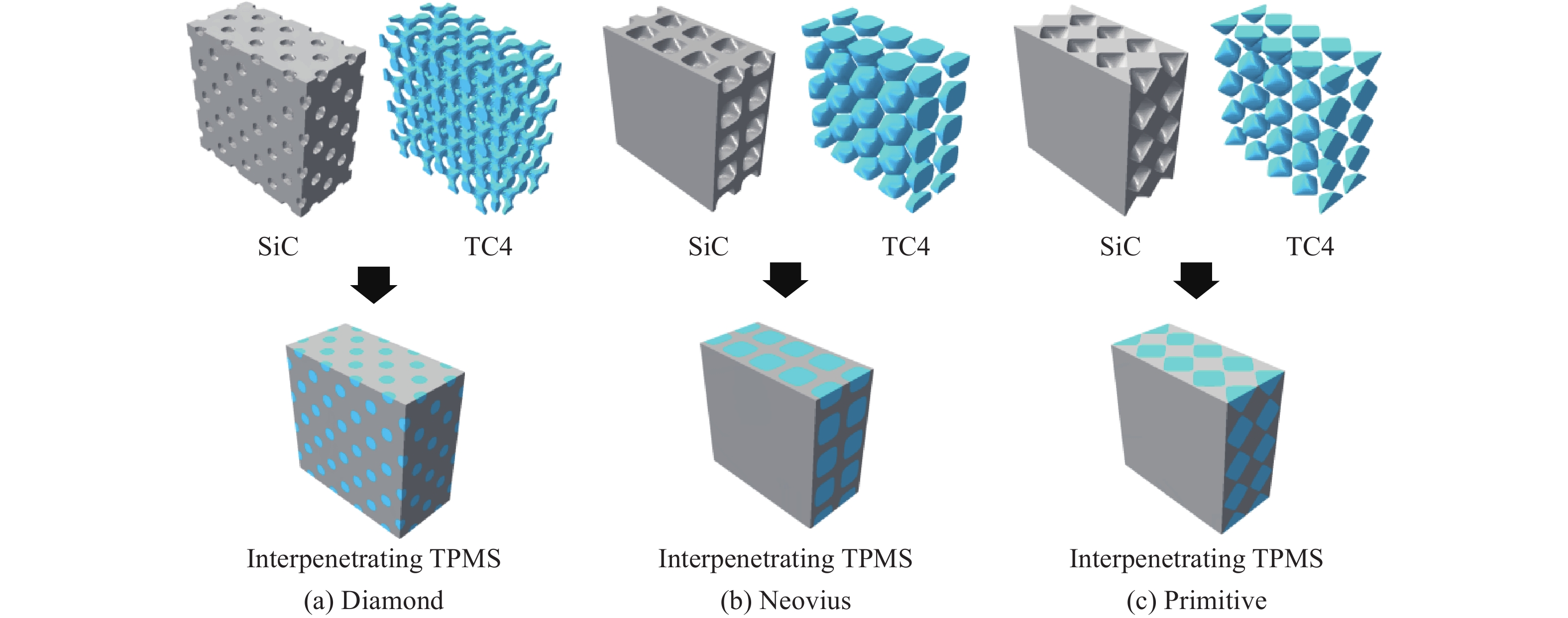
图 1 3种穿插式TPMS结构的1/4模型构建示意图
Figure 1. Schematic diagram of 1/4 model construction for three interpenetrating TPMS structures
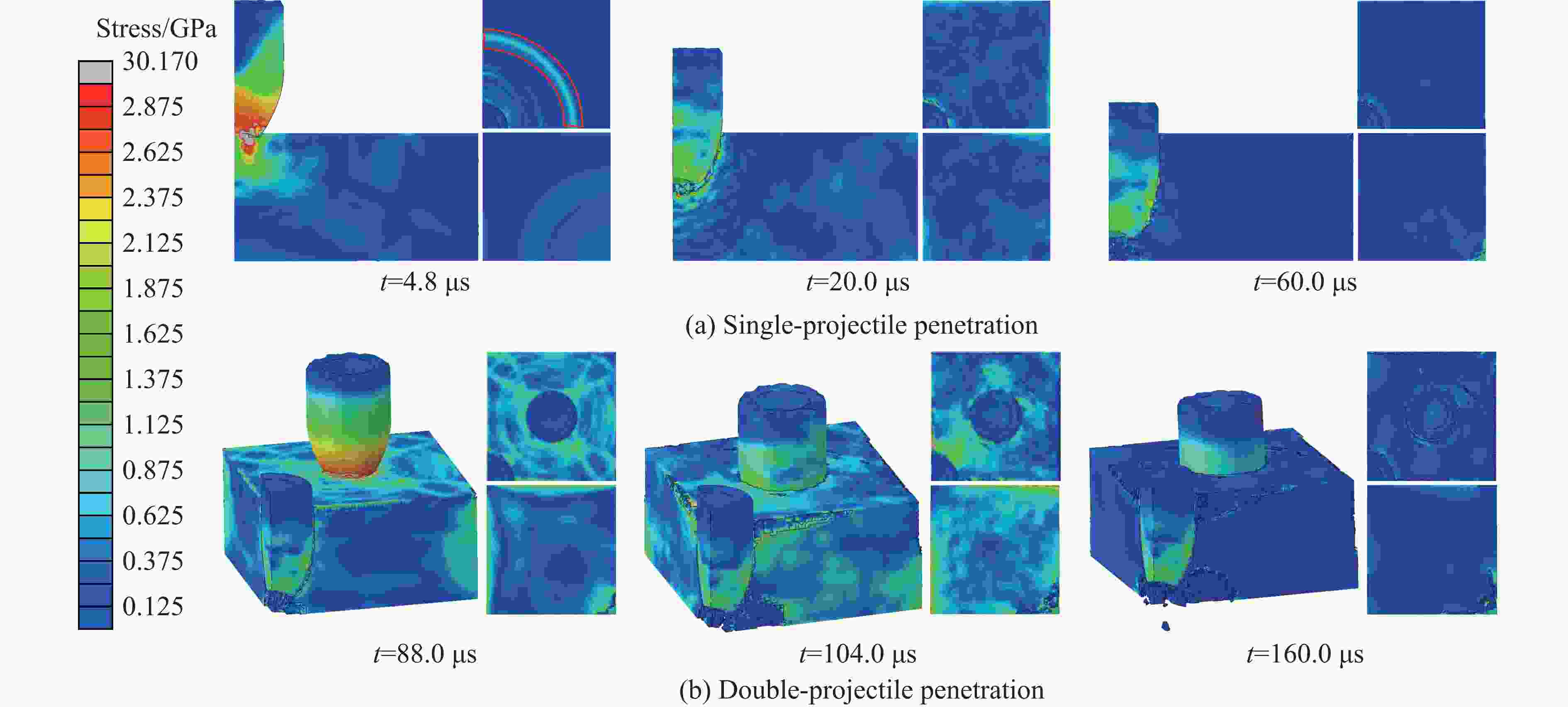
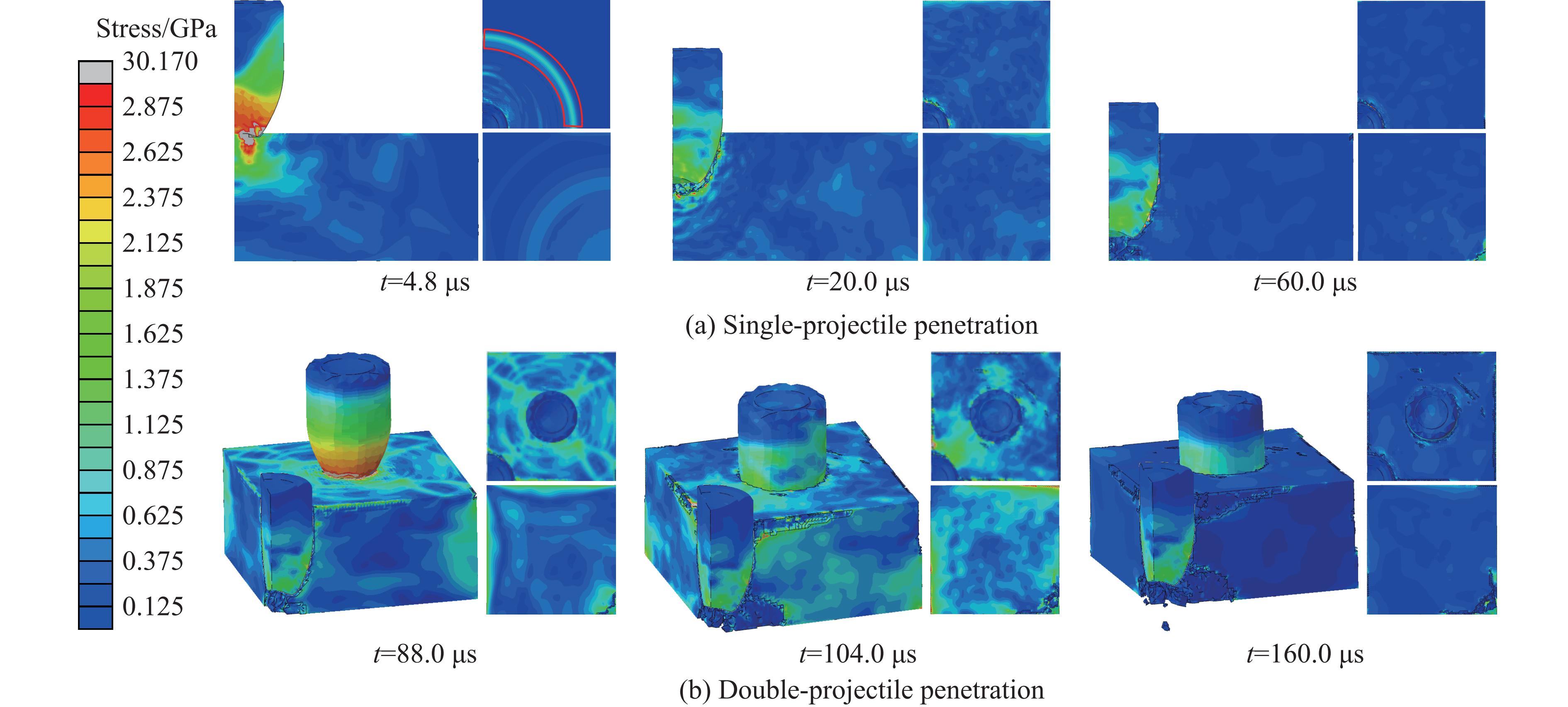
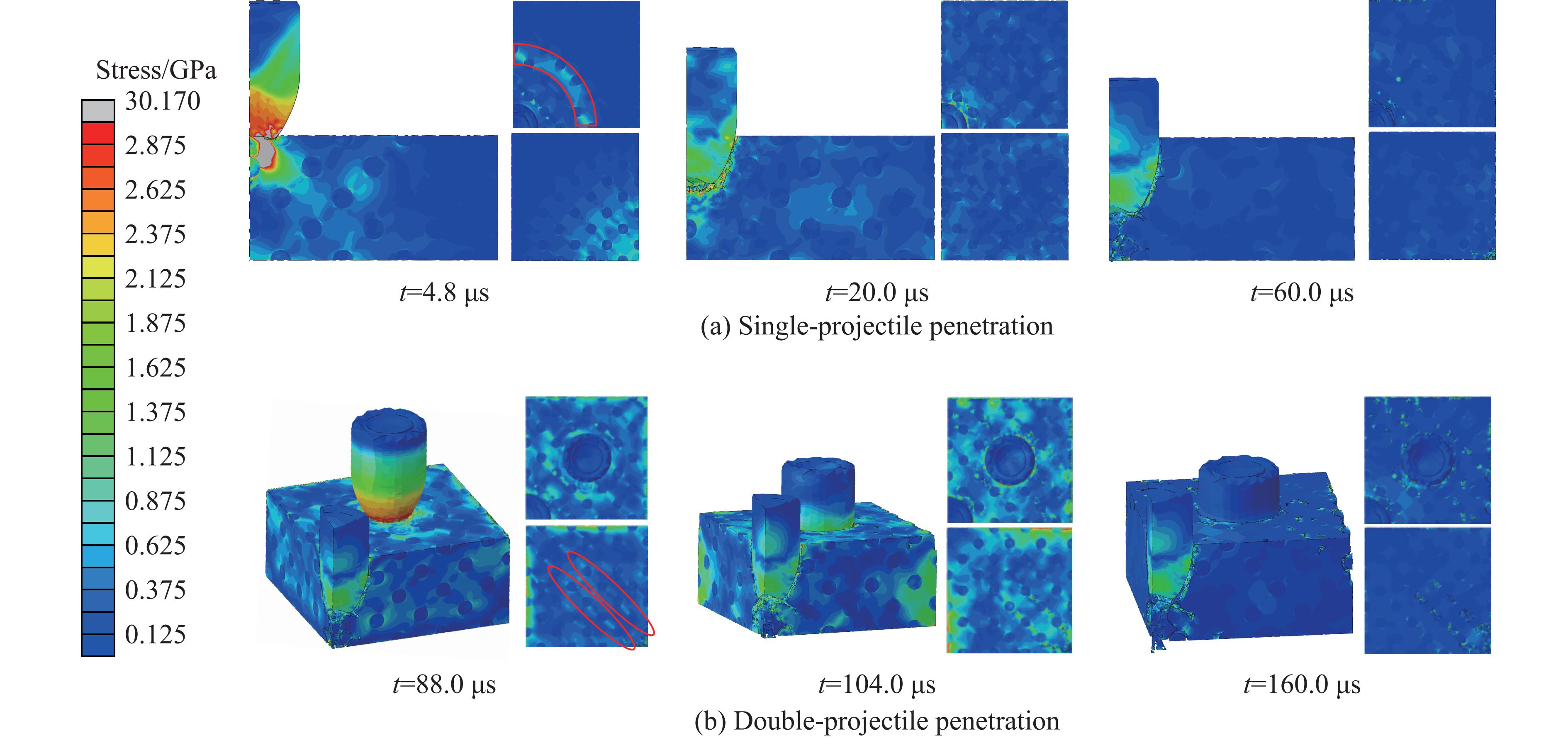
图 5 纯SiC在单弹侵彻/双弹侵彻工况下的应力云图
Figure 5. Stress contours of the pure SiC under single-projectile and double-projectile penetration conditions
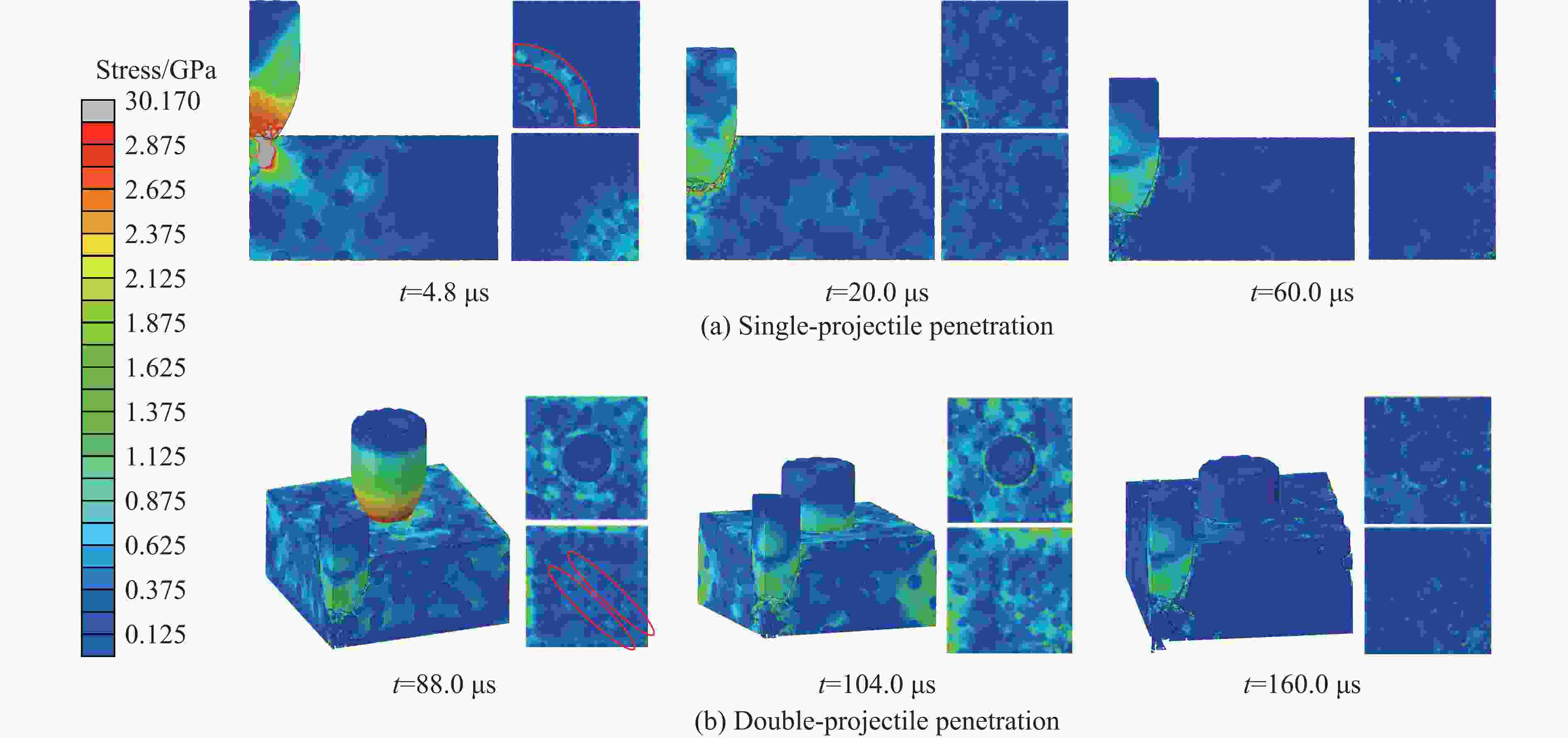
图 6 D型TPMS穿插靶在单弹侵彻/双弹侵彻工况下的应力云图
Figure 6. Stress contours of D-shaped TPMS interpenetrating target under single-projectile and double-projectile penetration conditions
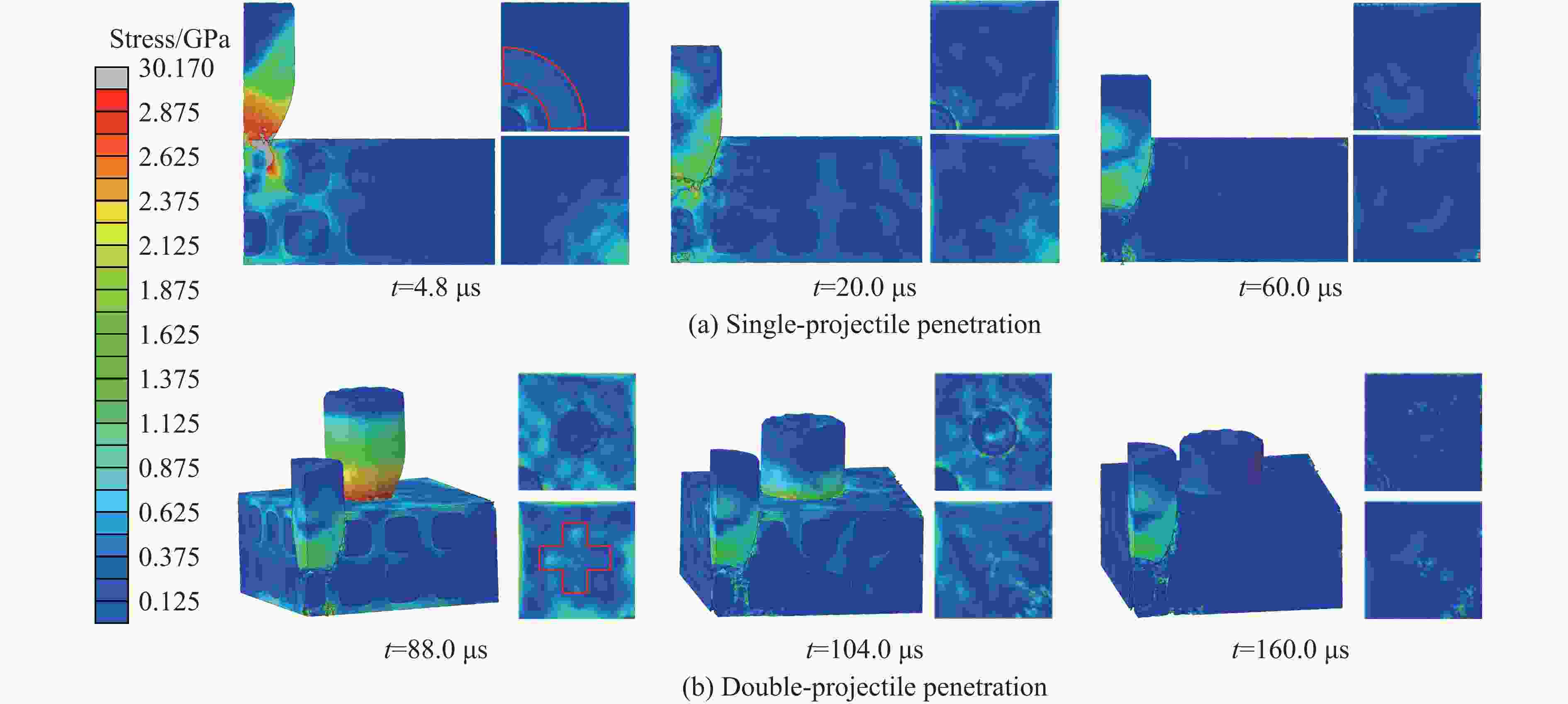
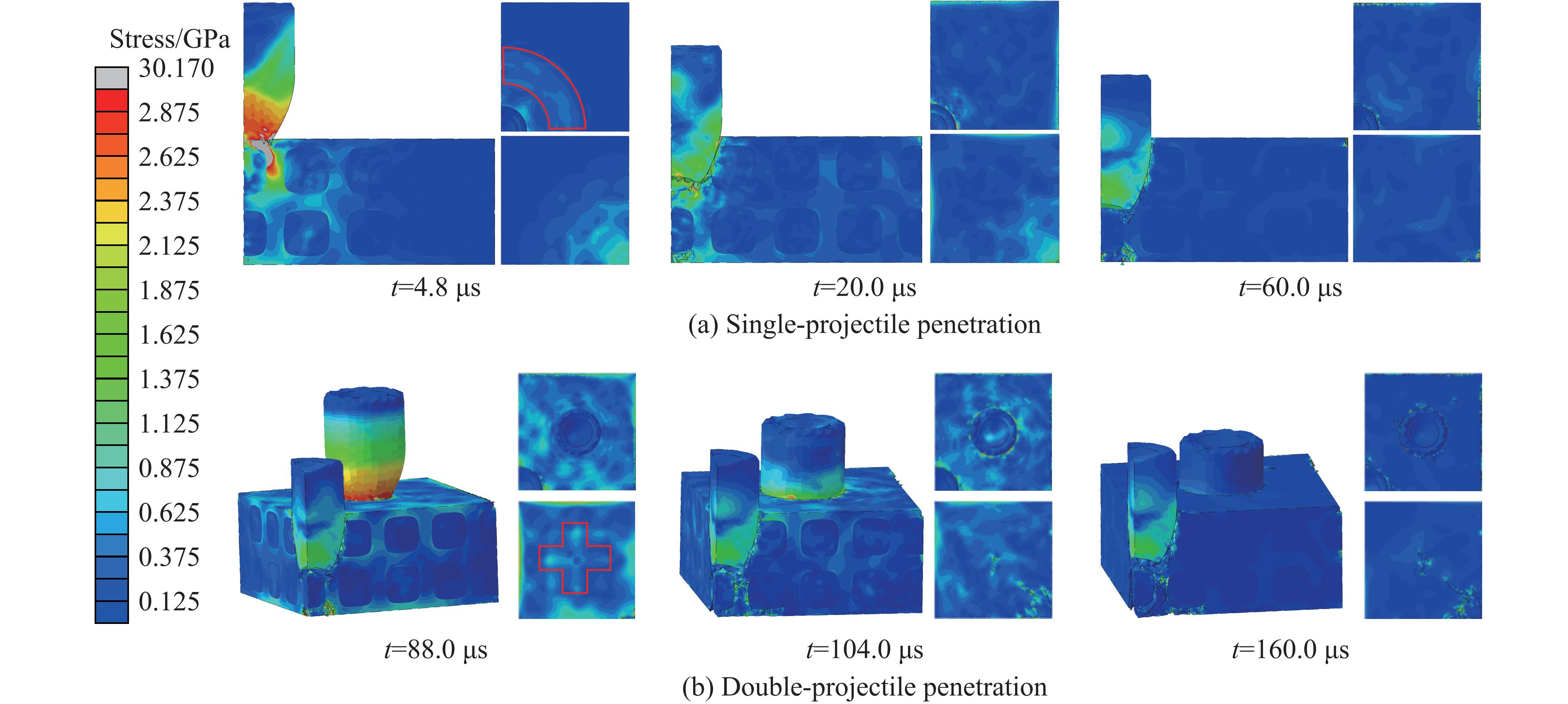
图 7 N型TPMS穿插靶在单弹侵彻/双弹侵彻工况下的应力云图
Figure 7. Stress contours of N-shaped TPMS interpenetrating target under single-projectile and two-projectile penetration conditions
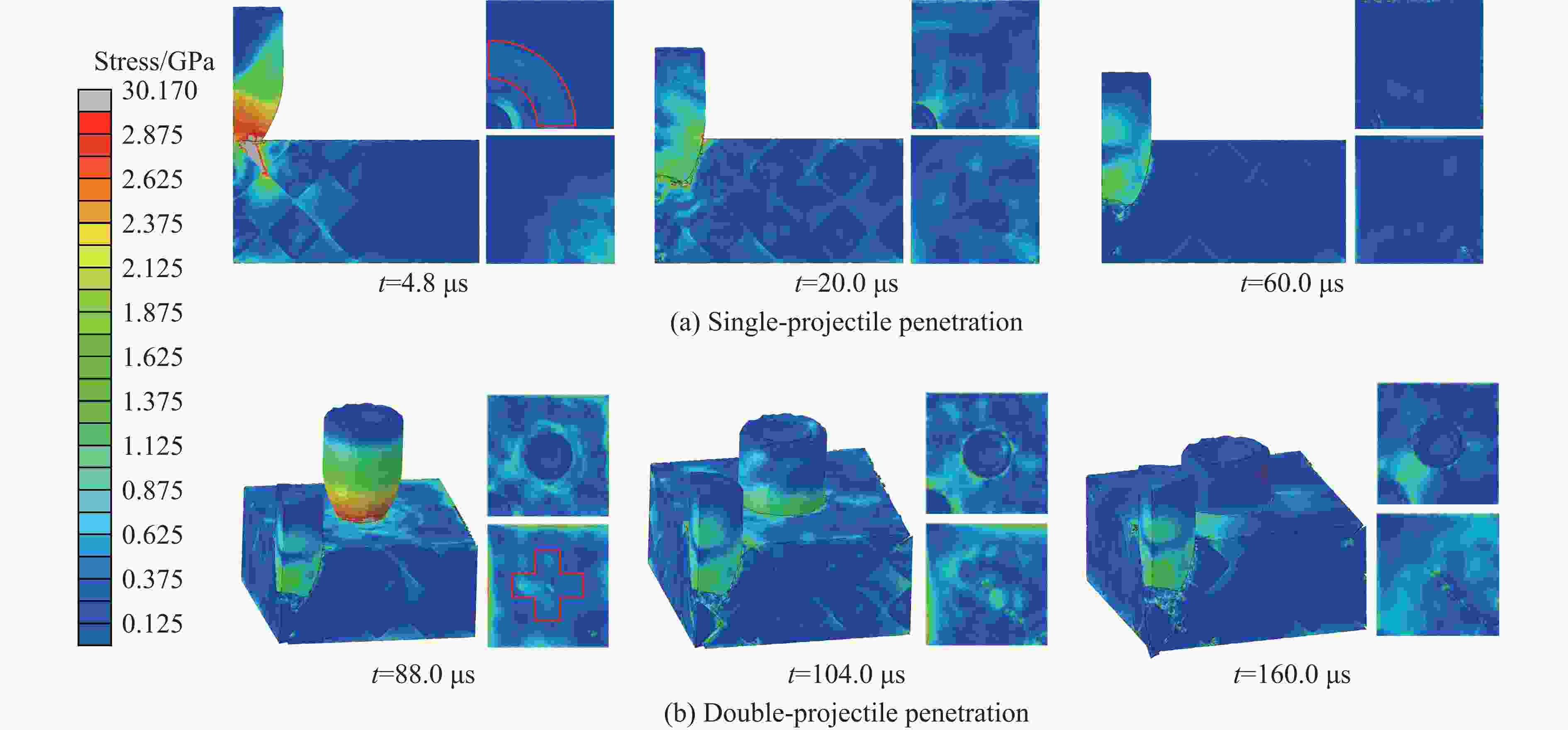
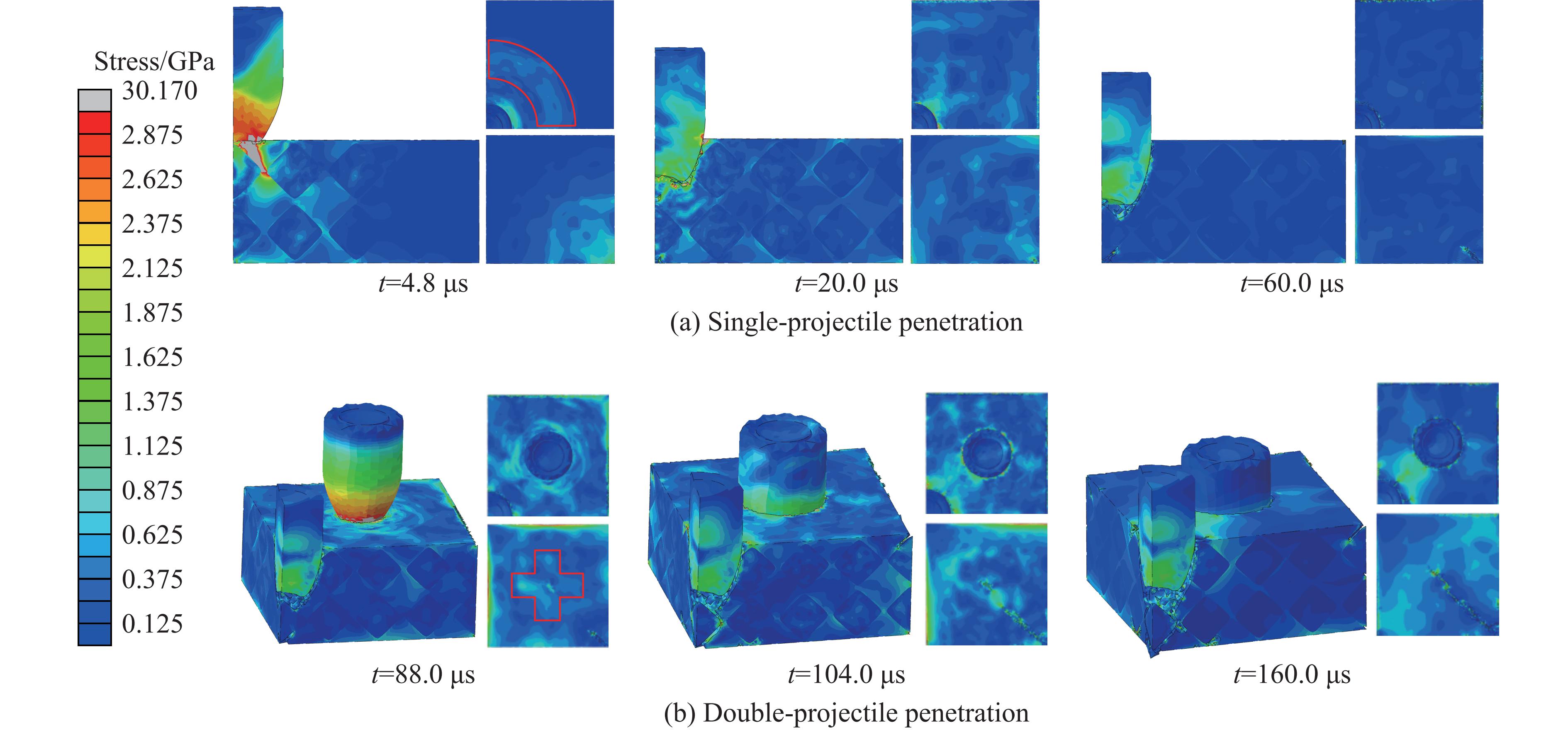
图 8 P型TPMS穿插靶在单弹侵彻/双弹侵彻工况下的应力云图
Figure 8. Stress contours of P-shaped TPMS interpenetrating target under single-projectile and double-projectile penetration conditions
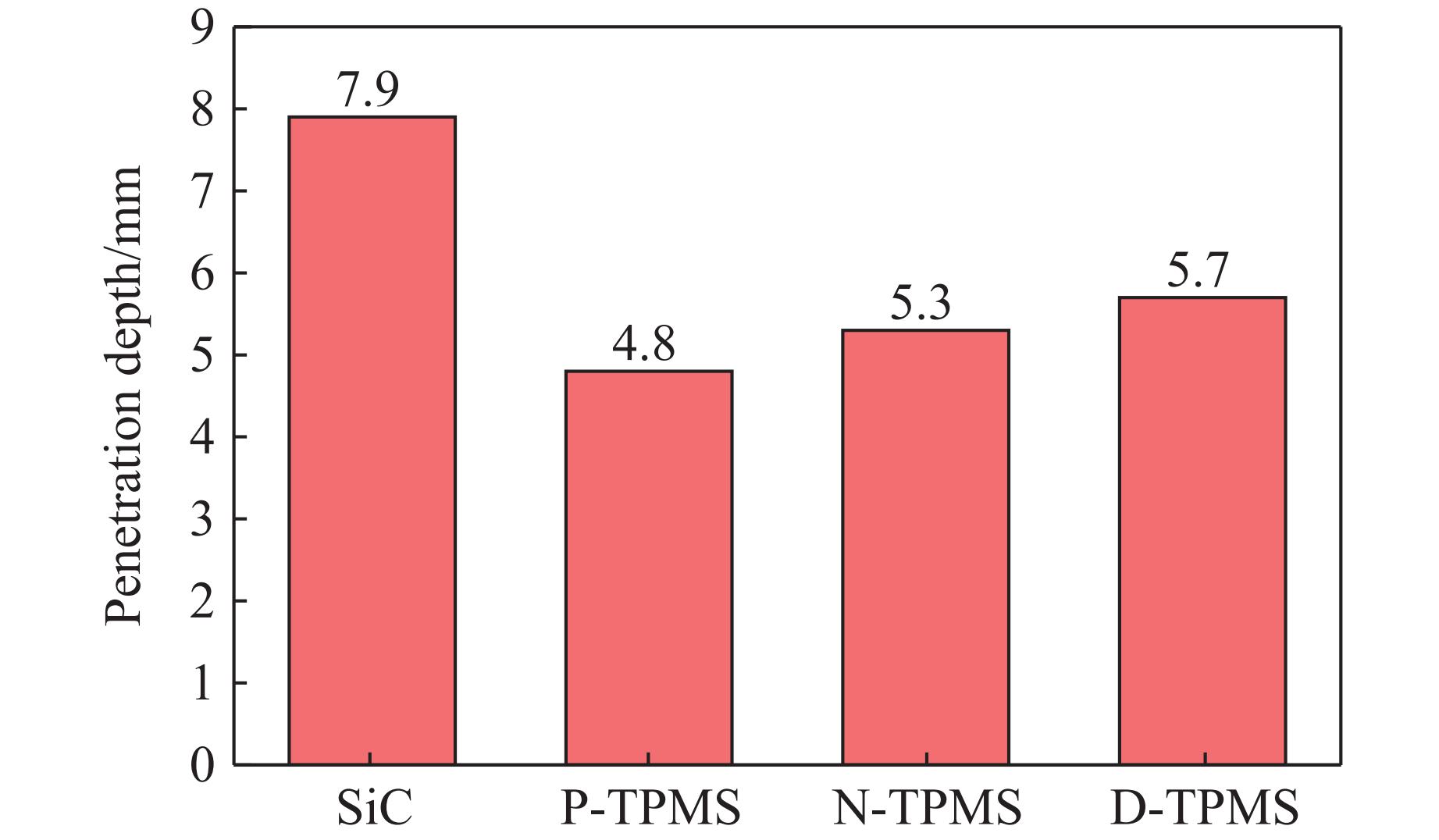
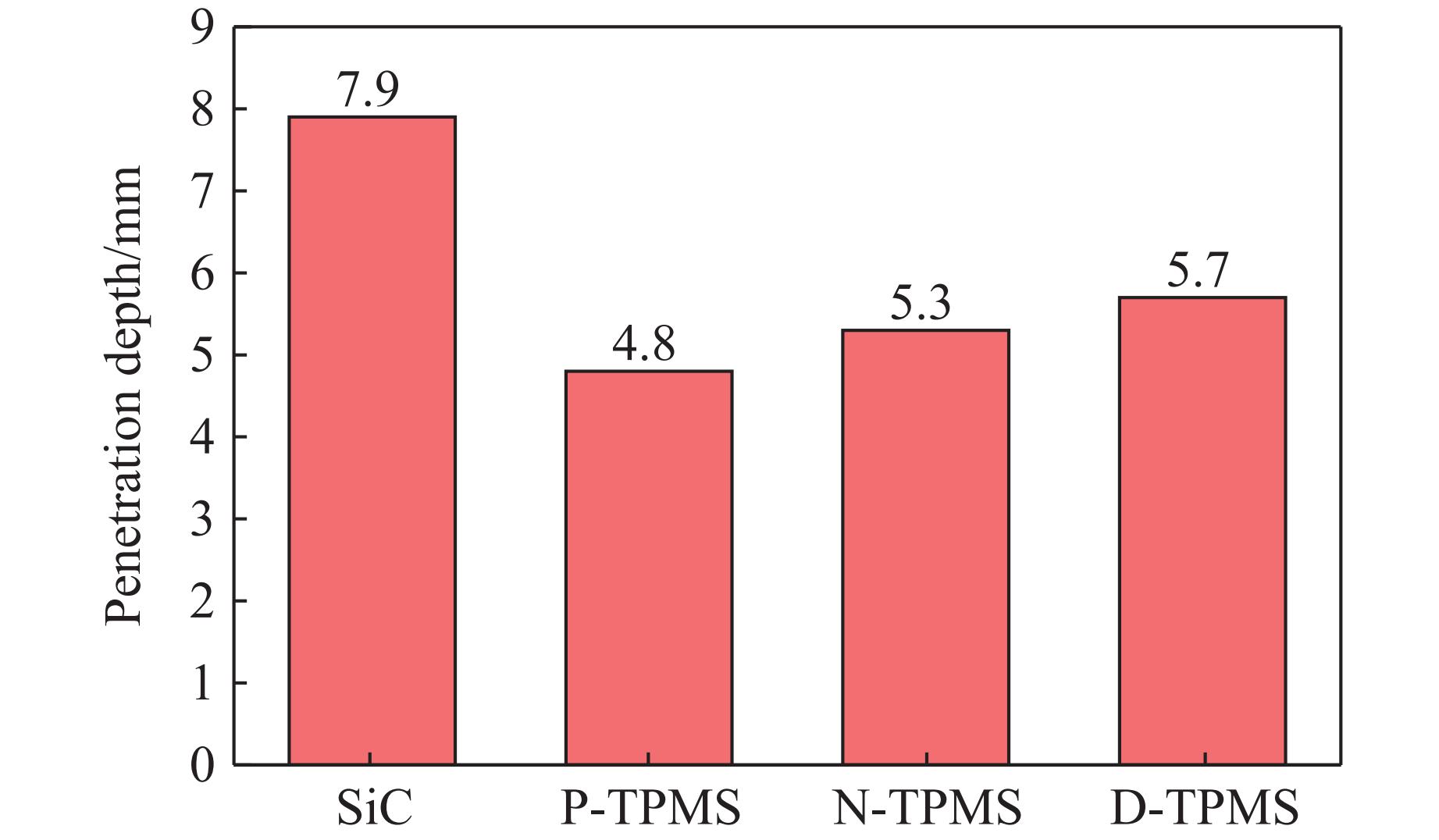
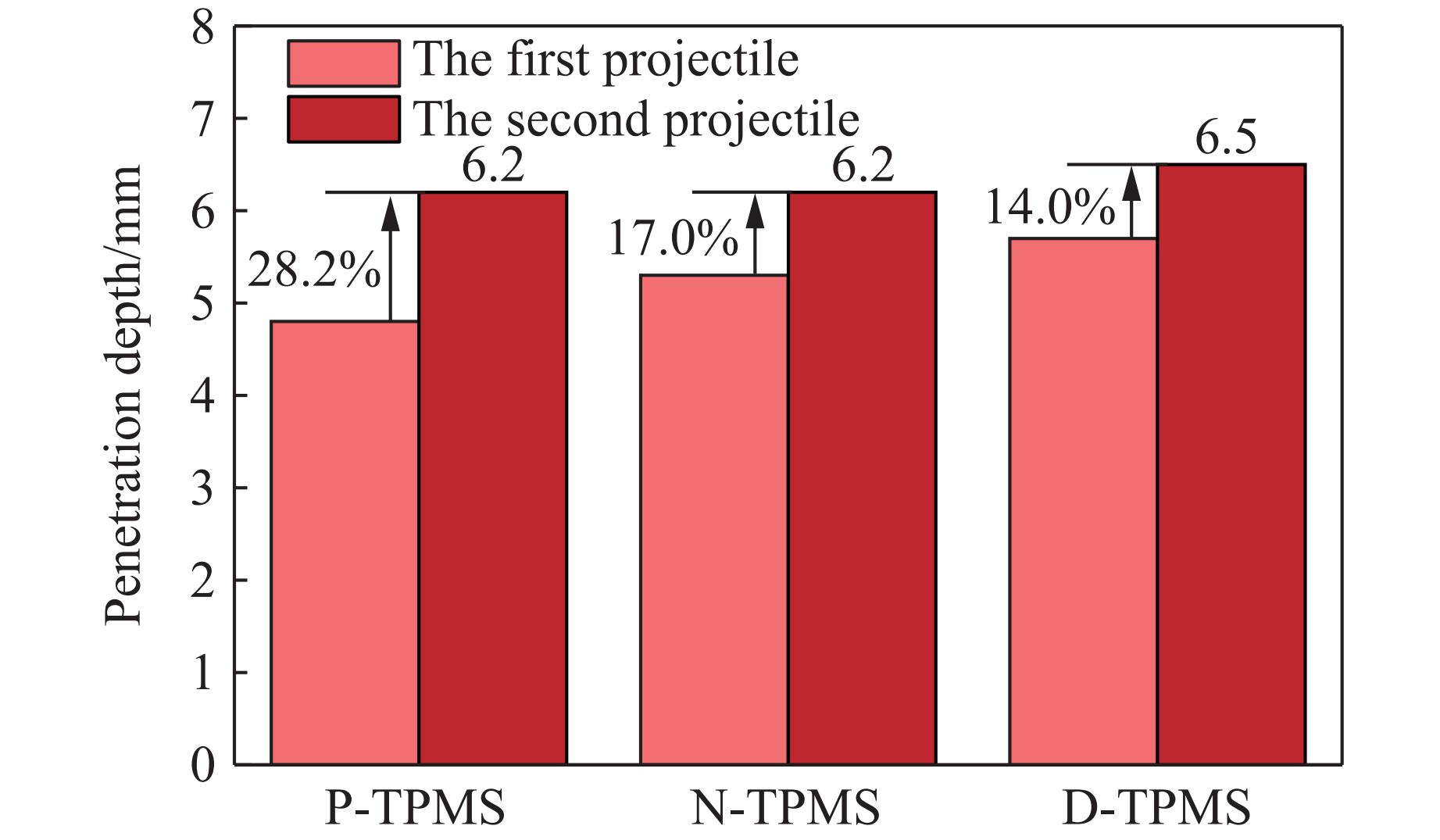
图 9 单弹以350 m/s速度侵彻不同结构的侵深对比
Figure 9. Comparison of penetration depth for different structures under single projectile at 350 m/s
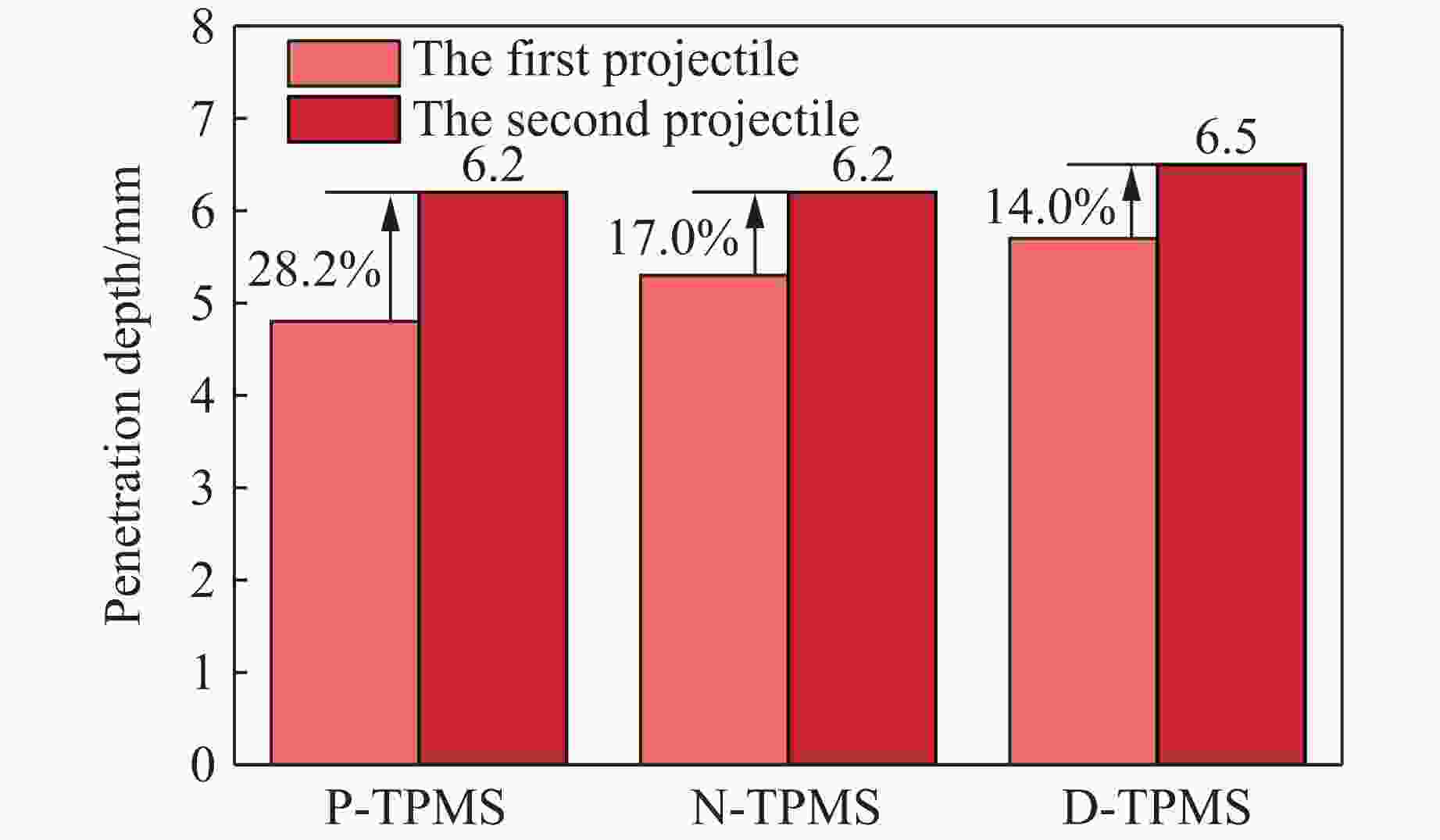
图 10 双弹以350 m/s速度侵彻不同结构的侵深对比
Figure 10. Comparison of penetration depth for different structures under double projectiles at 350 m/s
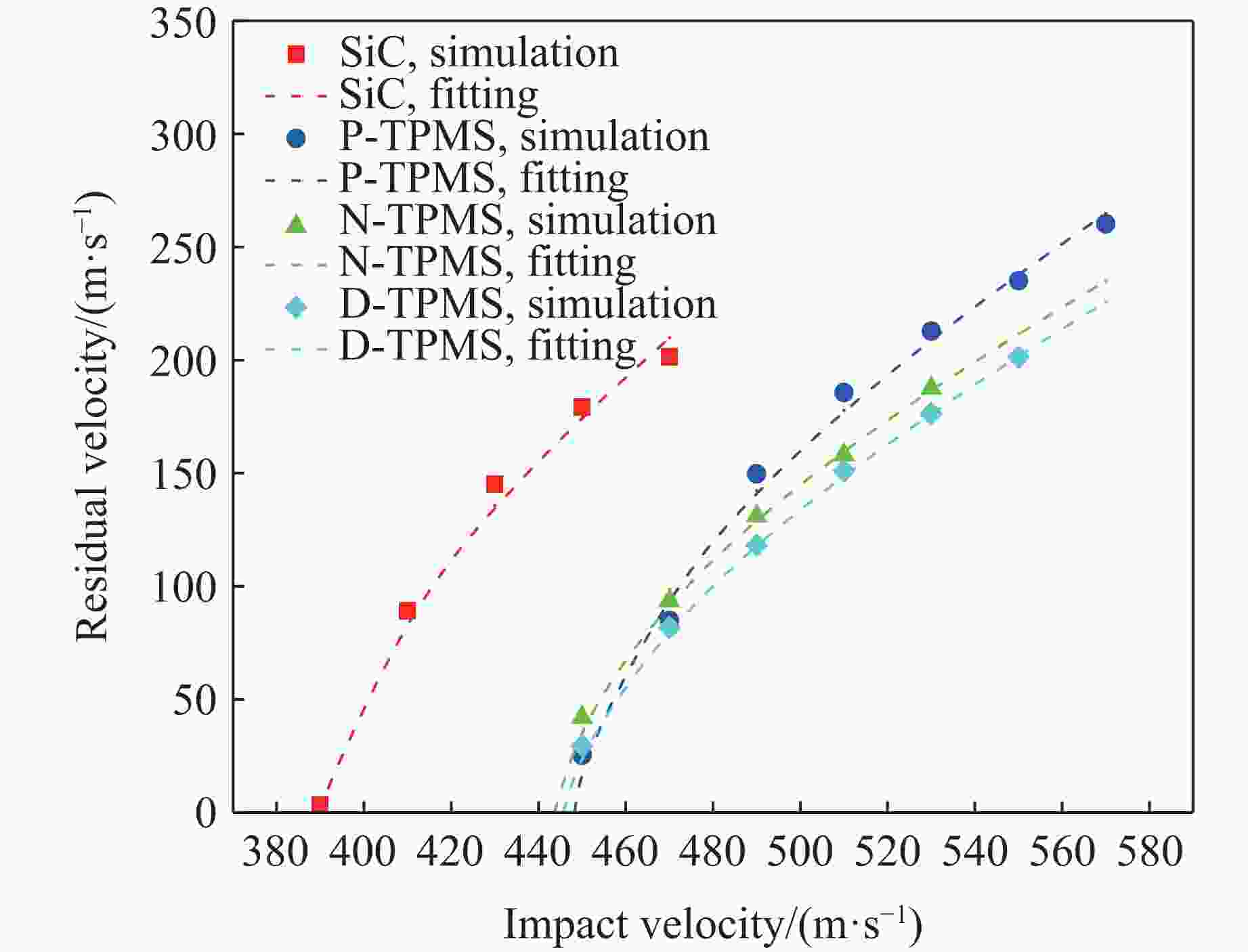
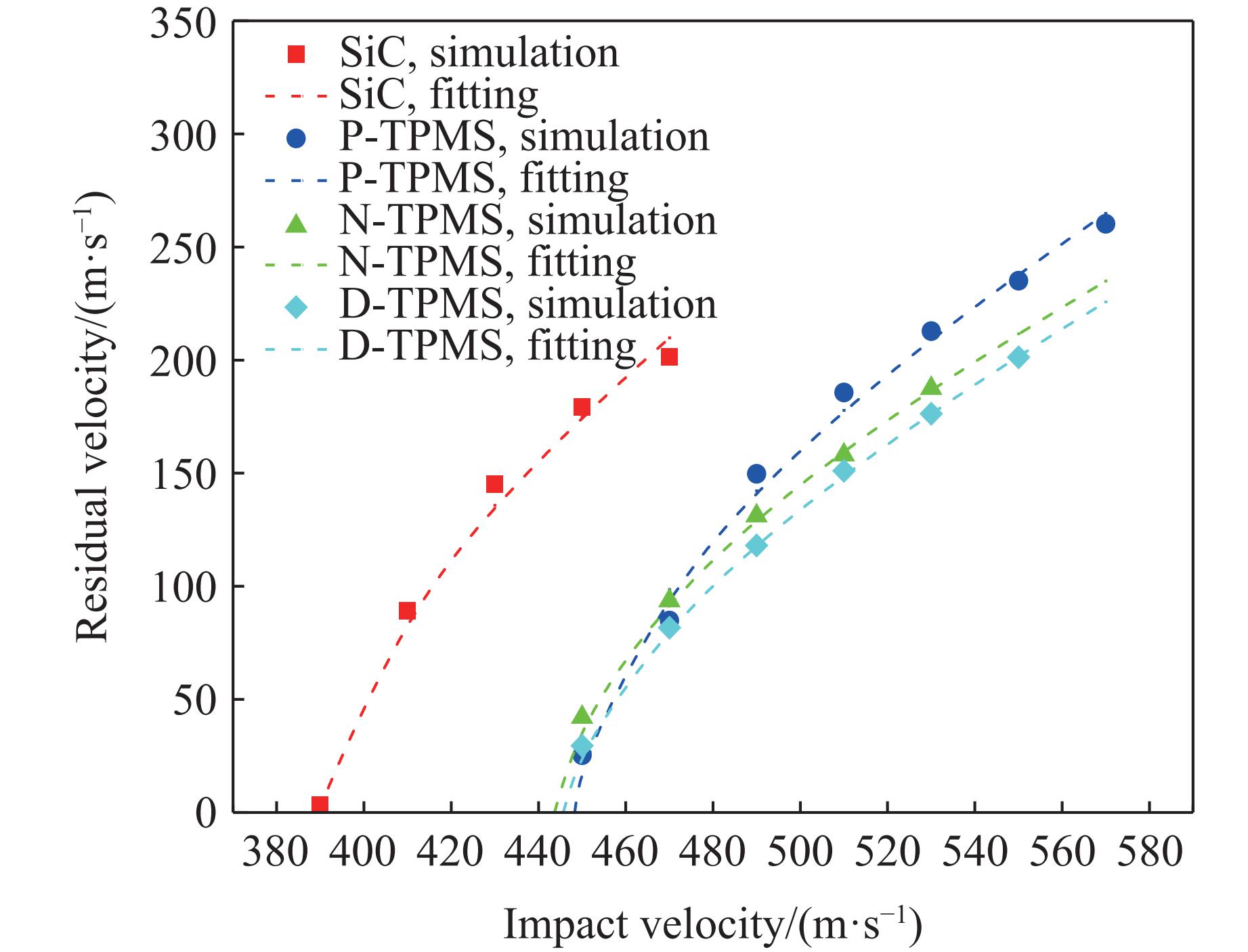
图 11 4种靶板的弹道极限速度拟合曲线
Figure 11. Fitting curves of the ballistic limit velocity for four target plates
ρ/(kg·m−3) G/GPa A B C M N σHEL/GPa d1 d2 K1/GPa K2/GPa K3/GPa 3 215 193 0.96 0.35 0.009 1 0.65 11.7 0.48 0.48 220 361 0  下载: 导出CSV
表 2 T12A钢与TC4合金的Johnson-Cook模型参数
Table 2. Johnson-Cook model parameters for T12A steel and TC4 alloy
Material ρ/(kg·m−3) E/GPa A0/MPa B0/MPa N0 M0 T12A 7 850 210 1 540 477 0.16 1.0 TC4 4400 110 1 030 952 0.40 0.8 Material D1 D2 D3 D4 D5 $\dot{\varepsilon}_0/{\rm{s}}^{-1}$ T12A 1.4 0 0 0 0 1.0 TC4 −0.2 0.25 0.2 0.014 3.87 1.0
下载: 导出CSV
表 3 3种穿插式TPMS结构的拟合参数
Table 3. Fitting parameters of three interpenetrating TPMS structures
Target type a P v50/(m·s–1) D 0.75 1.69 445.69 N 0.72 1.80 443.69 P 0.82 1.83 448.31
下载: 导出CSV
-
[1] 黄雪刚, 赵忠民, 张龙, 等. TiC-TiB2细晶陶瓷装甲抗钨合金长杆动能弹侵彻试验 [J]. 特种铸造及有色合金, 2011, 31(10): 891–894. doi: 10.3870/tzzz.2011.10.003HUANG X G, ZHAO Z M, ZHANG L, et al. Investigation of fine-grained TiC-TiB2 ceramic armor for defeating long-rod kinetic-energy tungsten alloy penetrator [J]. Special Casting & Nonferrous Alloys, 2011, 31(10): 891–894. doi: 10.3870/tzzz.2011.10.003 [2] 龚宣丞. 陶瓷复合材料装甲抗侵彻性能研究 [D]. 长沙: 湖南大学, 2020: 1−4.GONG X C. Research on the anti-penetration performance of ceramic composite armor [D]. Changsha: Hunan University, 2020: 1−4. [3] 孙金贵, 厉承森, 李宗家, 等. 装甲用陶瓷及高性能纤维复合材料的应用与发展 [J]. 合成纤维, 2025, 54(9): 50–56, 91. doi: 10.16090/j.cnki.hcxw.2025.09.018SUN J G, LI C S, LI Z J, et al. Application and development of ceramic and high performance fiber composites for armor [J]. Synthetic Fiber in China, 2025, 54(9): 50–56, 91. doi: 10.16090/j.cnki.hcxw.2025.09.018 [4] 戴俊宏, 李宗家, 李年华. 抗87式5.8 mm普通弹防弹插板的研究与制备 [J]. 合成纤维, 2024, 53(3): 20–25, 59. doi: 10.16090/j.cnki.hcxw.2024.03.022DAI J H, LI Z J, LI N H. Research and preparation of bulletproof insert board with resistance to type 87 5.8 mm ordinary bullets [J]. Synthetic Fiber in China, 2024, 53(3): 20–25, 59. doi: 10.16090/j.cnki.hcxw.2024.03.022 [5] 邹有纯, 熊超, 殷军辉, 等. 陶瓷/钛合金复合装甲抗侵彻性能优化设计研究 [J]. 兵器装备工程学报, 2024, 45(10): 69–74. doi: 10.11809/bqzbgcxb2024.10.009ZOU Y C, XIONG C, YIN J H, et al. Study on optimal design of penetration resistance of ceramic/titanium alloy composite armor [J]. Journal of Ordnance Equipment Engineering, 2024, 45(10): 69–74. doi: 10.11809/bqzbgcxb2024.10.009 [6] 刘倩利. 装甲陶瓷的界面击溃效应物质点法分析 [D]. 西安: 西安理工大学, 2024: 1−4.LIU Q L. Analysis of interfacial defeat effect of armor ceramics bymaterial point method [D]. Xi’an: Xi’an University of Technology, 2024: 1−4. [7] 陈智勇, 徐颖强, 高飞, 等. 轻质陶瓷复合装甲研究进展 [J]. 中国陶瓷, 2025, 61(5): 1–10. doi: 10.16521/j.cnki.issn.1001-9642.2025.05.001CHEN Z Y, XU Y Q, GAO F, et al. Research progress in lightweight ceramic composite armor [J]. China Ceramics, 2025, 61(5): 1–10. doi: 10.16521/j.cnki.issn.1001-9642.2025.05.001 [8] 杨佳蕊. 双连续(SiC-Si3N4)/Al梯度复合材料制备及性能研究 [D]. 哈尔滨: 哈尔滨工业大学, 2025: 3−5.YANG J R. Preparation and properties of co-continuous (SiC-Si3N4)/Al gradient composite materials [D]. Harbin: Harbin Institute of Technology, 2025: 3−5. [9] TAN M T, ZHANG X F, XIONG W, et al. Influence of layered back plate on the ballistic performance of ceramic armor [J]. Composite Structures, 2023, 308: 116688. doi: 10.1016/j.compstruct.2023.116688 [10] 陆文成, 武一丁, 余毅磊, 等. 不同厚度比的SiC陶瓷-纤维增强树脂基复合材料装甲的损伤失效及其抗弹性能 [J]. 复合材料学报, 2025, 42(2): 1125–1139. doi: 10.13801/j.cnki.fhclxb.20240508.003LU W C, WU Y D, YU Y L, et al. Damage failure and ballistic performance of SiC ceramic-fiber reinforced resin-based composite armor with different thickness ratios [J]. Acta Materiae Compositae Sinica, 2025, 42(2): 1125–1139. doi: 10.13801/j.cnki.fhclxb.20240508.003 [11] 代春泉, 矫维成, 金浩正, 等. 拼接式陶瓷复合装甲的研究现状及发展趋势 [J]. 复合材料学报, 2025, 43(4): 1927–1957. doi: 10.13801/j.cnki.fhclxb.20250616.001DAI C Q, JIAO W C, JIN H Z, et al. Research status and development trends of modular ceramic composite armor [J]. Acta Materiae Compositae Sinica, 2025, 43(4): 1927–1957. doi: 10.13801/j.cnki.fhclxb.20250616.001 [12] 尹飞, 纪伟, 王智慧. 陶瓷复合装甲的研究现状及发展 [J]. 兵器材料科学与工程, 2024, 47(1): 106–111. doi: 10.14024/j.cnki.1004-244x.20231218.002YIN F, JI W, WANG Z H. Research status and development of ceramic composite armor [J]. Ordnance Material Science and Engineering, 2024, 47(1): 106–111. doi: 10.14024/j.cnki.1004-244x.20231218.002 [13] STANISLAWEK S, MORKA A, NIEZGODA T. Pyramidal ceramic armor ability to defeat projectile threat by changing its trajectory [J]. Bulletin of the Polish Academy of Sciences Technical Sciences, 2015, 63(4): 843–849. doi: 10.1515/bpasts-2015-0096 [14] LIU P, ZHU D J, YAO Y M, et al. Numerical simulation of ballistic impact behavior of bio-inspired scale-like protection system [J]. Materials & Design, 2016, 99: 201–210. doi: 10.1016/j.matdes.2016.03.040 [15] GUO Y L, WU Y, ZHANG G X, et al. Penetration resistance of honeycomb ceramic matrix composites with filler material [J]. Ceramics International, 2024, 50(21): 41590–41602. doi: 10.1016/j.ceramint.2024.08.009 [16] GAO Y X, WANG X, WANG Y T, et al. Penetration resistance of bioinspired nacre-like SiC ceramic/ASP polyurea structure under projectile impact loading: experiment and simulation [J]. Thin-Walled Structures, 2025, 208: 112812. doi: 10.1016/j.tws.2024.112812 [17] TIAN C, AN X Y, SUN Q T, et al. Experimental and numerical analyses of the penetration resistance of ceramic-metal hybrid structures [J]. Composite Structures, 2019, 211: 264–272. doi: 10.1016/j.compstruct.2018.12.021 [18] 张茂哲, 王智慧, 纪伟, 等. 约束陶瓷复合装甲的研究进展 [J]. 粉末冶金材料科学与工程, 2024, 29(4): 255–262. doi: 10.19976/j.cnki.43-1448/TF.2024052ZHANG M Z, WANG Z H, JI W, et al. Research progress on confined ceramic composite armor [J]. Materials Science and Engineering of Powder Metallurgy, 2024, 29(4): 255–262. doi: 10.19976/j.cnki.43-1448/TF.2024052 [19] ZHANG L H, SUN X, ZHANG X Y, et al. Penetration resistance of corrugated hybrid structures with ceramic insertions against steel projectile impact [J]. Ceramics International, 2024, 50(11): 19148–19162. doi: 10.1016/j.ceramint.2024.03.014 [20] 陈铭, 张永亮, 郑航, 等. 陶瓷球金属复合结构的抗弹性能和梯度设计 [J]. 高压物理学报, 2021, 35(5): 054201. doi: 10.11858/gywlxb.20210739CHEN M, ZHANG Y L, ZHENG H, et al. Ballistic performance analysis and gradient optimization design of ceramic ball and metal composite armor [J]. Chinese Journal of High Pressure Physics, 2021, 35(5): 054201. doi: 10.11858/gywlxb.20210739 [21] QIU N, WAN Y H, SHEN Y J, et al. Experimental and numerical studies on mechanical properties of TPMS structures [J]. International Journal of Mechanical Sciences, 2024, 261: 108657. doi: 10.1016/j.ijmecsci.2023.108657 [22] 王广阳, 纪小刚, 牛国法, 等. 异构TPMS点阵结构的渐进变形和吸能特性 [J/OL]. 机械科学与技术 (2025-10-22) [2026-03-30]. https://link.cnki.net/doi/10.13433/j.cnki.1003-8728.20250101.WANG G Y, JI X G, NIU G F, et al. Progressive deformation and energy absorption characteristics of a heterogeneous TPMS lattice structure [J/OL]. Mechanical Science and Technology for Aerospace Engineering (2025-10-22) [2026-03-30]. https://link.cnki.net/doi/10.13433/j.cnki.1003-8728.20250101. [23] 谢钟洋, 杨春浩, 马吴宁. TPMS结构抗侵彻性能数值研究 [J]. 弹道学报, 2025, 37(1): 104–112. doi: 10.12115/ddxb.2023.11008XIE Z Y, YANG C H, MA W N. Numerical study on anti-penetration performance of TPMS structure [J]. Journal of Ballistics, 2025, 37(1): 104–112. doi: 10.12115/ddxb.2023.11008 [24] EJEH C J, BARSOUM I, ABU AL-RUB R K. Impact behavior of periodic, stochastic, and anisotropic minimal surface-lattice sandwich structures [J]. International Journal of Mechanical Sciences, 2024, 276: 109359. doi: 10.1016/j.ijmecsci.2024.109359 [25] YASSINE M, ALMASKARI F, ZAKI W. Low-speed impact penetration characterization of sheet-based triply periodic minimal surfaces [J]. International Journal of Mechanical Sciences, 2025, 303: 110561. doi: 10.1016/j.ijmecsci.2025.110561 [26] QIN H J, HOU H, XU C Y, et al. Effects of manufacturing defects and microstructure on the tensile and low cycle fatigue behavior of selective laser melting IN718 TPMS structures [J]. Thin-Walled Structures, 2026, 222: 114528. doi: 10.1016/j.tws.2026.114528 [27] 杜恒愷. 泡沫增强TPMS点阵结构力学与吸能性能研究 [D]. 重庆: 重庆大学, 2023: 2, 13−15.DU H K. Study on mechanical properties and energy absorption properties of foam-reinforced TPMS lattice structure [D]. Chongqing: Chongqing University, 2023: 2, 13−15. [28] NOVAK N, AL-KETAN O, MAUKO A, et al. Quasi-static and impact behaviour of polymer-metal interpenetrating phase TPMS composites [J]. Composite Structures, 2025, 366: 119225. doi: 10.1016/j.compstruct.2025.119225 [29] SINGH A, AL-KETAN O, KARATHANASOPOULOS N. Hybrid manufacturing and mechanical properties of architected interpenetrating phase metal-ceramic and metal-metal composites [J]. Materials Science and Engineering: A, 2024, 897: 146322. doi: 10.1016/j.msea.2024.146322 [30] SANTOS S, MATOS C, DUARTE I, et al. Effect of TPMS reinforcement on the mechanical properties of aluminium-alumina interpenetrating phase composites [J]. Progress in Additive Manufacturing, 2025, 10(2): 1187–1199. doi: 10.1007/s40964-024-00698-7 [31] XIAO L J, LI Y N, ZHU Y L, et al. Tension-compression asymmetry in triply periodic minimal surface lattice structures [J]. Thin-Walled Structures, 2026, 220: 114351. doi: 10.1016/j.tws.2025.114351 [32] MICHIELSEN K, KOLE J S. Photonic band gaps in materials with triply periodic surfaces and related tubular structures [J]. Physical Review B, 2003, 68(11): 115107. doi: 10.1103/PhysRevB.68.115107 [33] 李毅, 王晓强, 易文珏, 等. 不同体积分数Primitive点阵结构的AlMgScZr合金力热性能研究 [J]. 稀有金属材料与工程, 2026, 55(2): 406–418. doi: 10.12442/j.issn.1002-185X.20250262LI Y, WANG X Q, YI W J, et al. Mechanical and thermal properties of AlMgScZr alloy with primitive lattice structure of different volume fractions [J]. Rare Metal Materials and Engineering, 2026, 55(2): 406–418. doi: 10.12442/j.issn.1002-185X.20250262 [34] 范小杰. 激光选区熔化钛合金梯度多孔仿生骨结构性能研究 [D]. 重庆: 重庆大学, 2021: 11−13.FAN X J. Study on the properties of the Ti6Al4V graded-porous bionic structures fabricated by laser selective melting [D]. Chongqing: Chongqing University, 2021: 11−13. [35] AL-KETAN O, ABU AL-RUB R K, ROWSHAN R. Mechanical properties of a new type of architected interpenetrating phase composite materials [J]. Advanced Materials Technologies, 2017, 2(2): 1600235. doi: 10.1002/admt.201600235 [36] AL-KETAN O, ABU AL-RUB R K. MSLattice: a free software for generating uniform and graded lattices based on triply periodic minimal surfaces [J]. Material Design & Processing Communications, 2021, 3(6): e205. doi: 10.1002/mdp2.205 [37] CHU Y Y, XU J Y, WANG X C, et al. Experimental and numerical study on ballistic performance of a sandwich composite plate with biomimetic tendon basalt filament bundles (SCP-BTBFB) [J]. Thin-Walled Structures, 2026, 218: 113960. doi: 10.1016/j.tws.2025.113960 [38] FENG G Z, LI S, XIAO L J, et al. Mechanical properties and deformation behavior of functionally graded TPMS structures under static and dynamic loading [J]. International Journal of Impact Engineering, 2023, 176: 104554. doi: 10.1016/j.ijimpeng.2023.104554 [39] XIAO L J, XU X, FENG G Z, et al. Compressive performance and energy absorption of additively manufactured metallic hybrid lattice structures [J]. International Journal of Mechanical Sciences, 2022, 219: 107093. doi: 10.1016/j.ijmecsci.2022.107093 [40] JOHNSON G R, HOLMQUIST T J. An improved computational constitutive model for brittle materials [J]. AIP Conference Proceedings, 1994, 309(1): 981–984. doi: 10.1063/1.46199 [41] CRONIN D S, BUI K, KAUFMANN C, et al. Implementation and validation of the Johnson-Holmquist ceramic material model in LS-DYNA [C]//Proceedings of the 4th European LS-DYNA Users Conference. Germany, 2003. [42] JOHNSON G R, COOK W H. Fracture characteristics of three metals subjected to various strains, strain rates, temperatures and pressures [J]. Engineering Fracture Mechanics, 1985, 21(1): 31–48. doi: 10.1016/0013-7944(85)90052-9 [43] 杨睿. TC4/Kevlar/TC4夹层板抗高速破片侵彻性能研究 [D]. 武汉: 武汉理工大学, 2022: 24−26.YANG R. Research on penetration resistance of TC4/Kevlar/TC4 sandwich panels under high-speed fragments [D]. Wuhan: Wuhan University of Technology, 2022: 24−26. [44] 宗香华, 王银, 孔祥振, 等. 错位多次打击下UHPC靶体损伤破坏效应的数值模拟研究 [J]. 高压物理学报, 2024, 38(3): 034201. doi: 10.11858/gywlxb.20230834ZONG X H, WANG Y, KONG X Z, et al. Numerical investigation on damage and failure of UHPC targets subjected to dislocation multi-attacks [J]. Chinese Journal of High Pressure Physics, 2024, 38(3): 034201. doi: 10.11858/gywlxb.20230834 [45] 刘铁磊, 徐豫新, 王晓锋, 等. 钨合金球形破片侵彻低碳钢的弹道极限速度计算模型 [J]. 兵工学报, 2022, 43(4): 768–779. doi: 10.12382/bgxb.2021.0448LIU T L, XU Y X, WANG X F, et al. Ballistic limit calculation model of tungsten alloy spherical fragments penetrating into low carbon steel plate [J]. Acta Armamentarii, 2022, 43(4): 768–779. doi: 10.12382/bgxb.2021.0448 [46] IPSON T W, RECHT R F. Ballistic-penetration resistance and its measurement [J]. Experimental Mechanics, 1975, 15(7): 249–257. doi: 10.1007/BF02318057 [47] SHEN J C, PAN Y, ZUO J Y. Study on thermal fatigue damage mechanisms for high-speed train’s wheel-mounted brake disc considering multiaxial stress state [J]. Engineering Failure Analysis, 2025, 174: 109525. doi: 10.1016/j.engfailanal.2025.109525 [48] JI Q L, LI Y B, YE P H, et al. The effect of the interface structure on the interfacial bonding strength of Ti/Al clad plates [J]. Progress in Natural Science: Materials International, 2025, 35(3): 568–577. doi: 10.1016/j.pnsc.2025.03.006 -

 下载:
下载:

计量
- 文章访问数: 456
- HTML全文浏览量: 190
- PDF下载量: 65
