




Inverse Design and Boundary Effects in Impact Waveform Control of Graded Foam Metals
-
摘要: 为实现航空安全测试等领域对高冲击量值波形的精准生成,研究了梯度泡沫金属在不同边界条件下的冲击波形调控机制。基于质量与动量守恒定律,分别建立了自由边界与弹性边界下梯度泡沫金属冲击波形发生理论模型;进一步提出了一种基于平均相对密度约束与高斯-牛顿迭代的密度梯度反向设计方法,实现了从目标加速度波形到材料密度梯度分布的逆向求解。有限元结果表明,该方法在不同边界下均能有效生成目标波形,如三角波和半正弦波。研究还发现:自由边界更适合生成高幅值、宽脉宽波形,而弹性边界则可通过刚度调节改善低幅值波形的可实现性;边界条件虽不改变冲击持续时间,但会对波形形状产生显著影响。此外,若相邻层间的阻抗差异过大,将导致波形波动加剧,从而影响波形生成精度。所提出的密度梯度反向设计策略具有良好的通用性,为高冲击测试技术的自主发展提供了理论支撑与实用化设计工具。Abstract: To achieve the precise generation of high-amplitude impact waveforms required for aviation safety testing and related fields, this study investigates the impact waveform regulation mechanisms of graded cellular metals under different boundary conditions. Based on the conservation laws of mass and momentum, theoretical models for impact waveform generation using graded cellular metals are established for both free and elastic boundary conditions. Furthermore, an inverse design method for density gradient is proposed, which incorporates an average relative density constraint combined with Gauss-Newton iteration, enabling the reverse solution from a prescribed acceleration waveform to the material density gradient distribution. Finite element results demonstrate that the proposed method can effectively generate required waveforms—such as triangular and half-sine waves—under both boundary conditions. The study also reveals that: free boundaries are more suitable for generating high amplitude and long duration waveforms, whereas elastic boundaries can improve the realizability of low-amplitude waveforms through stiffness regulation; boundary conditions do not alter the impact duration but exert a significant influence on waveform shape; and excessive impedance mismatch between adjacent layers will intensify waveform oscillations, thereby compromising the waveform generation accuracy. The proposed inverse design strategy for density gradients exhibits favorable versatility and provides both theoretical support and a practical design tool for the development of high-amplitude impact testing technologies.
-
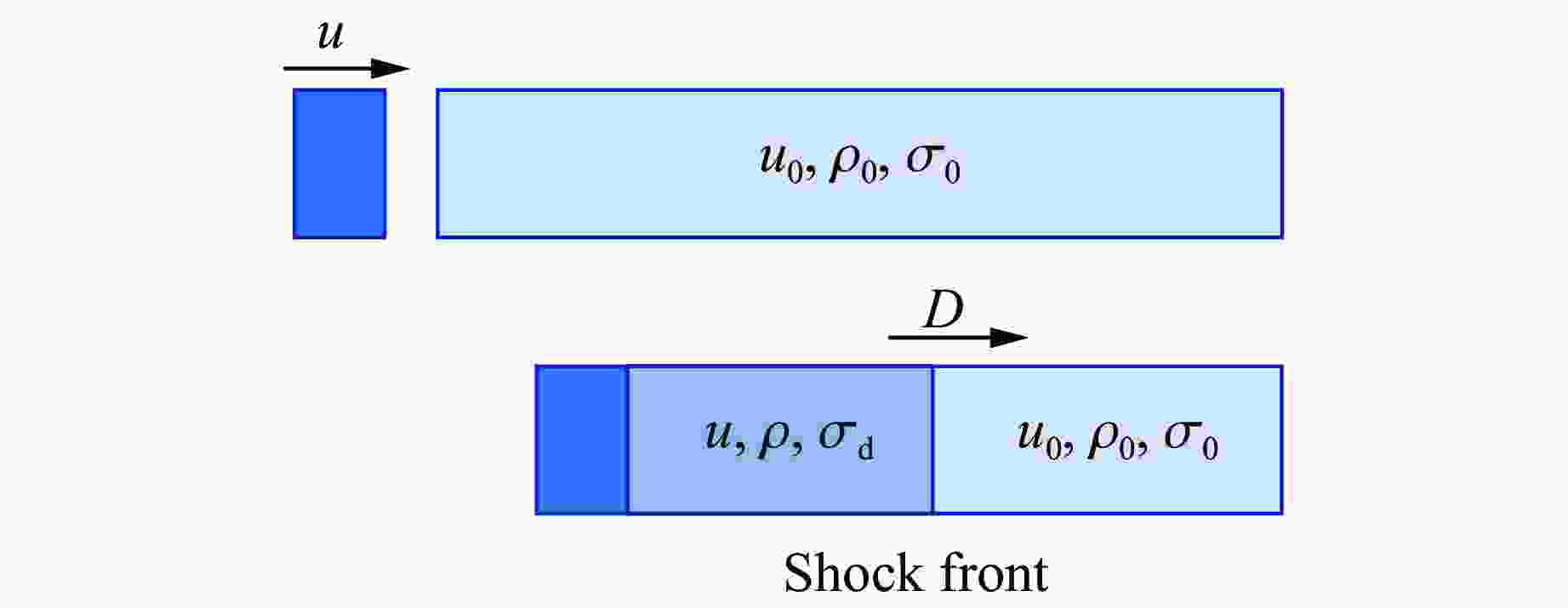
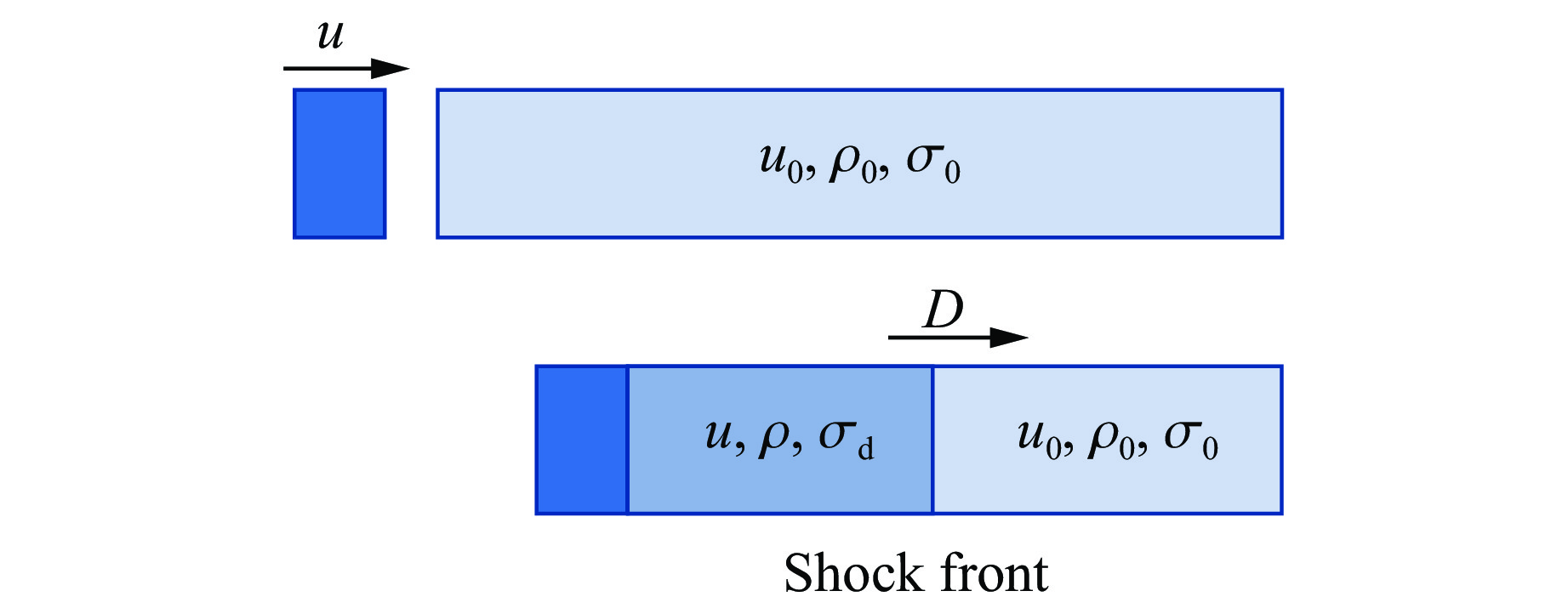
图 1 冲击波基本传播机制示意图
Figure 1. Schematic diagram of basic shock wave propagation mechanisms
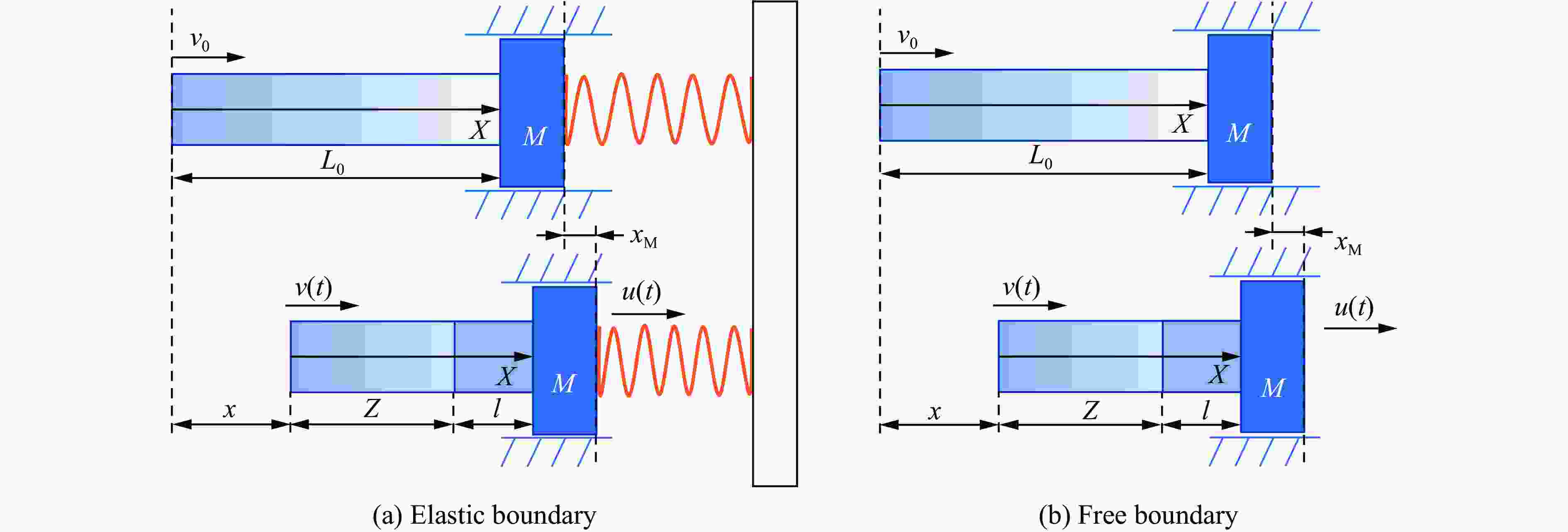
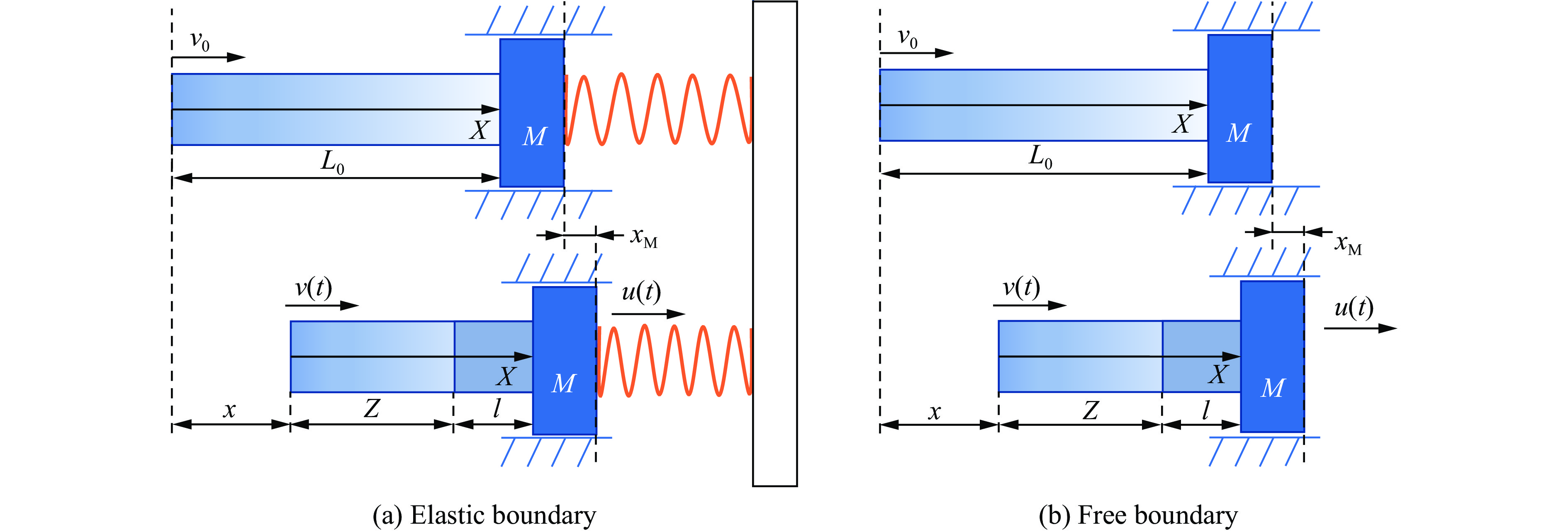
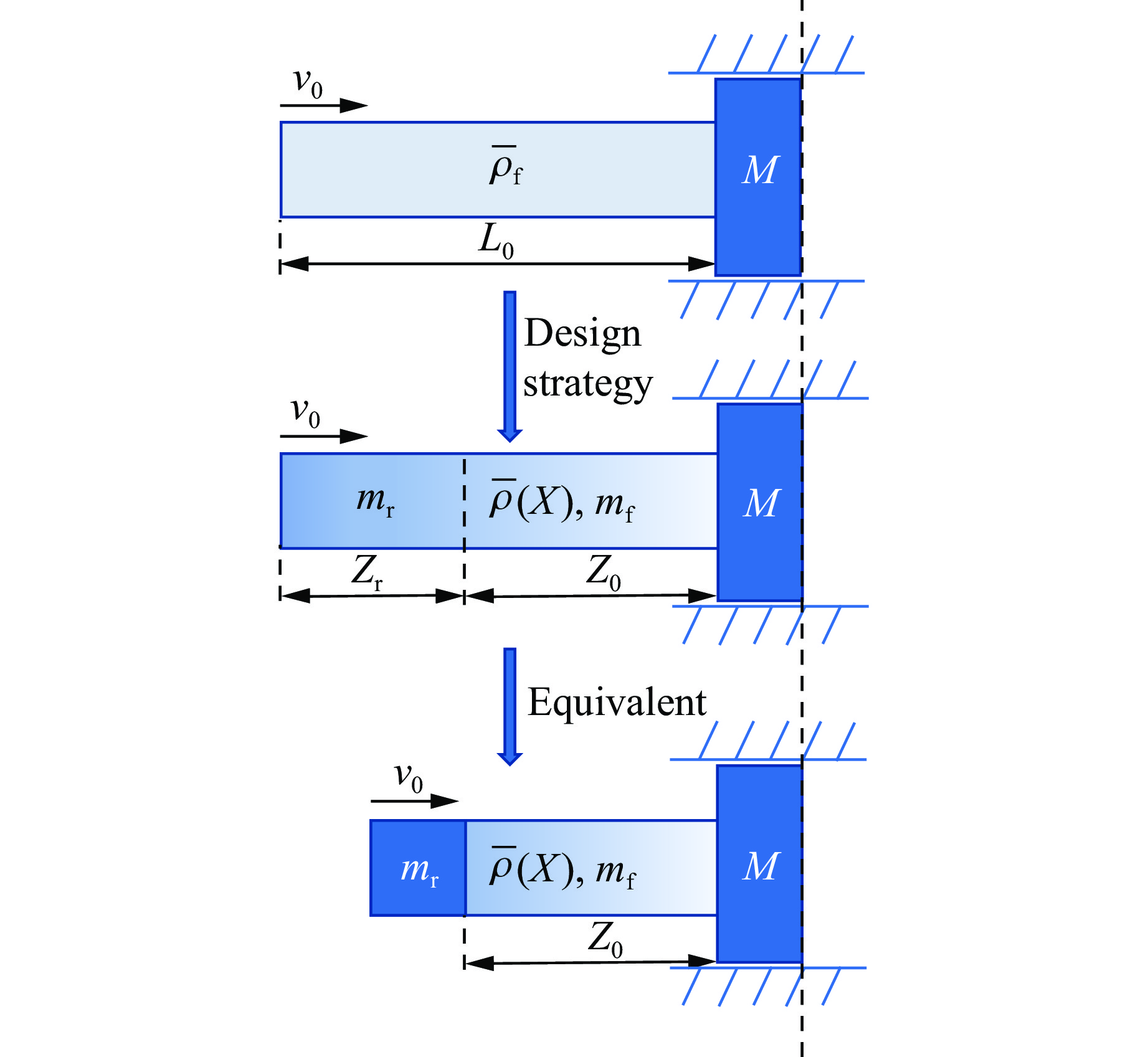
图 2 梯度泡沫金属冲击刚性块示意图
Figure 2. Schematic diagram of a gradient metallic foam cylinder impacting a mass
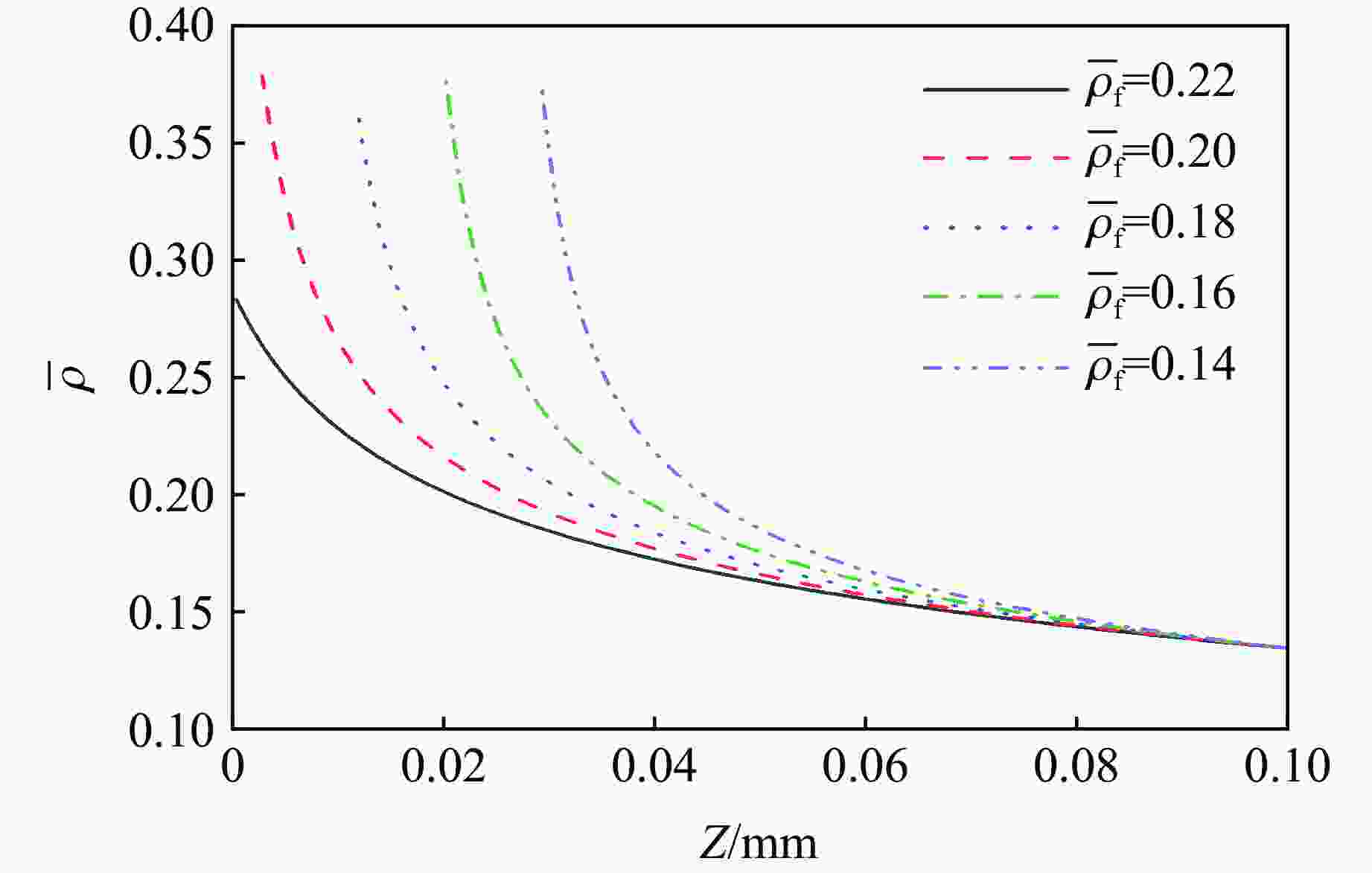
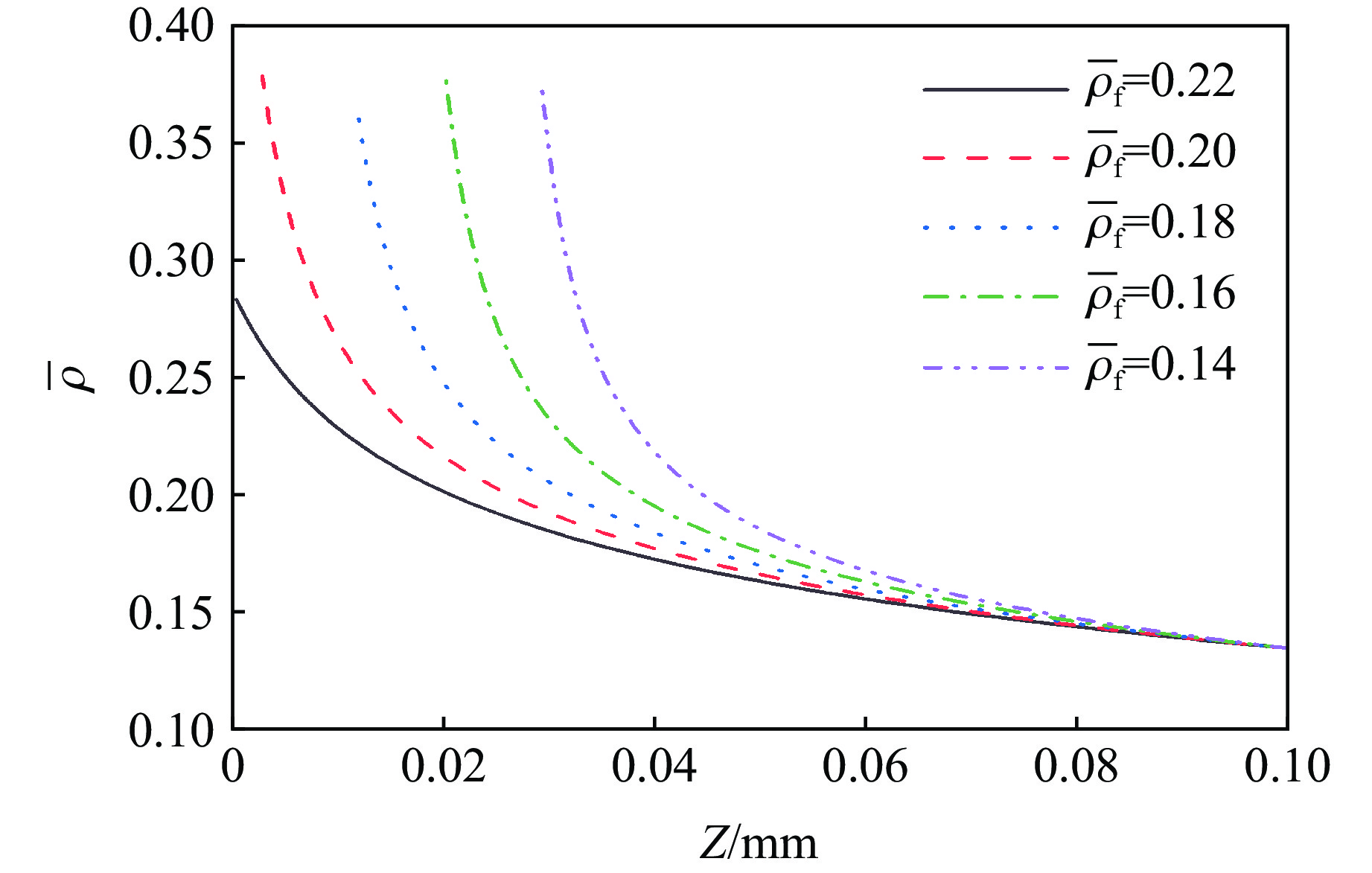
图 3 不同$ {\overline{\rho }}_{\text{f}} $下相对密度随拉格朗日坐标的分布
Figure 3. Distribution of relative density with Lagrangian coordinates for different values of $ {\overline{\rho }}_{\text{f}} $
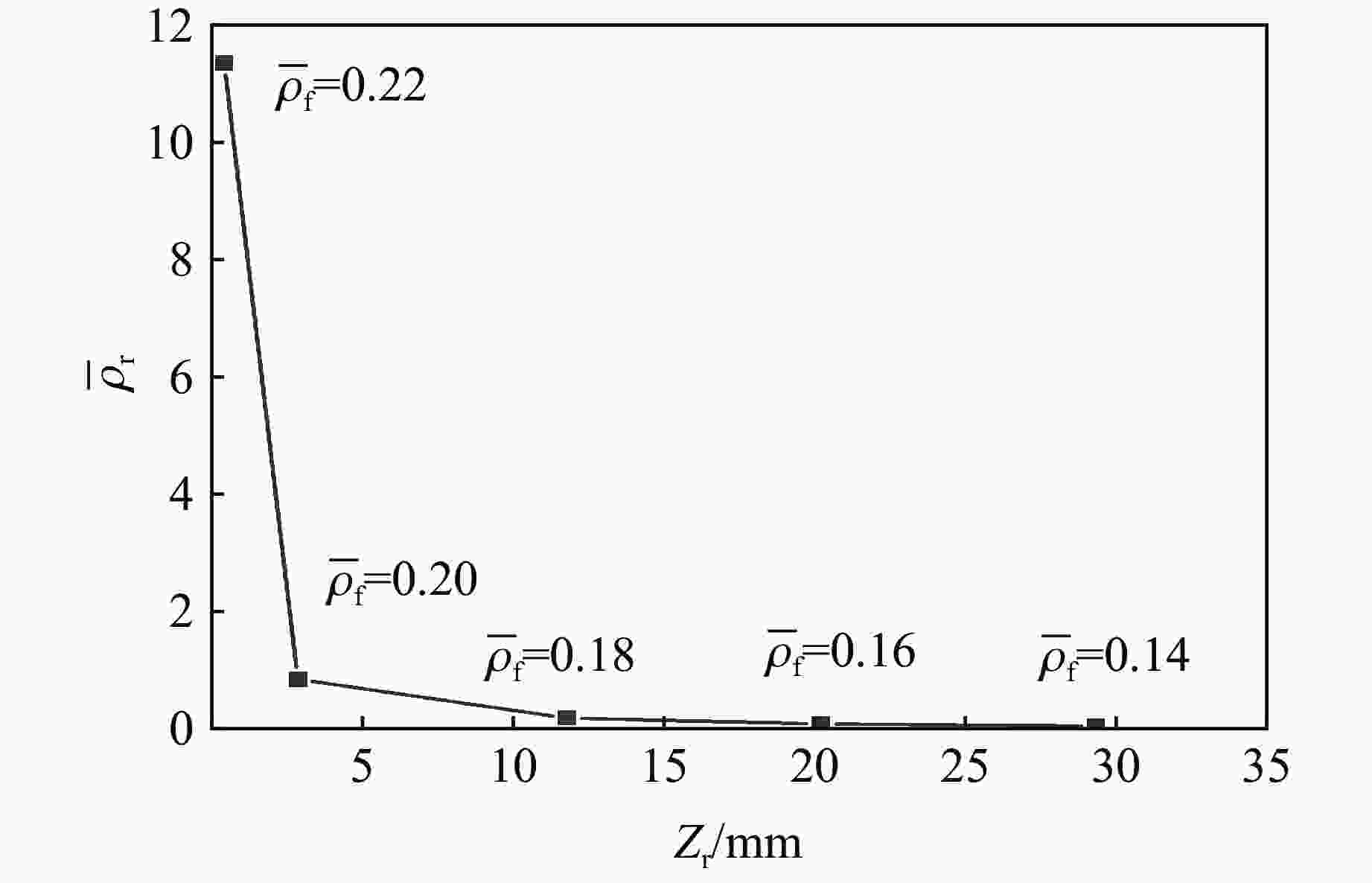
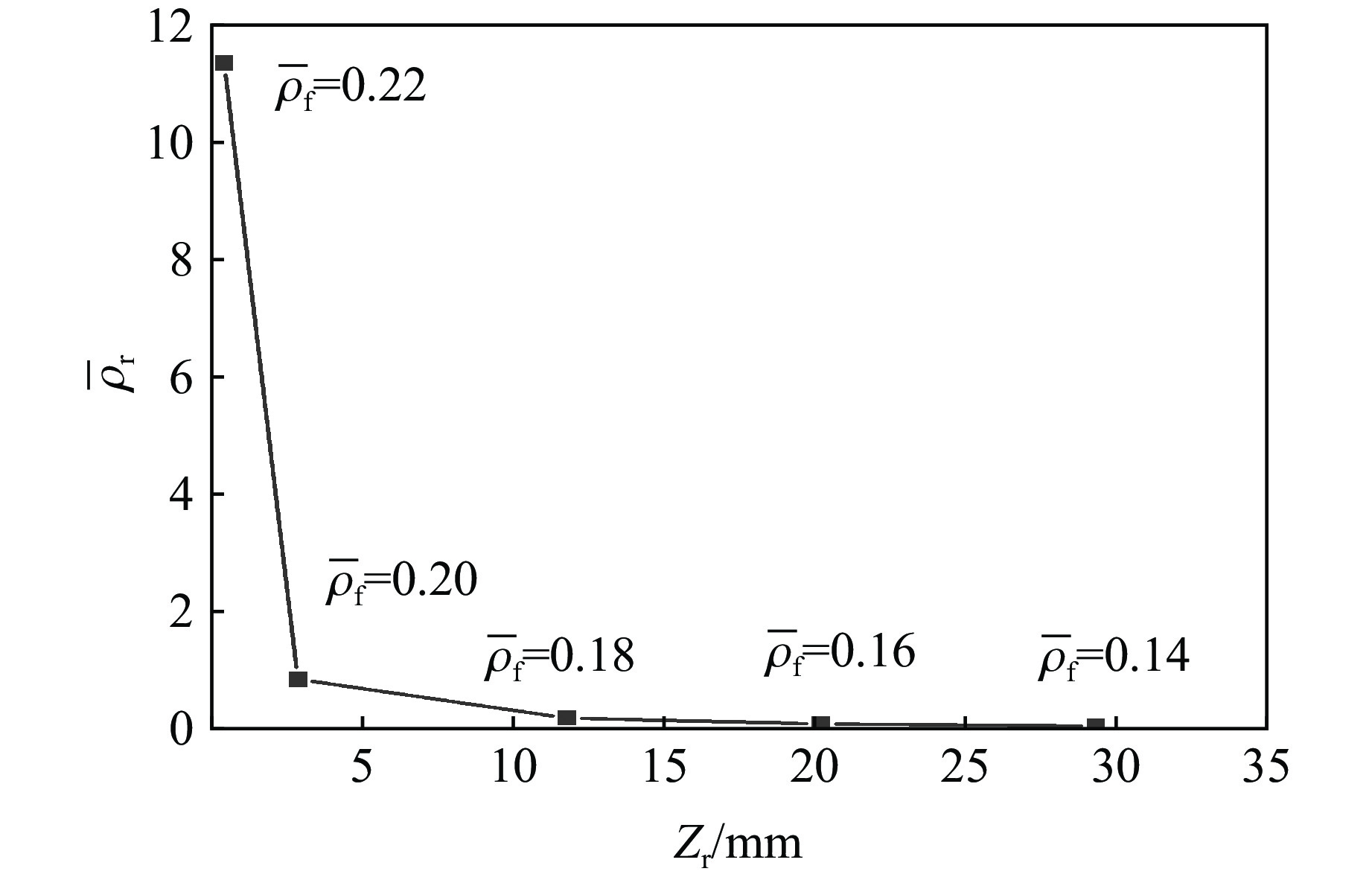
图 4 不同$ {\overline{\rho }}_{\text{f}} $下剩余相对密度随剩余长度的变化
Figure 4. Residual relative density as a function of residual length for different values of $ {\overline{\rho }}_{\text{f}} $
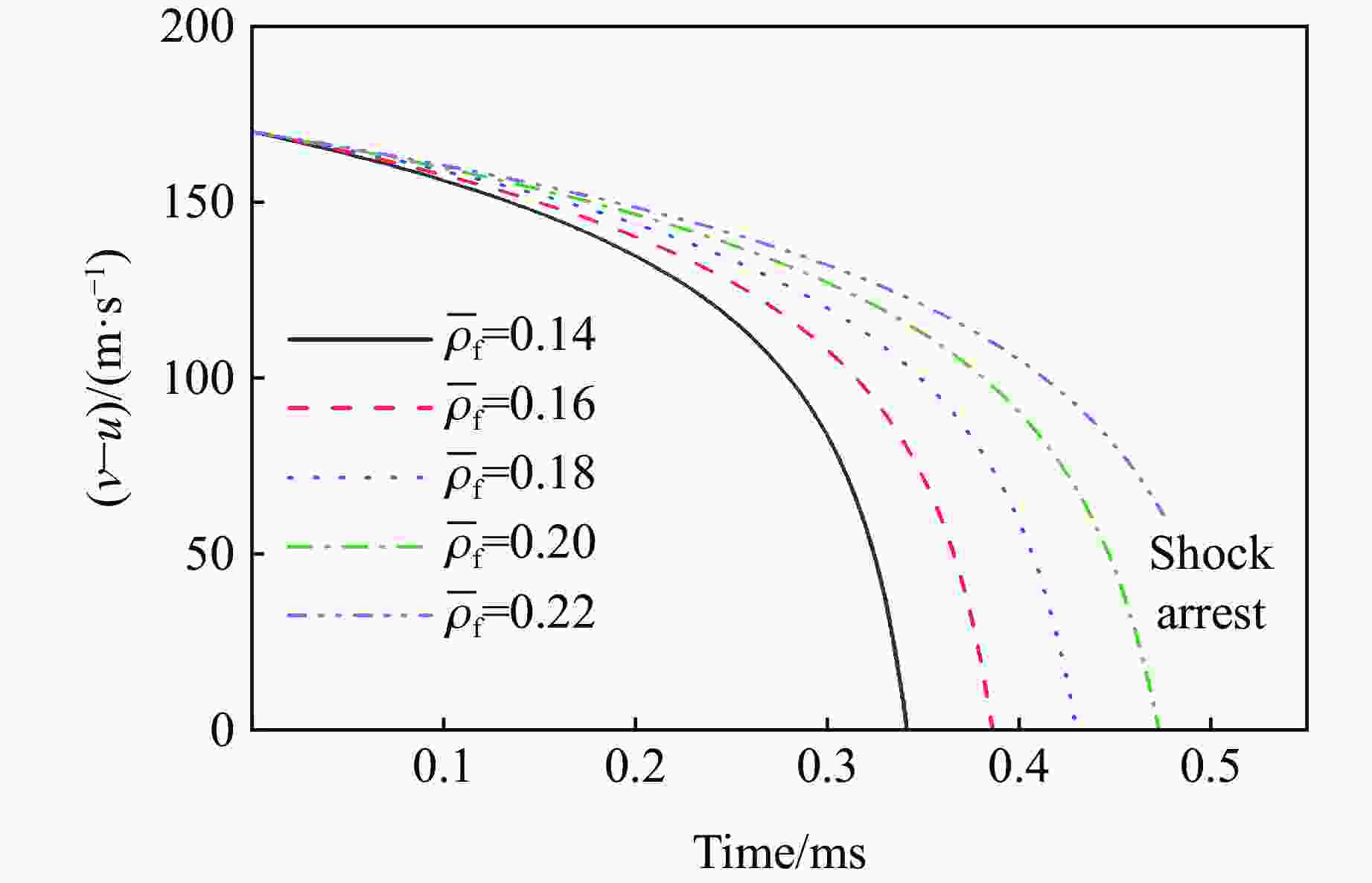
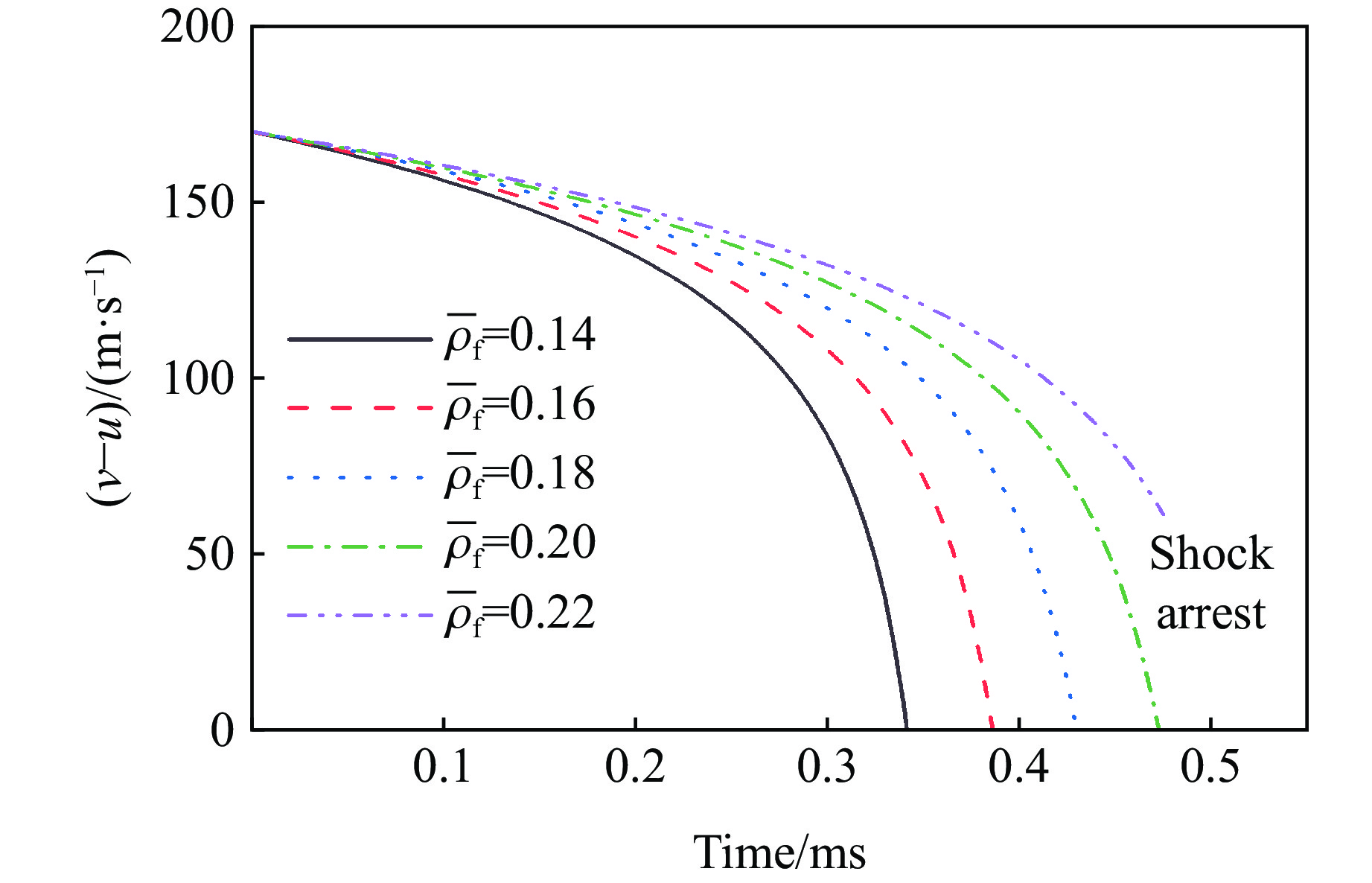
图 5 不同$ {\overline{\rho }}_{\text{f}} $下相对速度随时间变化曲线
Figure 5. Relative velocity as a function of time for different values of $ {\overline{\rho }}_{\text{f}} $
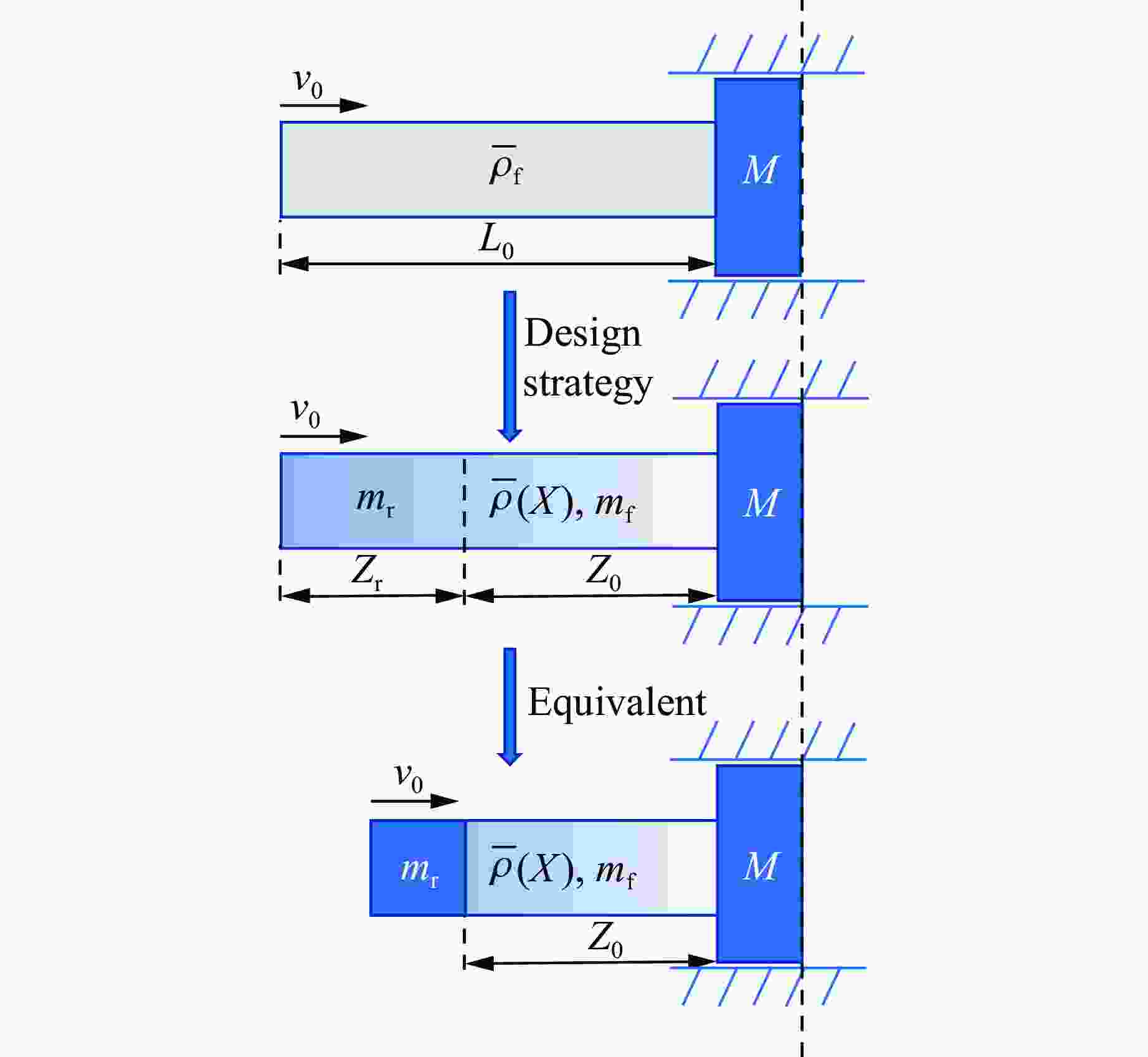
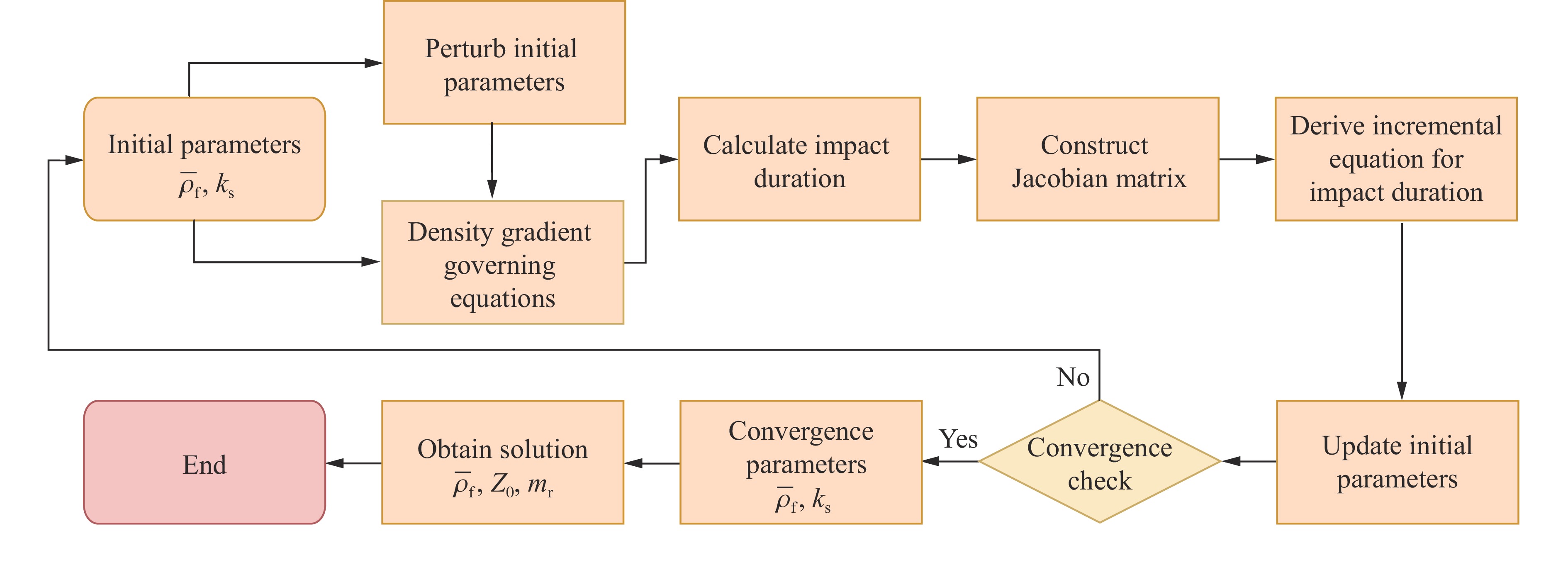
图 6 梯度泡沫杆设计优化示意图(Z0为冲击波波头位置)
Figure 6. Schematic diagram of design optimization of gradient foam rod (Z0 is the position of shock wave front)
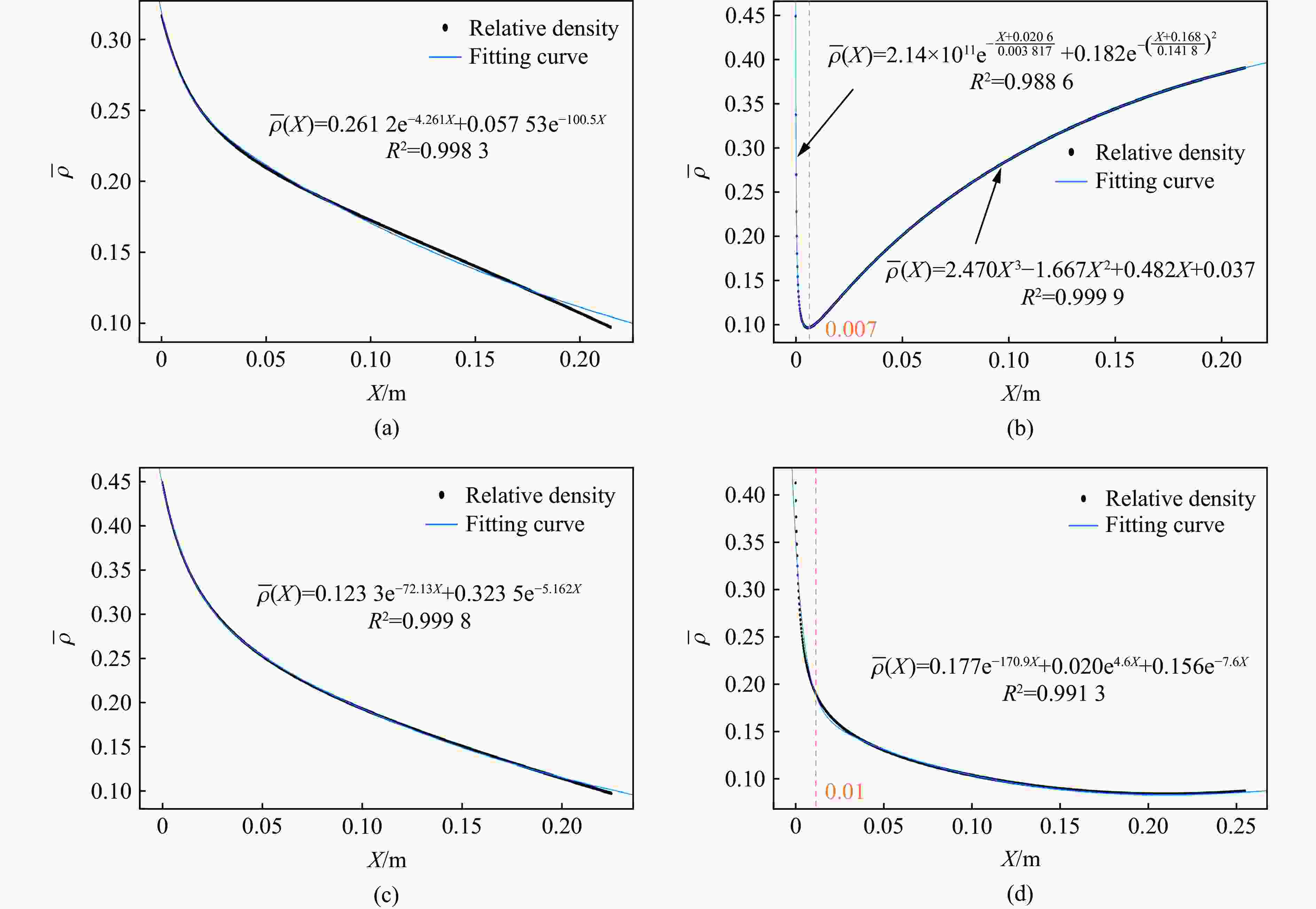
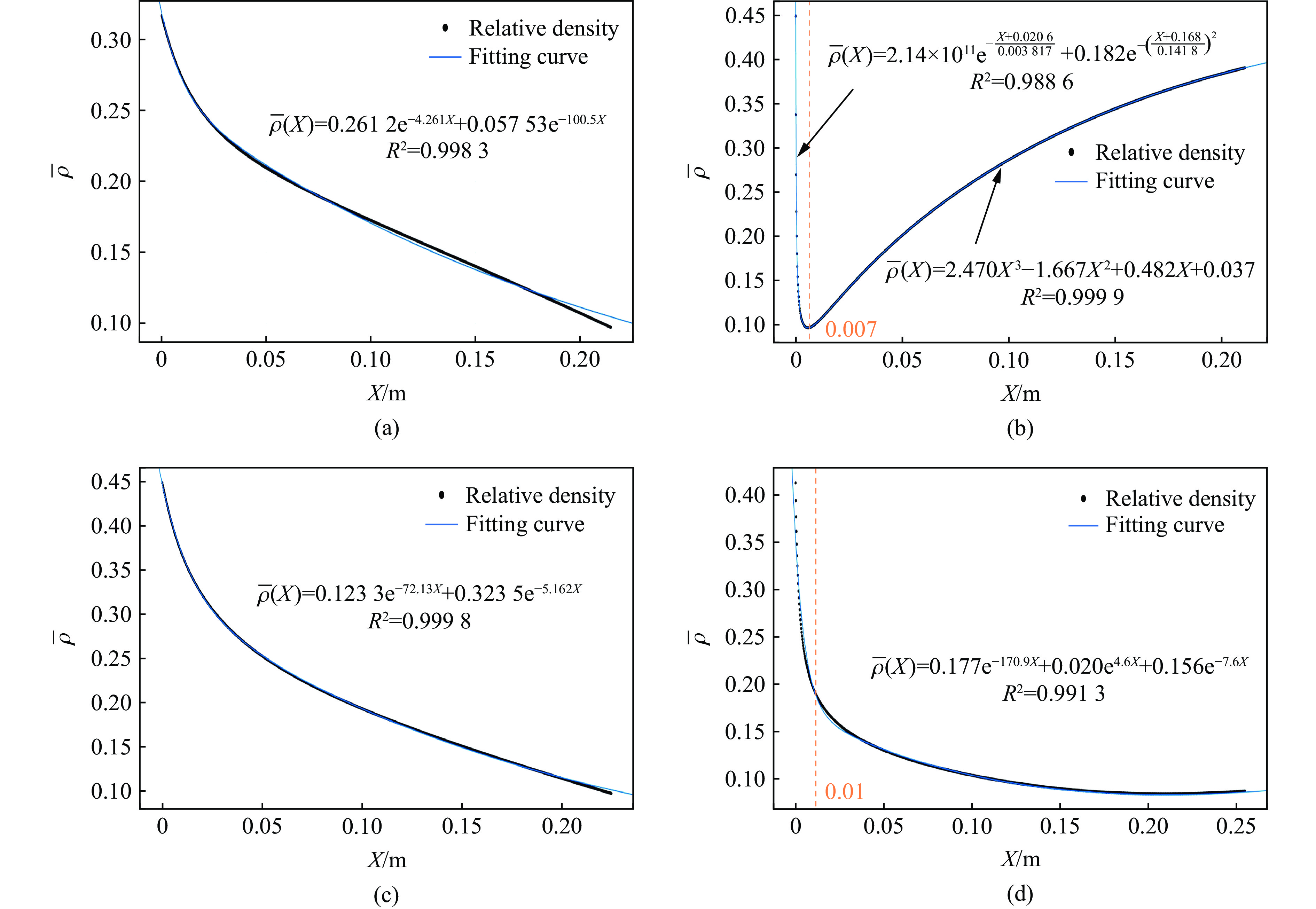
图 8 不同边界下迭代后的相对密度分布:自由边界下模拟正弦加速度 (a) 和三角加速度 (b),弹性边界下模拟正弦加速度 (c) 和三角加速度 (d)
Figure 8. Relative density distribution after iteration under different boundary conditions: simulated sinusoidal (a) and triangular (b) acceleration waveforms under free boundary conditions; simulated sinusoidal (c) and triangular (d) acceleration waveforms under elastic boundary conditions
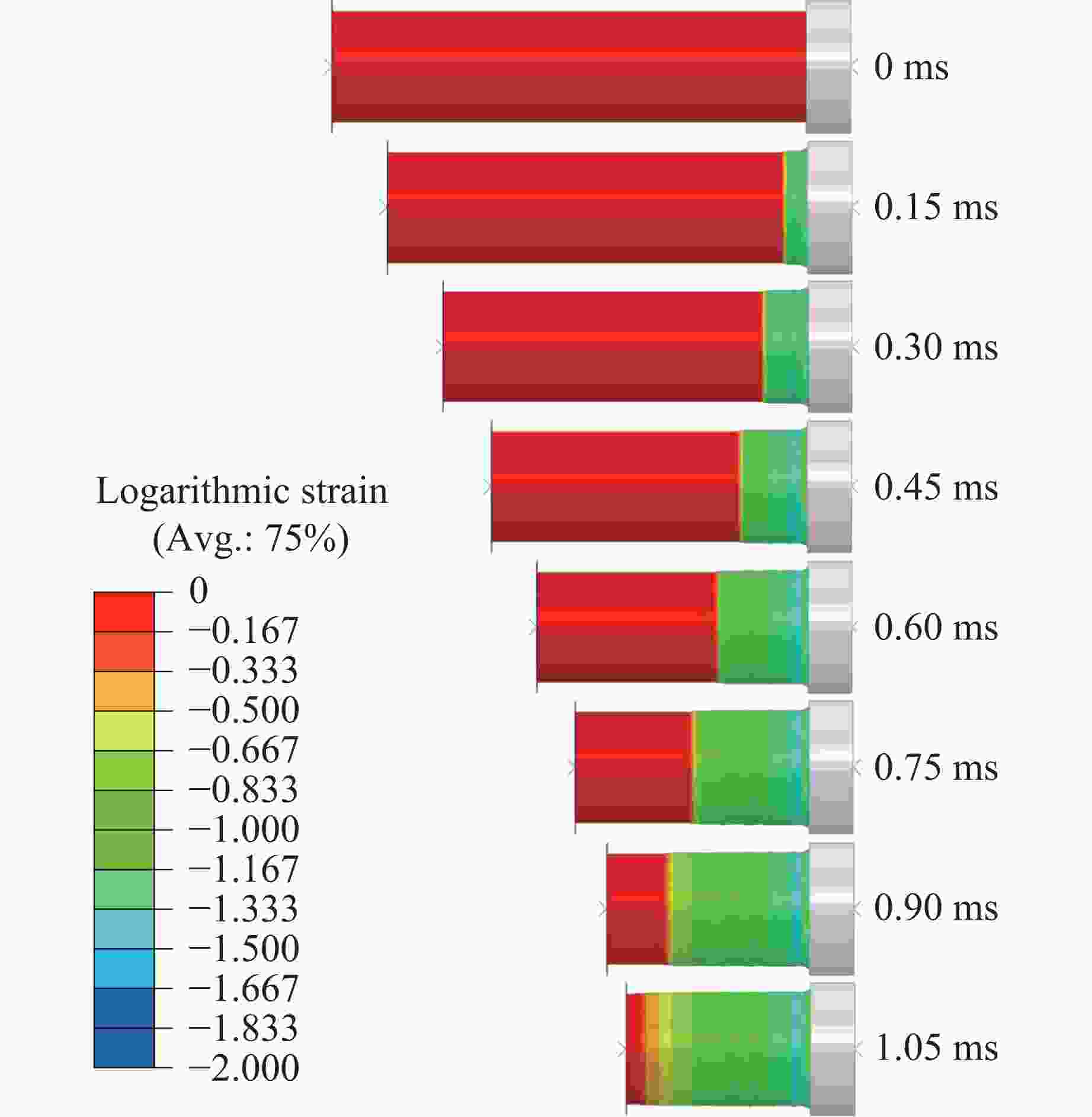
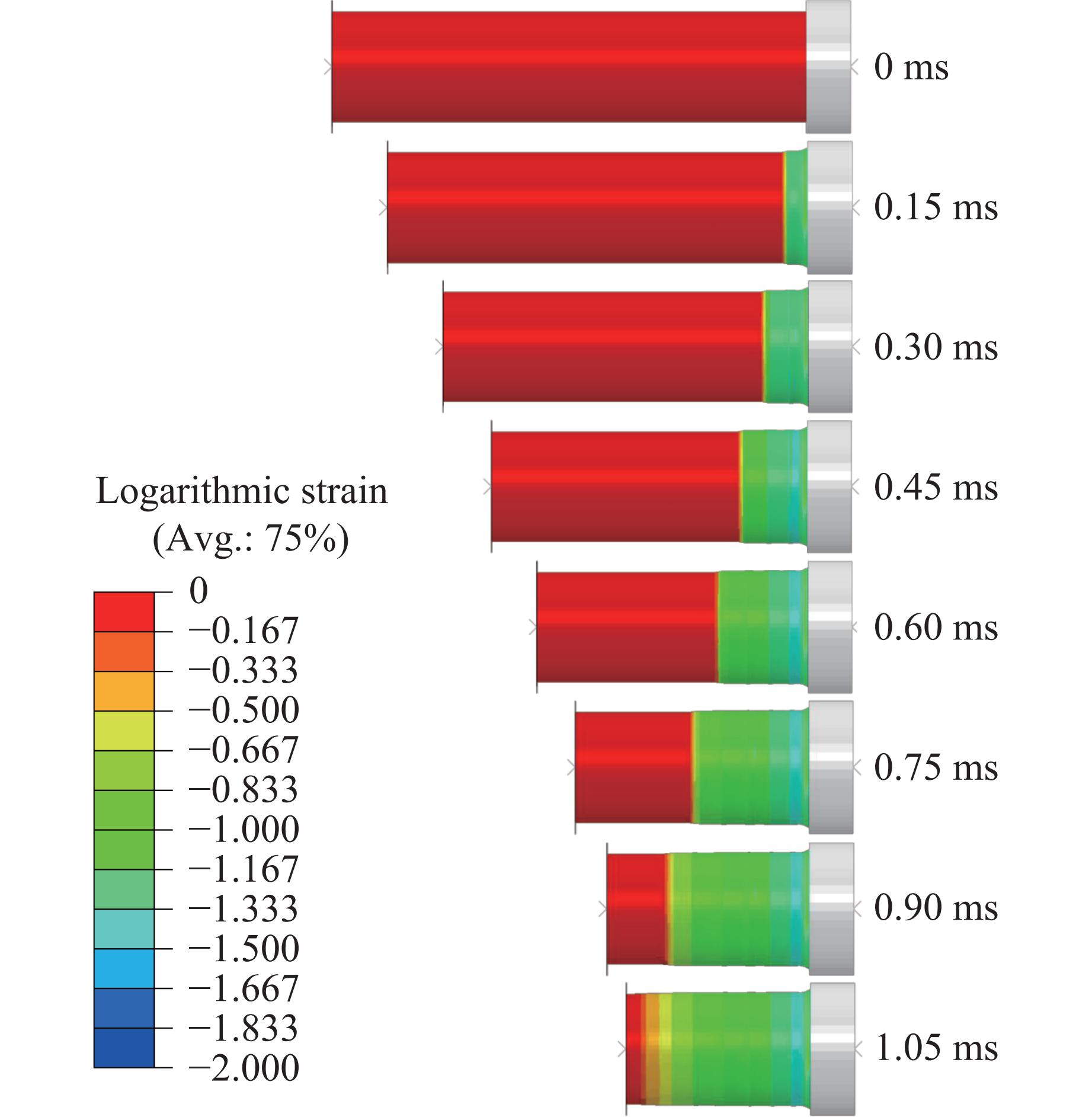
图 10 自由边界下模拟正弦加速度时不同时刻梯度多孔杆中的沿轴向对数应变
Figure 10. Longitudinal logarithmic strain in the graded porous rod at different time instances during simulated sinusoidal acceleration under free boundary conditions
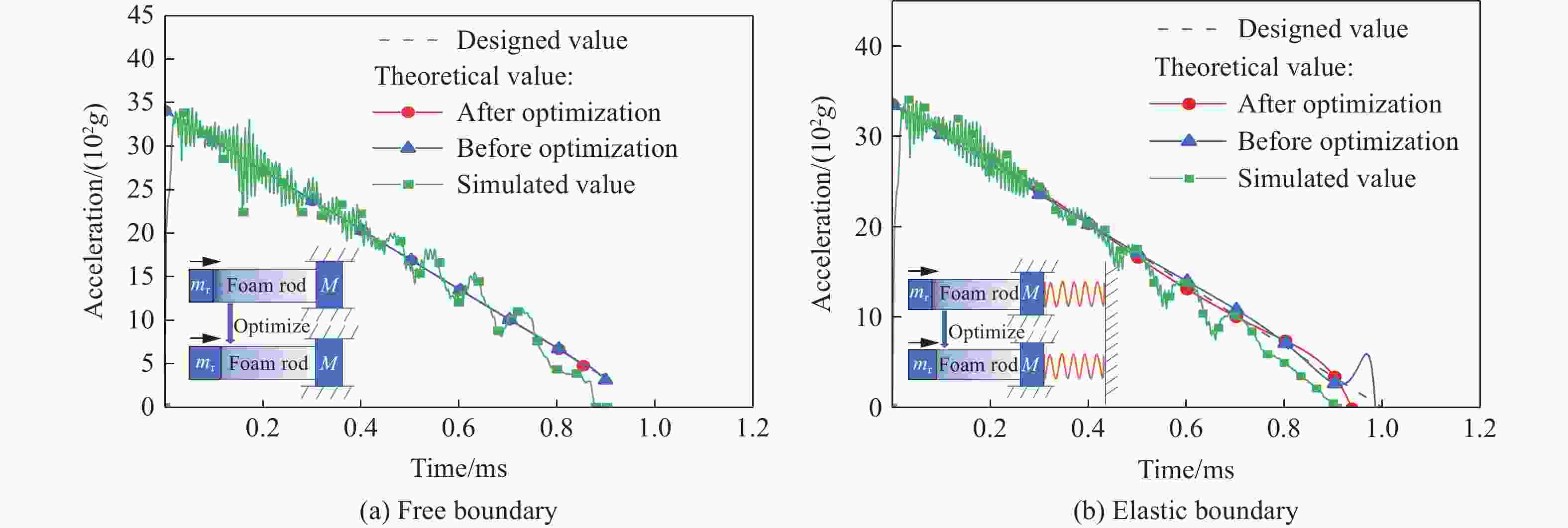
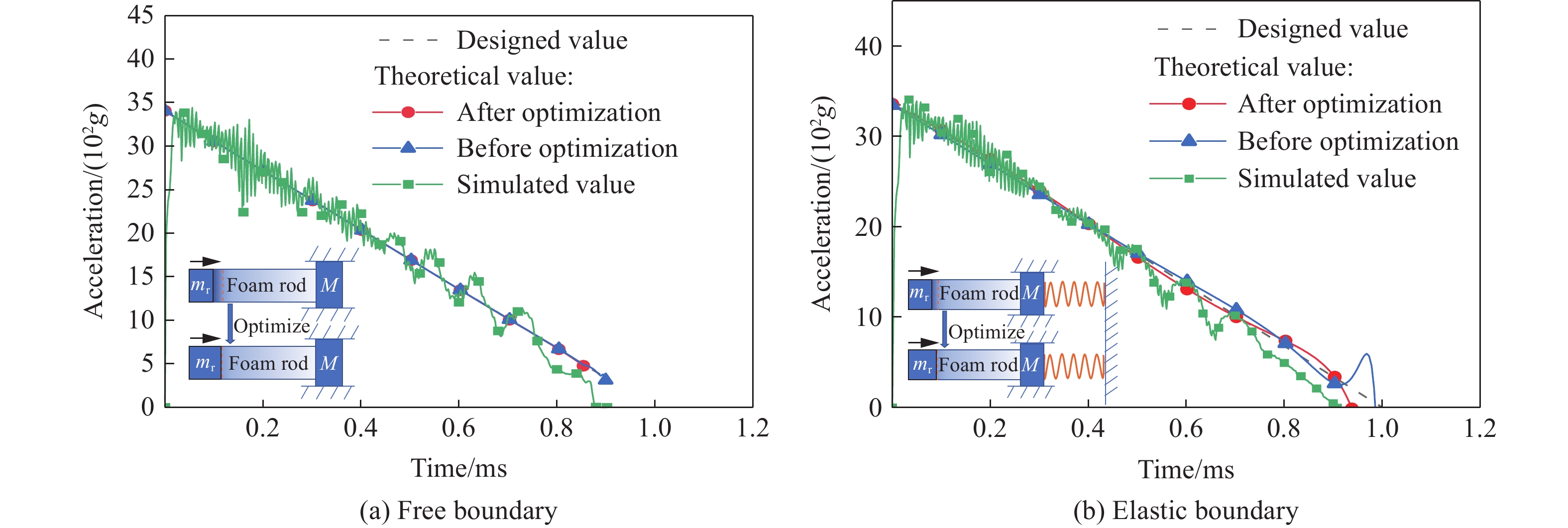
图 11 不同边界下模拟三角加速度的仿真值、理论值与设计值比较
Figure 11. Comparison of simulated, theoretical, and design values for the simulated triangular acceleration under different boundary conditions
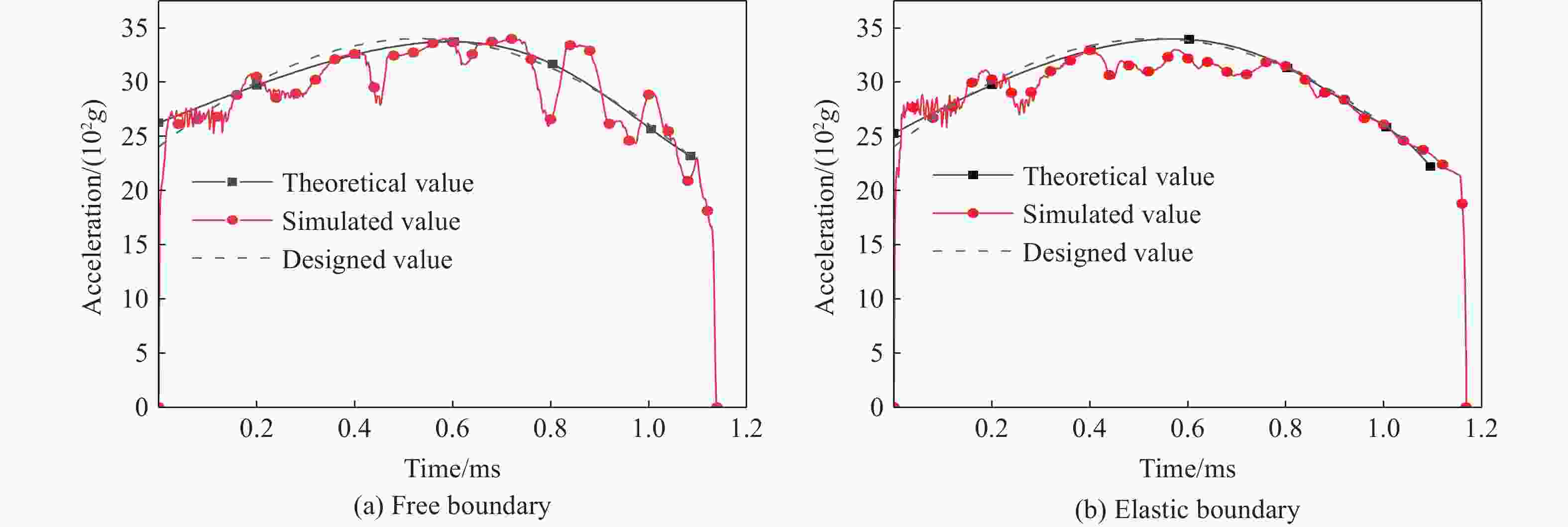
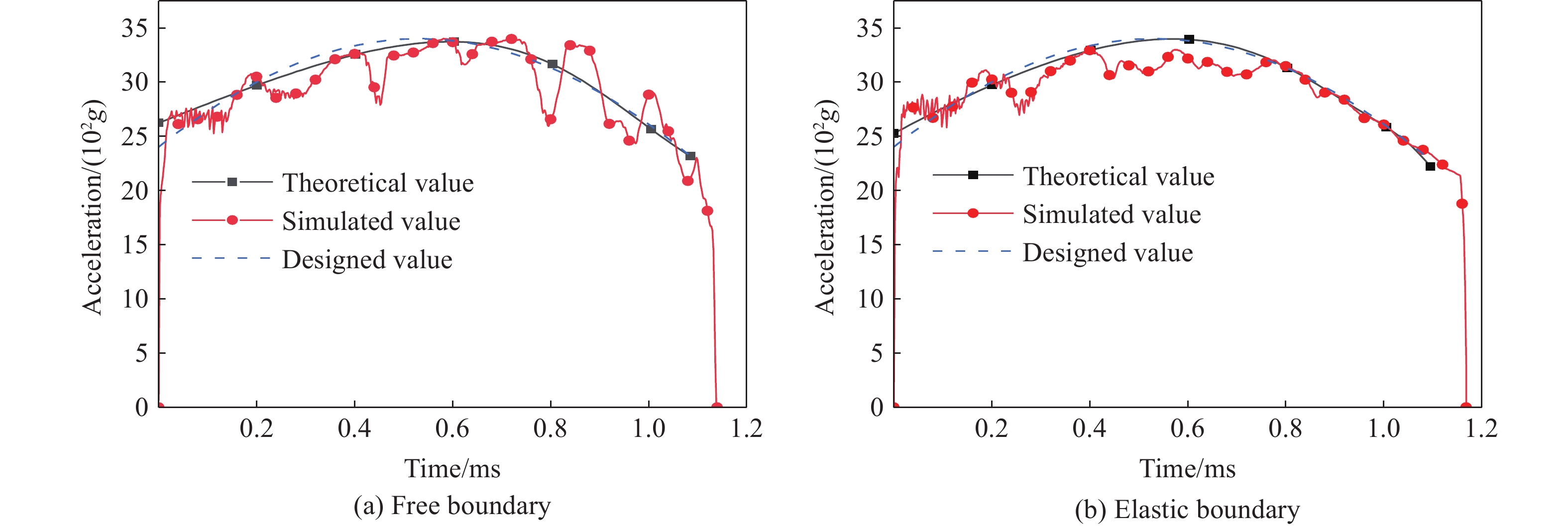
图 12 不同边界下模拟正弦加速度的仿真值、理论值与设计值比较
Figure 12. Comparison of simulated, theoretical, and design values for the simulated sinusoidal acceleration under different boundary conditions
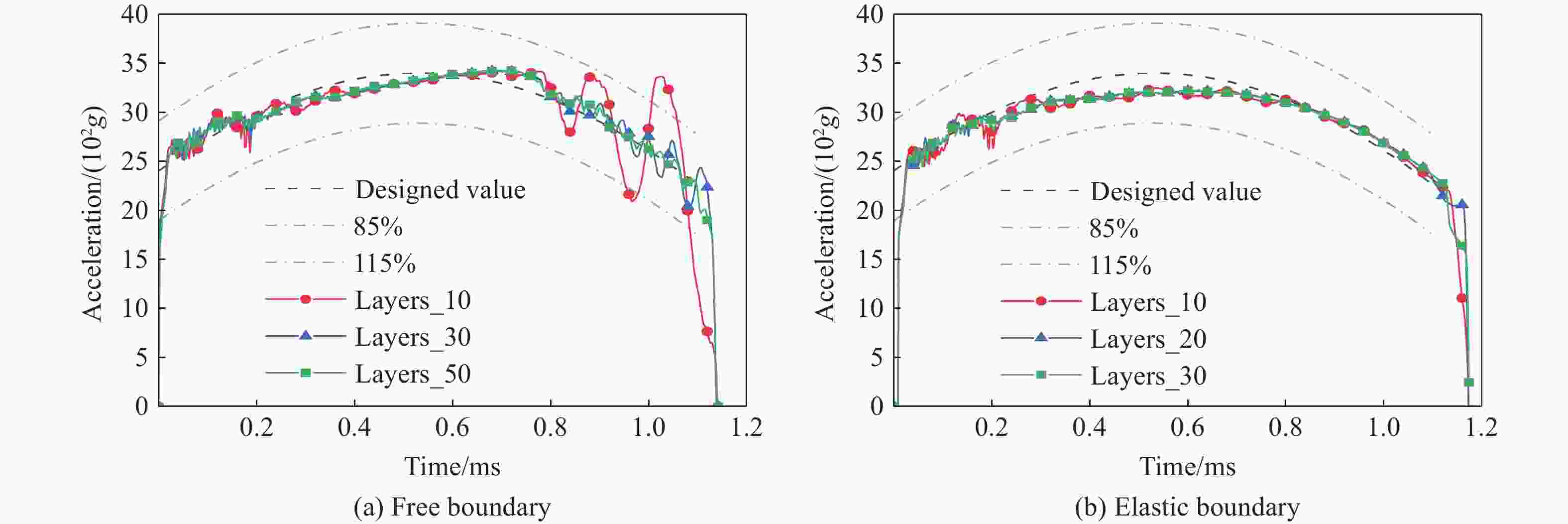
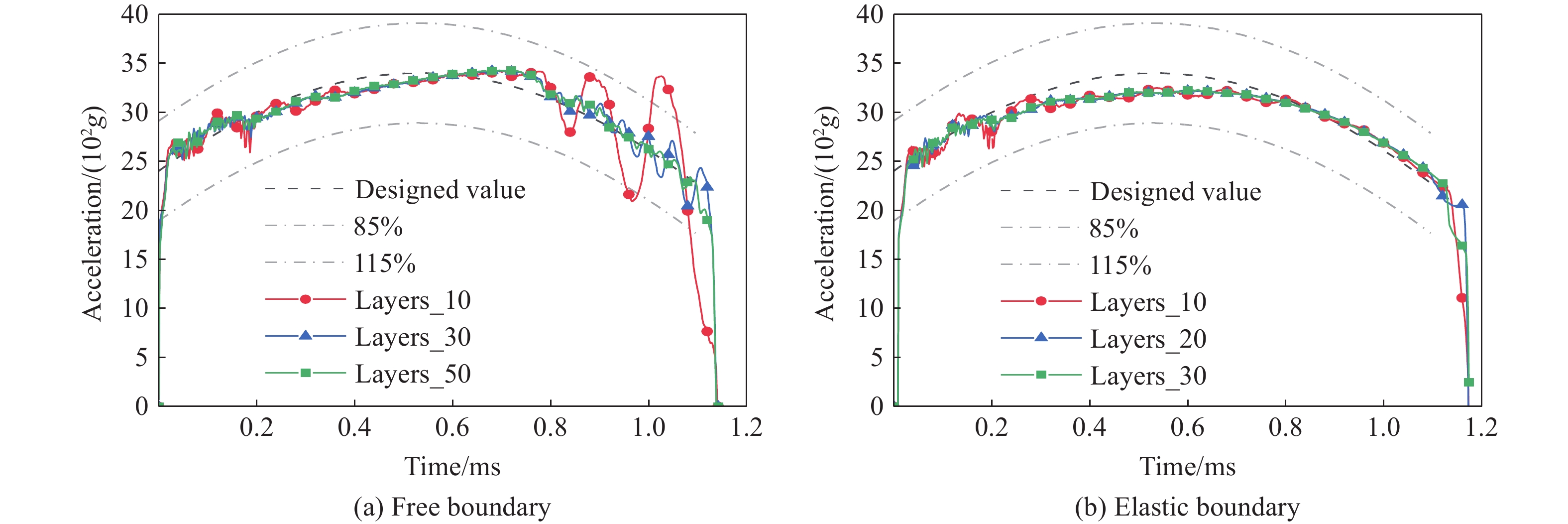
图 13 不同分层数的影响(黑色虚线为设计半正弦波,灰色虚线表示波形允差)
Figure 13. Effects of the number of layers (The target half-sine wave and waveform tolerance are indicated by the black and gray dashed lines, respectively.)
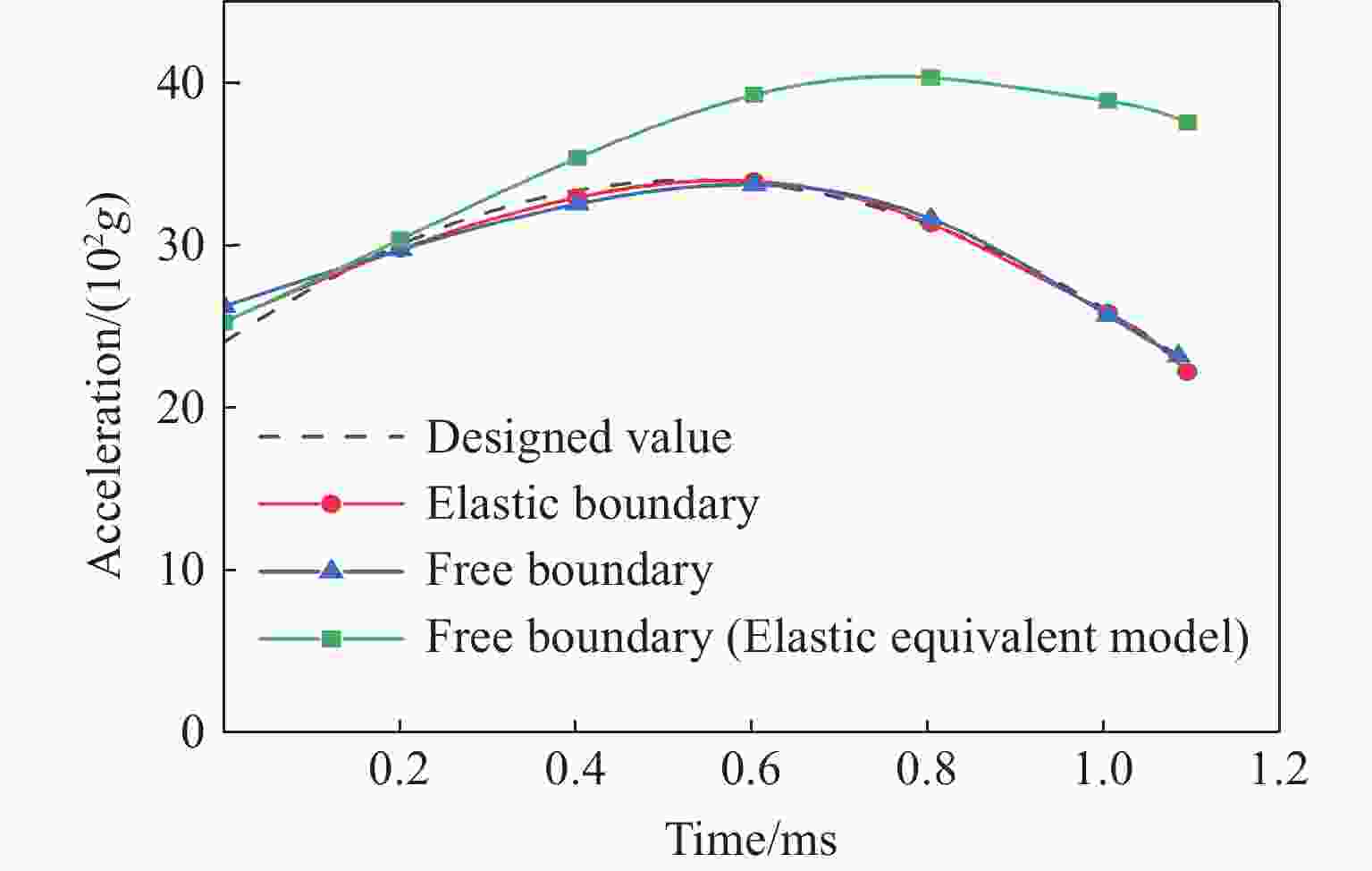
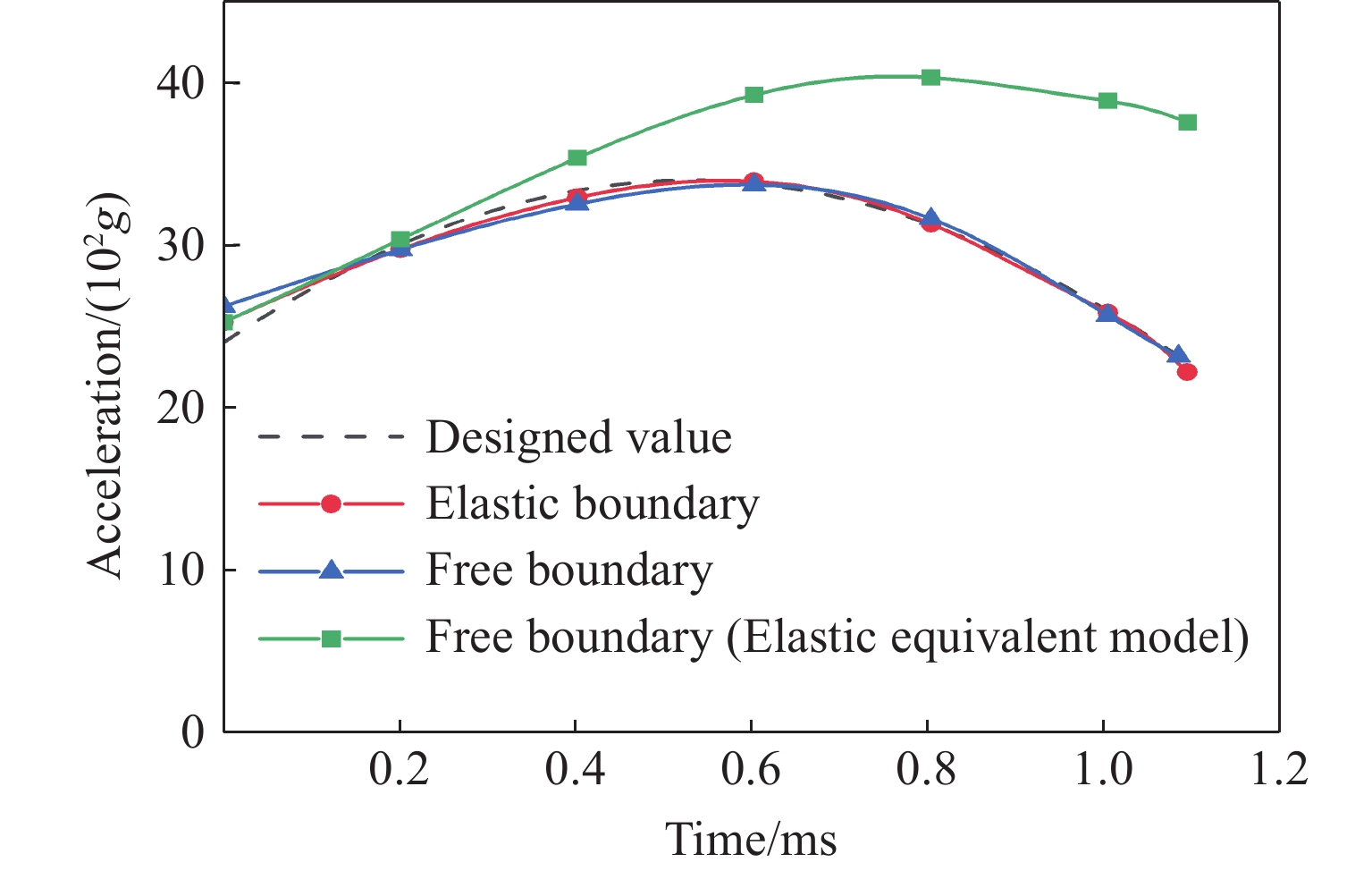
图 14 自由边界与弹性边界下模拟的正弦加速度
Figure 14. Simulated sinusoidal acceleration under free and elastic boundary conditions
表 2 2种边界下的设计需求
Table 2. Design requirements under two types of boundaries
Boundary Acceleration Free boundary $ {a}_{\mathrm{M}}=3\,400g\sin \left[2\text{π} (t+0.53)/4.243\right],\;\;\;\;t\in [0,1.09\;\mathrm{ms}] $ Elastic boundary $ {a}_{\mathrm{M}}=-3\,400g(t-1),\;\;\;\;t\in [0,1.00\;\mathrm{ms}] $  下载: 导出CSV
表 3 密度梯度反向设计输入参数
Table 3. Input parameters for inverse density gradient design
A0/mm2 M/kg $ \Delta t $/ms $ {L}_{0} $/m $ {\overline{\rho }}_{\text{f}} $ $ {v}^{1} $($ {\overline{\rho }}_{1} $)/(m·s−1) $ {k}_{\text{s}} $/(N·m−1) Triangular
accelerationSinusoidal
accelerationTriangular
accelerationSinusoidal
acceleration1963 1 0.002 1 0.1 230(0.089) 170(0.095) 2×10⁶ 106
下载: 导出CSV
表 4 泡沫铝密度梯度反向设计等效模型
Table 4. Equivalent model for inverse density gradient design of aluminum foam
Acceleration Boundary $ \overline{\rho }(X) $ Z0/m mr/kg $ {k}_{\text{s}} $/
(kN·mm−1)$ {a}_{\text{M}}=3\,400g \sin \dfrac{2\text{π} \left(t+0.53\right)}{4.243}$
$ t\in \left[0,1.09\,\mathrm{ms}\right] $Free boundary $ \overline{\rho }(X)=0.261\,2{\mathrm{e}}^{-4.261X}+0.057\,53{\mathrm{e}}^{-100.5X} $ 0.2146 0.0380 Elastic boundary $ \overline{\rho }(X)=0.123\,3{\mathrm{e}}^{-72.13X}+0.323\,5{\mathrm{e}}^{-5.162X} $ 0.2247 0.0557 1.18 $ {a}_{\text{M}}=3\,400g\left(t-1\right) $
$ t\in \left[0,1.00\,\mathrm{ms}\right] $Free boundary $ \begin{aligned}\overline{\rho }(X)=\;&2.466{X}^{3}-1.621{X}^{2}+0.461\,1X+\\&0.039\,95\;\;(\text{After optimization})\end{aligned} $ 0.2046 0.0014 Elastic boundary $ \begin{aligned}\overline{\rho }(X)=\;&{\left(5.374+61.87X-149.4{X}^{2}\right)}^{-1}\\& (\text{After optimization})\end{aligned} $ 0.2446 0.0170 3.92
下载: 导出CSV
-
[1] POLITIS E. Minimum operational performance specification for crash protected airborne recorder systems: ED-112 [S]. Malakoff: European Organization for Civil Aviation Equipment, 2013. [2] 赵清洲, 闫宝祝, 冯小军, 等. 民用飞机飞行记录系统: “黑匣子” [M]. 上海: 上海交通大学出版社, 2019.ZHAO Q Z, YAN B Z, FENG X J, et al. Civil aircraft flight recording system: “black box” [M]. Shanghai: Shanghai Jiao Tong University Press, 2019. [3] RADFORD D D, DESHPANDE V S, FLECK N A. The use of metal foam projectiles to simulate shock loading on a structure [J]. International Journal of Impact Engineering, 2005, 31(9): 1152–1171. doi: 10.1016/j.ijimpeng.2004.07.012 [4] LI L, HAN B, HE S Y, et al. Shock loading simulation using density-graded metallic foam projectiles [J]. Materials & Design, 2019, 164: 107546. doi: 10.1016/j.matdes.2018.107546 [5] LIU X F, WANG Y R, HE X M, et al. Deformation failure mechanism and constitutive model of gradient aluminum foam under impact loading [J]. Composite Structures, 2024, 327: 117684. doi: 10.1016/j.compstruct.2023.117684 [6] CHANG B X, ZHENG Z J, ZHANG Y R, et al. Crashworthiness design of graded cellular materials: experimental verification of the backward design strategy [J]. International Journal of Impact Engineering, 2023, 171: 104366. doi: 10.1016/j.ijimpeng.2022.104366 [7] 杨东, 郭民, 牛宇浩, 等. 高能量冲击环境试验研究 [J]. 机械科学与技术, 2000, 19(Suppl 1): 7−8.YANG D, GUO M, NIU Y H, et al. The research of high energy shock environment test [J]. Mechanical Science and Technology, 2000, 19(Suppl 1): 7−8. [8] 钞红晓, 刘奇涛, 黄宏胜. 高能效宽脉冲强冲击试验与测试技术 [M]. 北京: 科学出版社, 2024.CHAO H X, LIU Q T, HUANG H S. High-efficiency wide-pulse strong impact testing and measurement technology [M]. Beijing: Science Press, 2024. [9] BAILEY T. Flight data recorders: built to survive [EB/OL]. (2006-01)[2026-01-27]. https://aea.net/AvionicsNews/ANArchives/FlightDataRecord-ersJan06.pdf. [10] ISLAM M A, BROWN A D, HAZELL P J, et al. Mechanical response and dynamic deformation mechanisms of closed-cell aluminium alloy foams under dynamic loading [J]. International Journal of Impact Engineering, 2018, 114: 111–122. doi: 10.1016/j.ijimpeng.2017.12.012 [11] REID S R, PENG C. Dynamic uniaxial crushing of wood [J]. International Journal of Impact Engineering, 1997, 19(5/6): 531–570. doi: 10.1016/S0734-743X(97)00016-X [12] ZHENG Z J, WANG C F, YU J L, et al. Dynamic stress-strain states for metal foams using a 3D cellular model [J]. Journal of the Mechanics and Physics of Solids, 2014, 72: 93–114. doi: 10.1016/j.jmps.2014.07.013 [13] WANG P F, XU S L, LI Z B, et al. Experimental investigation on the strain-rate effect and inertia effect of closed-cell aluminum foam subjected to dynamic loading [J]. Materials Science and Engineering: A, 2015, 620: 253–261. doi: 10.1016/j.msea.2014.10.026 [14] TAN P J, REID S R, HARRIGAN J J, et al. Dynamic compressive strength properties of aluminium foams. part Ⅰ—experimental data and observations [J]. Journal of the Mechanics and Physics of Solids, 2005, 53(10): 2174–2205. doi: 10.1016/j.jmps.2005.05.007 [15] DESHPANDE V S, FLECK N A. High strain rate compressive behaviour of aluminium alloy foams [J]. International Journal of Impact Engineering, 2000, 24(3): 277–298. doi: 10.1016/S0734-743X(99)00153-0 [16] LOPATNIKOV S L, GAMA B A, HAQUE J, et al. Dynamics of metal foam deformation during Taylor cylinder—Hopkinson bar impact experiment [J]. Composite Structures, 2003, 61(1/2): 61–71. doi: 10.1016/S0263-8223(03)00039-4 [17] PATTOFATTO S, ELNASRI I, ZHAO H, et al. Shock enhancement of cellular structures under impact loading: part Ⅱ analysis [J]. Journal of the Mechanics and Physics of Solids, 2007, 55(12): 2672–2686. doi: 10.1016/j.jmps.2007.04.004 [18] BARNES A T, RAVI-CHANDAR K, KYRIAKIDES S, et al. Dynamic crushing of aluminum foams: part Ⅰ—experiments [J]. International Journal of Solids and Structures, 2014, 51(9): 1631–1645. doi: 10.1016/j.ijsolstr.2013.11.019 [19] LIU J G, HOU B, LU F Y, et al. A theoretical study of shock front propagation in the density graded cellular rods [J]. International Journal of Impact Engineering, 2015, 80: 133–142. doi: 10.1016/j.ijimpeng.2015.02.001 [20] YANG J, WANG S L, DING Y Y, et al. Crashworthiness of graded cellular materials: a design strategy based on a nonlinear plastic shock model [J]. Materials Science and Engineering: A, 2017, 680: 411–420. doi: 10.1016/j.msea.2016.11.010 [21] ZHANG Y R, ZHU Y D, CHANG B X, et al. Blast-loading simulators: multiscale design of graded cellular projectiles considering projectile: beam coupling effect [J]. Journal of the Mechanics and Physics of Solids, 2023, 180: 105402. doi: 10.1016/j.jmps.2023.105402 [22] GUPTA V, KIDANE A. Designing density-graded cellular materials for tailored constitutive response [J]. Composites Part B: Engineering, 2024, 287: 111793. doi: 10.1016/j.compositesb.2024.111793 [23] GUPTA V, KIDANE A, SUTTON M. Dynamic characteristics of density-graded cellular materials for impact mitigation [J]. International Journal of Solids and Structures, 2024, 296: 112816. doi: 10.1016/j.ijsolstr.2024.112816 [24] 谭华. 实验冲击波物理 [M]. 北京: 国防工业出版社, 2018.TAN H. Experimental shock wave physics [M]. Beijing: National Defense Industry Press, 2018. [25] TRUNIN R F. Shock compression of condensed materials [M]. Cambridge: Cambridge University Press, 1998. [26] HE S Y, LV Y N, CHEN S T, et al. Gradient regulation and compressive properties of density-graded aluminum foam [J]. Materials Science and Engineering: A, 2020, 772: 138658. doi: 10.1016/j.msea.2019.138658 [27] DESHPANDE V S, FLECK N A. Isotropic constitutive models for metallic foams [J]. Journal of the Mechanics and Physics of Solids, 2000, 48(6/7): 1253–1283. doi: 10.1016/S0022-5096(99)00082-4 [28] ZHANG Y, HE S Y, LIU J G, et al. Density gradient tailoring of aluminum foam-filled tube [J]. Composite Structures, 2019, 220: 451–459. doi: 10.1016/j.compstruct.2019.04.026 [29] GIBSON L J. Mechanical behavior of metallic foams [J]. Annual Review of Materials Research, 2000, 30: 191–227. doi: 10.1146/annurev.matsci.30.1.191 [30] SIMONE A E, GIBSON L J. Effects of solid distribution on the stiffness and strength of metallic foams [J]. Acta Materialia, 1998, 46(6): 2139–2150. doi: 10.1016/S1359-6454(97)00421-7 [31] 吕振华, 孙靖譞. 轴向变密度铝泡沫件的动态和静态压缩实验与有限元模拟分析 [J]. 清华大学学报(自然科学版), 2017, 57(7): 753–762. doi: 10.16511/j.cnki.qhdxxb.2017.25.033LYU Z H, SUN J X. Dynamic and static compression tests and FEA analyses of aluminum foam specimen with variable density in the loading direction [J]. Journal of Tsinghua University (Science and Technology), 2017, 57(7): 753–762. doi: 10.16511/j.cnki.qhdxxb.2017.25.033 -

 下载:
下载:

计量
- 文章访问数: 641
- HTML全文浏览量: 252
- PDF下载量: 61
