




Research Progress on Two-Dimensional Diamond
-
摘要: 二维金刚石作为一种新型的原子级超薄碳基材料,不仅继承了块体金刚石的优异性能,且有望展现出因量子尺度效应带来的独特物性。当前,二维金刚石研究仍处于以理论探索为主的起步阶段,实验研究则集中于可控制备与结构验证。受表界面效应及尺寸效应的多重影响,传统高压合成方法难以在纳米碳材料中直接实现由石墨烯中sp2向sp3杂化的高效稳定转化,这为二维金刚石研究带来了诸多亟待解决的关键科学问题。系统总结了近年来二维金刚石在结构特征、合成策略及物理化学性质等方面的理论与实验研究进展,并对二维金刚石未来的发展方向与潜在的应用场景进行了展望。Abstract: Two-dimensional (2D) diamond, an atomically thin carbon-based material, not only inherits the exceptional properties of bulk diamond but is also expected to exhibit unique physical characteristics arising from nanoscale effects. Currently, research on 2D diamond remains in its infancy, being primarily driven by theoretical investigations, while experimental efforts have mainly focused on its controllable synthesis and structural characterization. Owing to pronounced interfacial effects, the direct application of conventional high-pressure synthesis methods to nanoscale systems is considerably limited, making it challenging to achieve a stable transition from sp2 to sp3 hybridization, thereby posing numerous critical scientific challenges for the study of 2D diamond. This review systematically summarizes recent theoretical and experimental advances in the structural features, synthesis strategies, and physicochemical properties of 2D diamond, and provides perspectives on future research directions and scientific opportunities in the field of 2D diamond.
-
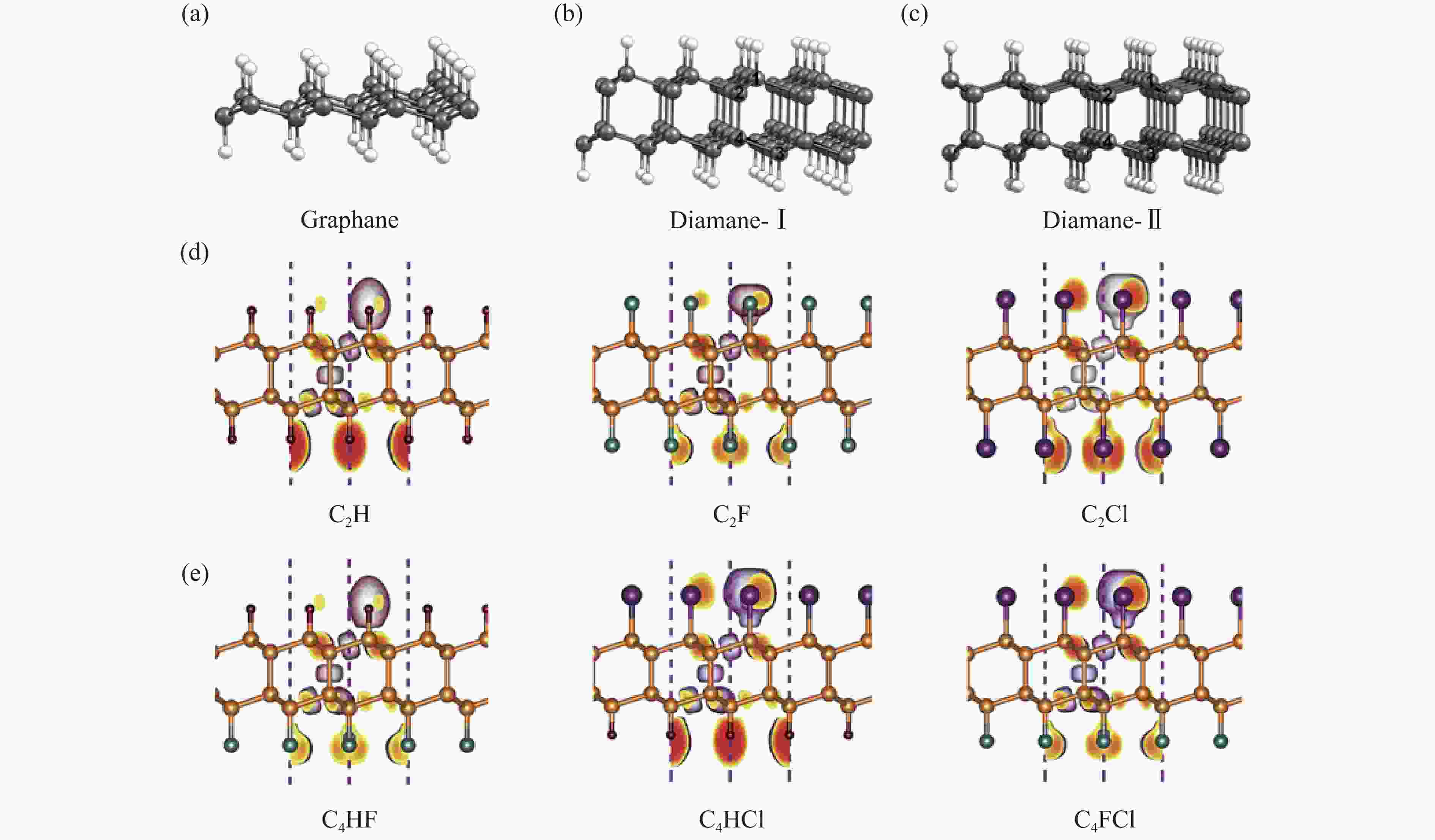
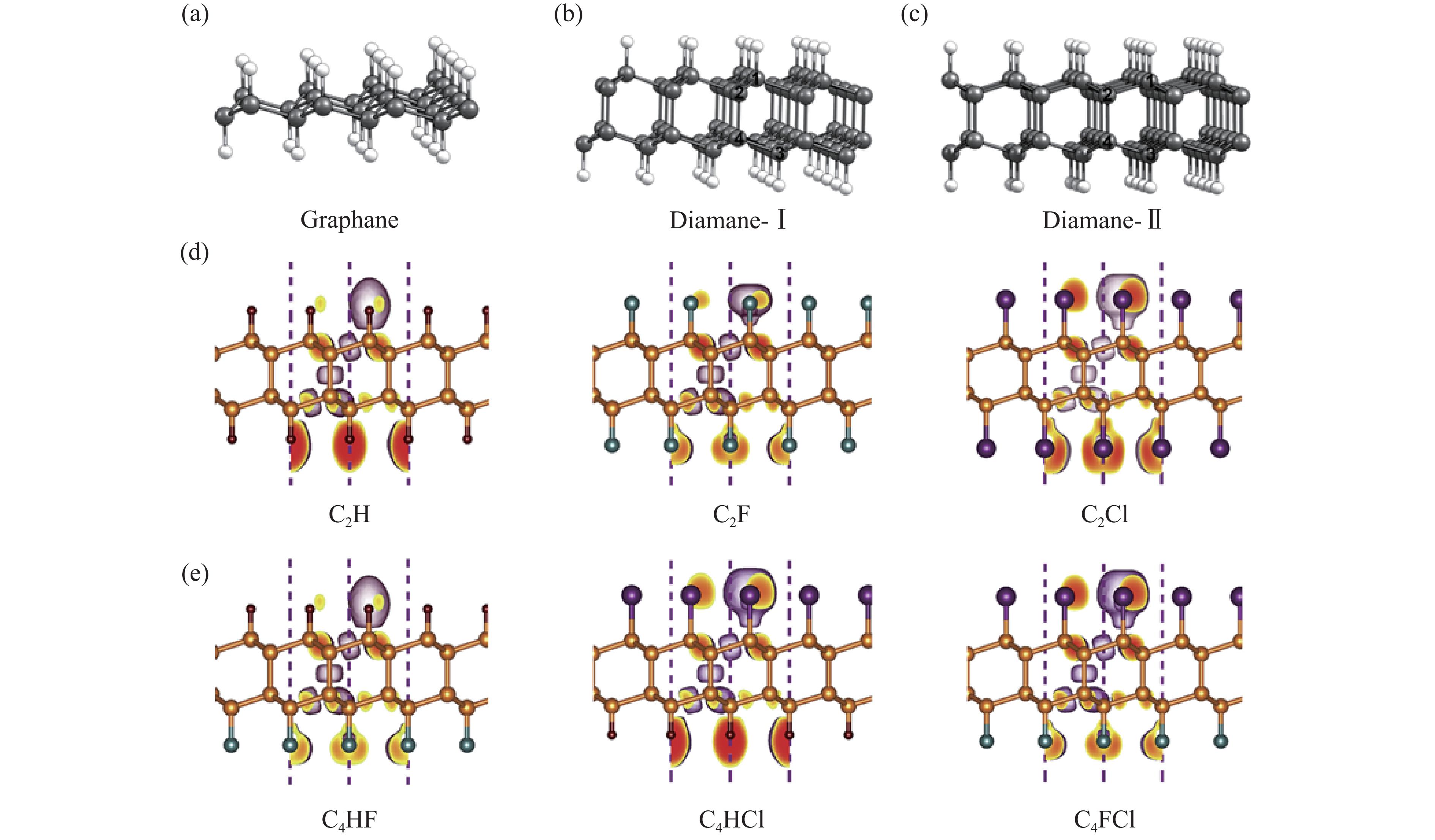
图 1 二维金刚石的多样结构及其示意图:(a)石墨烷结构示意图[26],(b) AB堆垛方式的氢化二维金刚石(Diamane-Ⅰ)结构模型[26],(c) AA堆垛方式的氢化二维金刚石(Diamane-Ⅱ)结构模型[26],(d) 非Janus型二维金刚石(C2X, X=H, F, Cl)和 (e) Janus型二维金刚石(C4XY, X≠Y=H, F, Cl)的结构和电子态分布[30]
Figure 1. Atomic structures and schematic diagram of two-dimensional diamond (diamane): (a) graphane[26]; (b) diamane-I with AB stacking[26]; (c) diamane-Ⅱ with AA stacking[26]; atomic structures and electron localization functions of (d) non-Janus (C2X, X = H, F, Cl) and (e) Janus diamane (C4XY, X≠Y=H, F, Cl) [30]
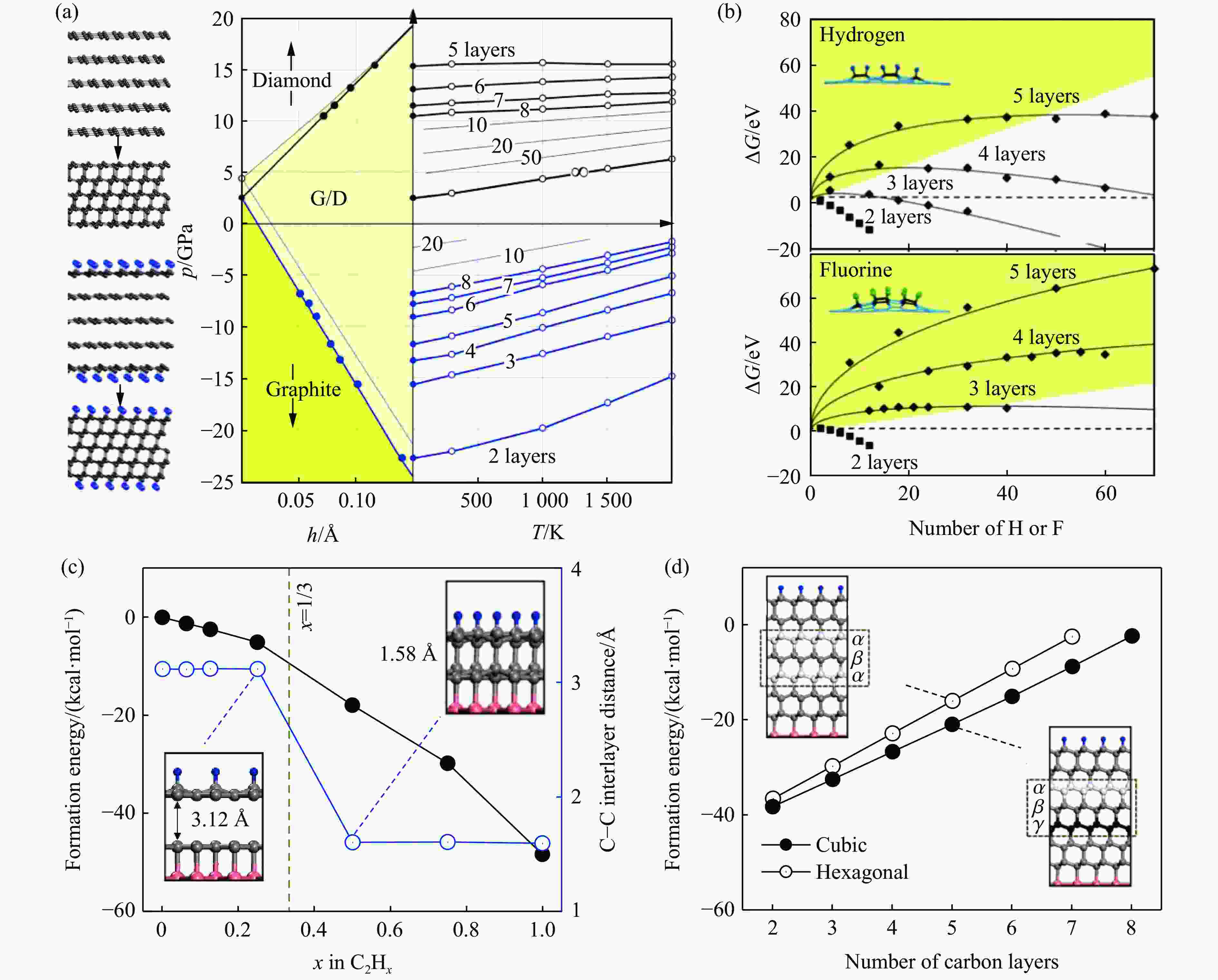
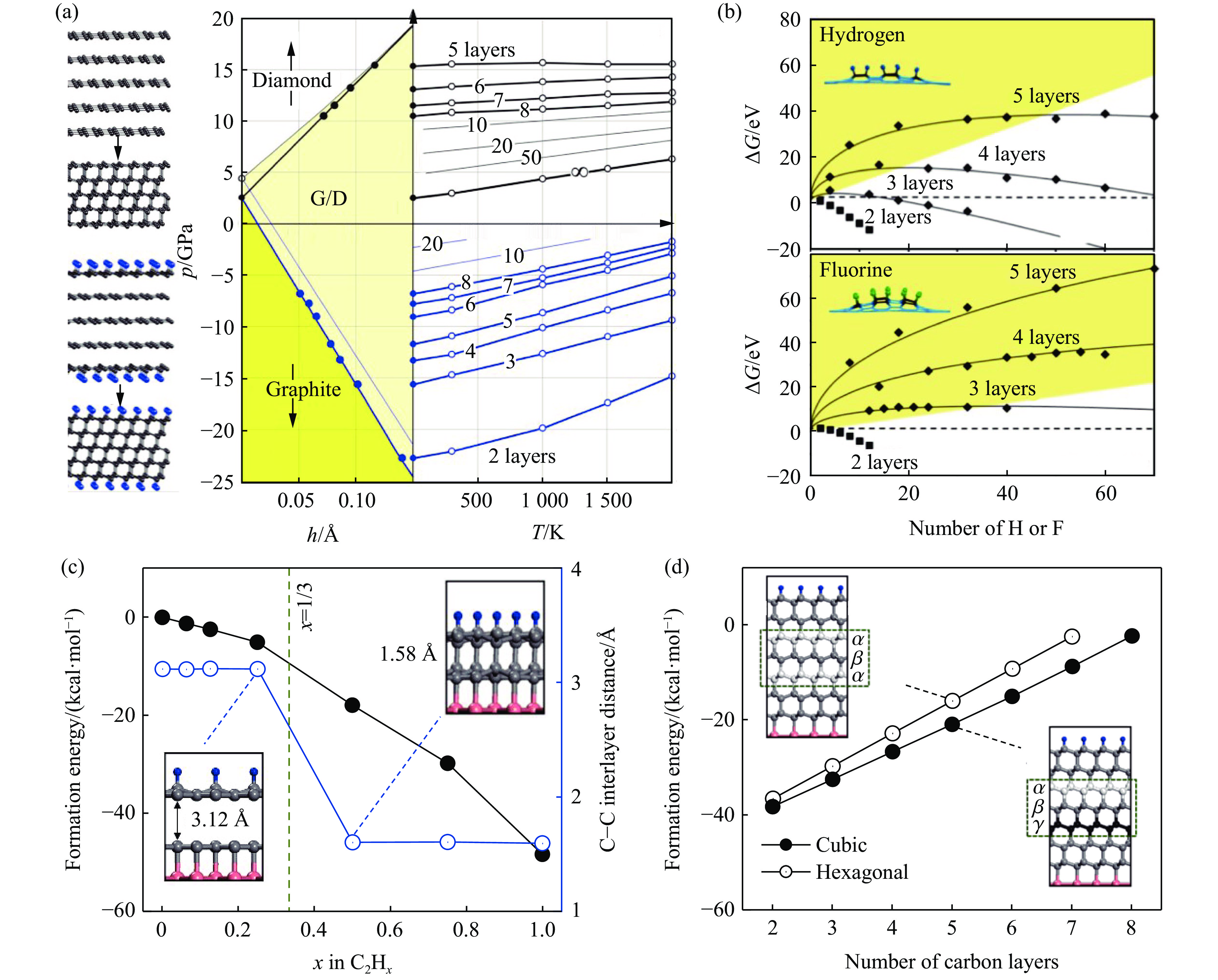
图 2 FLG向二维金刚石转变的理论计算结果:(a)未修饰与表面修饰的多层石墨烯及其相应金刚石薄膜的结构示意图,以及随层数依赖的压力-温度相图[17];(b)常压下不同层数氢化(上)、氟化(下)石墨烯的相对吉布斯自由能ΔG随吸附原子数目的变化关系[37];(c) Co (0001)表面上氢化BLG的形成能(实心)及C―C层间距(空心)随吸附氢覆盖度的变化关系[38];(d) Co (0001)表面上完全氢化的BLG的形成能随厚度的变化关系(实心与空心符号分别对应立方和六方金刚石)[38]
Figure 2. Theoretical calculations of the transition from FLG to 2D diamond: (a) atomic configurations of FLG and the corresponding diamond films with pristine and hydrogenated surfaces, along with the pressure-temperature phase diagram[17]; (b) Gibbs free energy evolution (ΔG) of hydrogenated (top) and fluorinated (bottom) as a function of the number of adsorbed atoms at ambient conditions[37]; (c) the dependences of formation energy and interlayer C―C spacing of BLG on Co (0001) on hydrogen coverage[38]; (d) formation energy of fully hydrogenated BLG on Co (0001) as a function of film thickness (Solid and open symbols correspond to the cubic and hexagonal diamond, respectively.)[38]
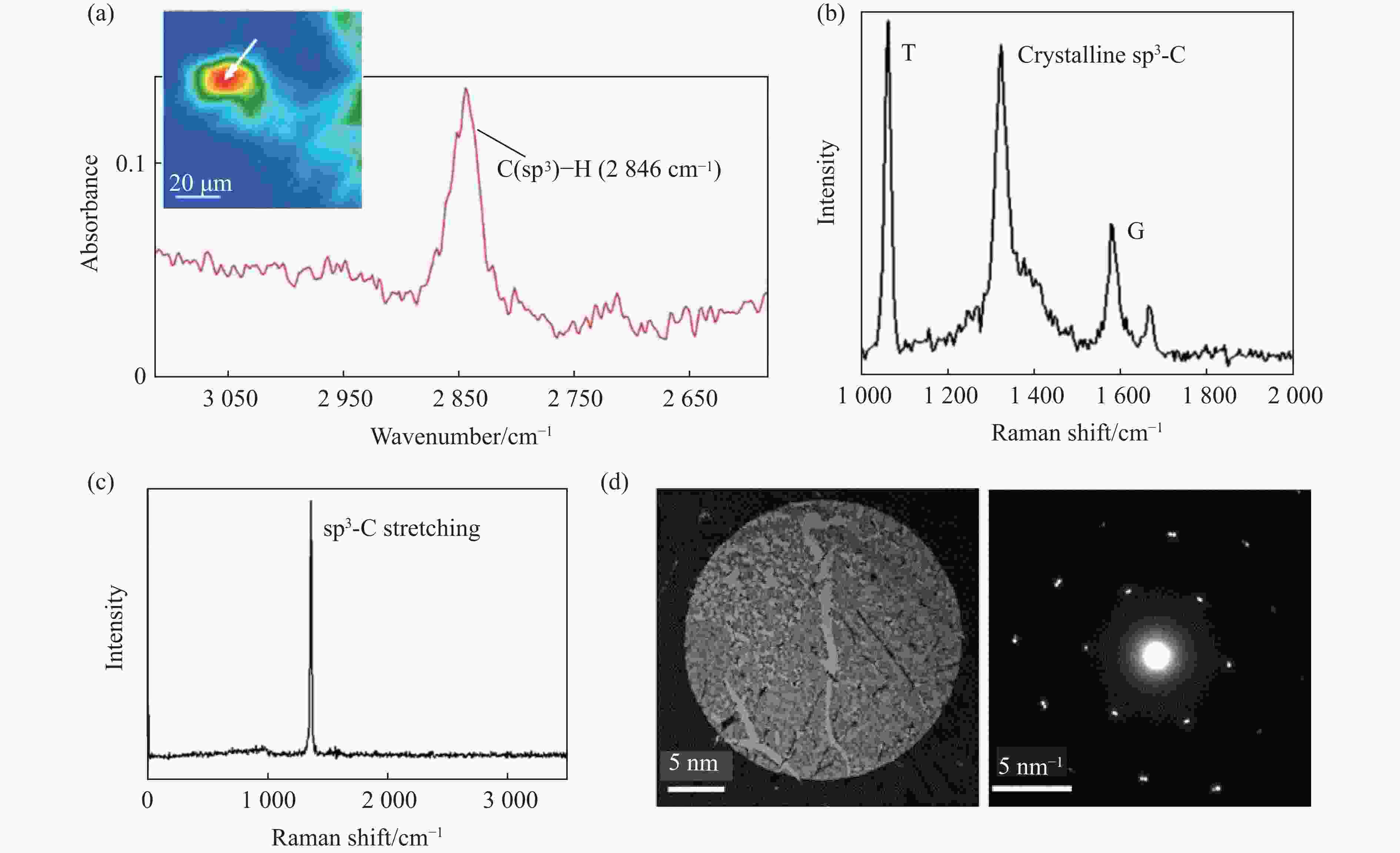
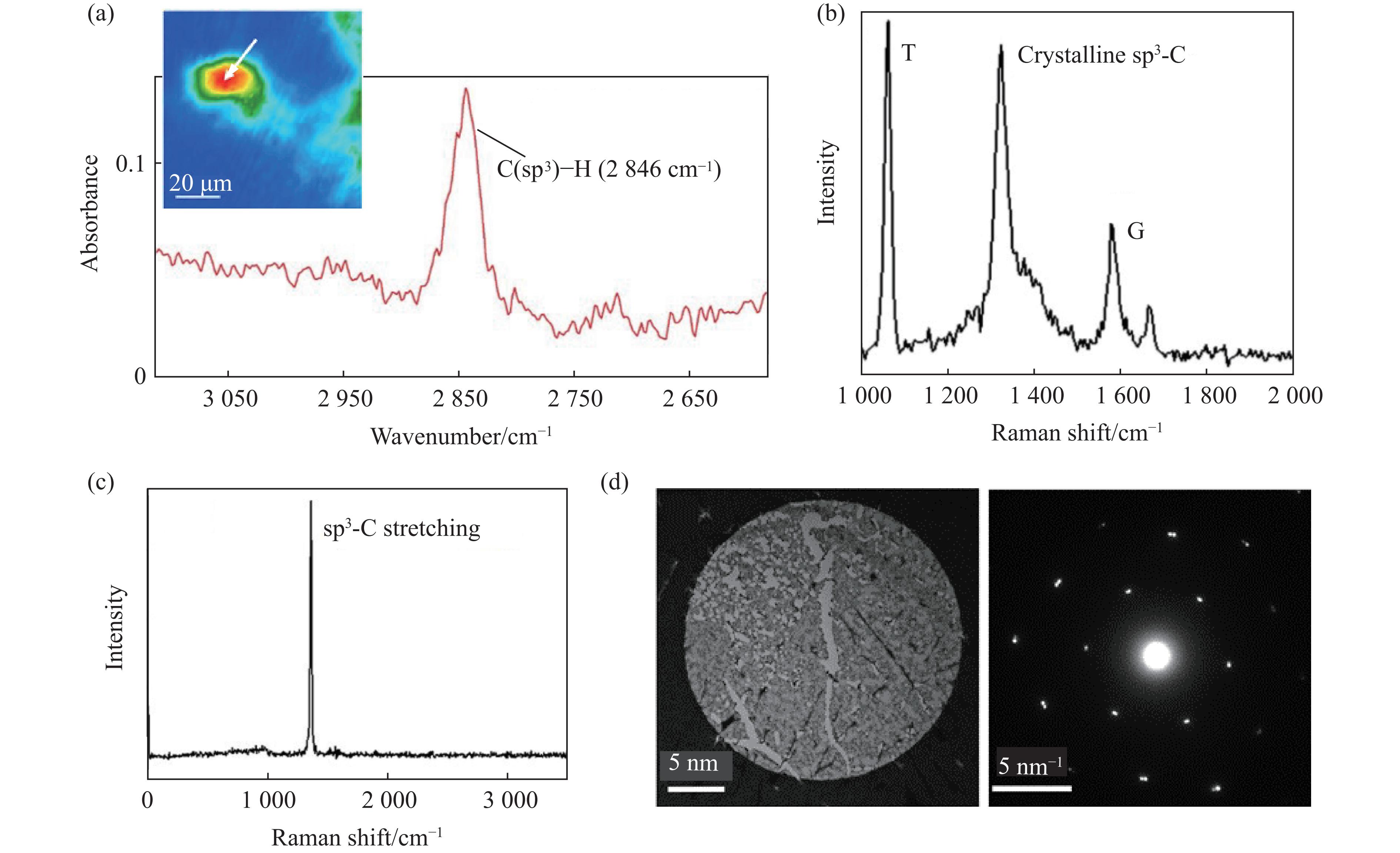
图 3 氢化二维金刚石的实验制备:(a) FLG氢化后的红外吸收光谱[47];(b) FLG氢化后的紫外拉曼光谱(T峰和结晶sp3-C峰的出现表明形成了氢化二维金刚石)[47];(c)氢化后BLG的典型紫外拉曼光谱,其具有明显的sp3-C伸缩振动特征峰[48];(d)氢化后双层石墨烯薄膜的TEM图像及相应的SAED图[48]
Figure 3. Experimental formation of hydrogenated 2D diamond: (a) typical infrared absorption spectrum of FLG after hydrogenation[47]; (b) ultraviolet (UV) Raman spectrum of hydrogenated FLG (The appearance of T band and the crystalline sp3-C peak indicate the formation of 2D diamond)[47]; (c) representative UV Raman spectrum of hydrogenated BLG, exhibiting a distinct sp3-C stretching feature[48]; (d) TEM image and corresponding SAED pattern of hydrogenated BLG[48]
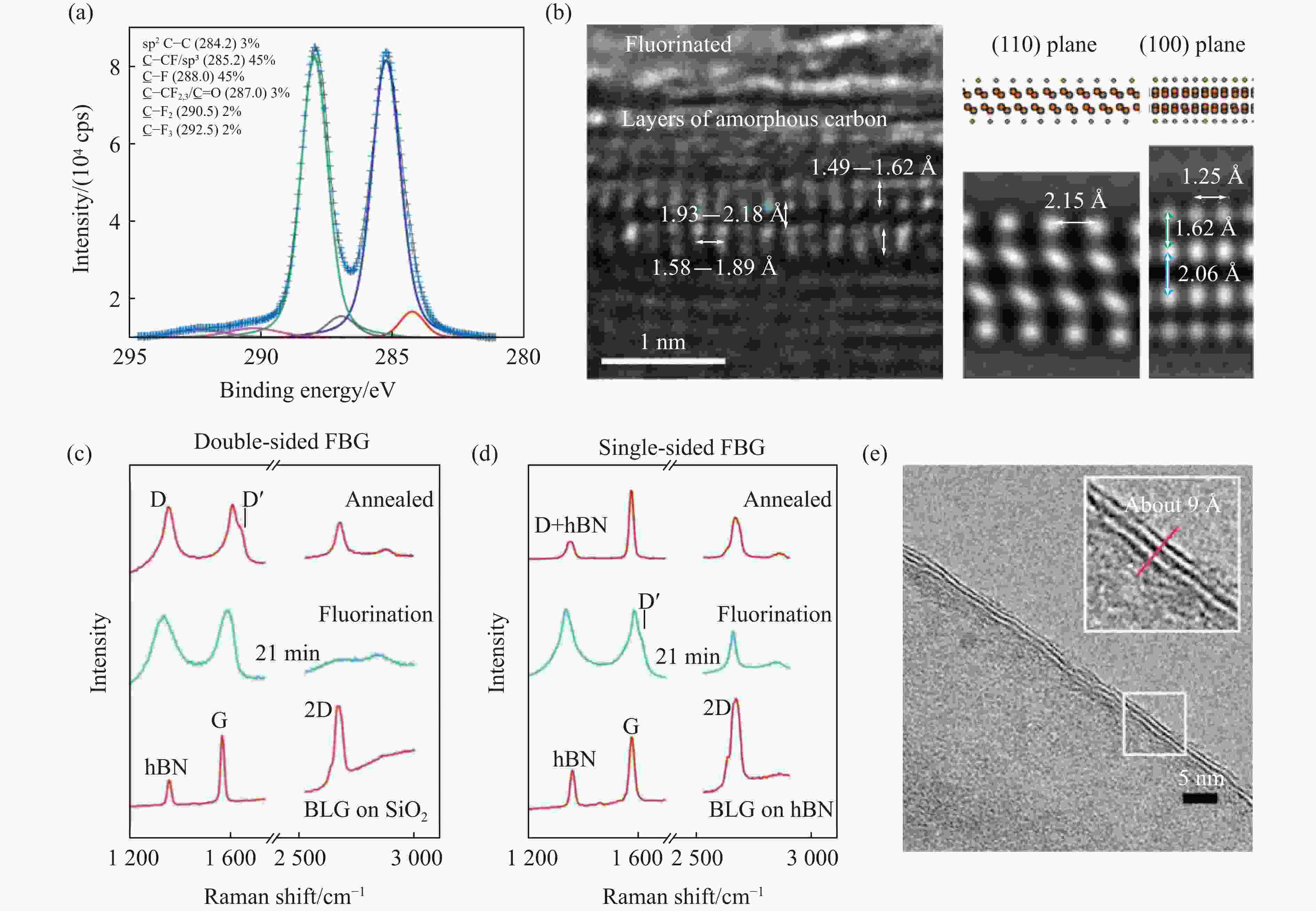
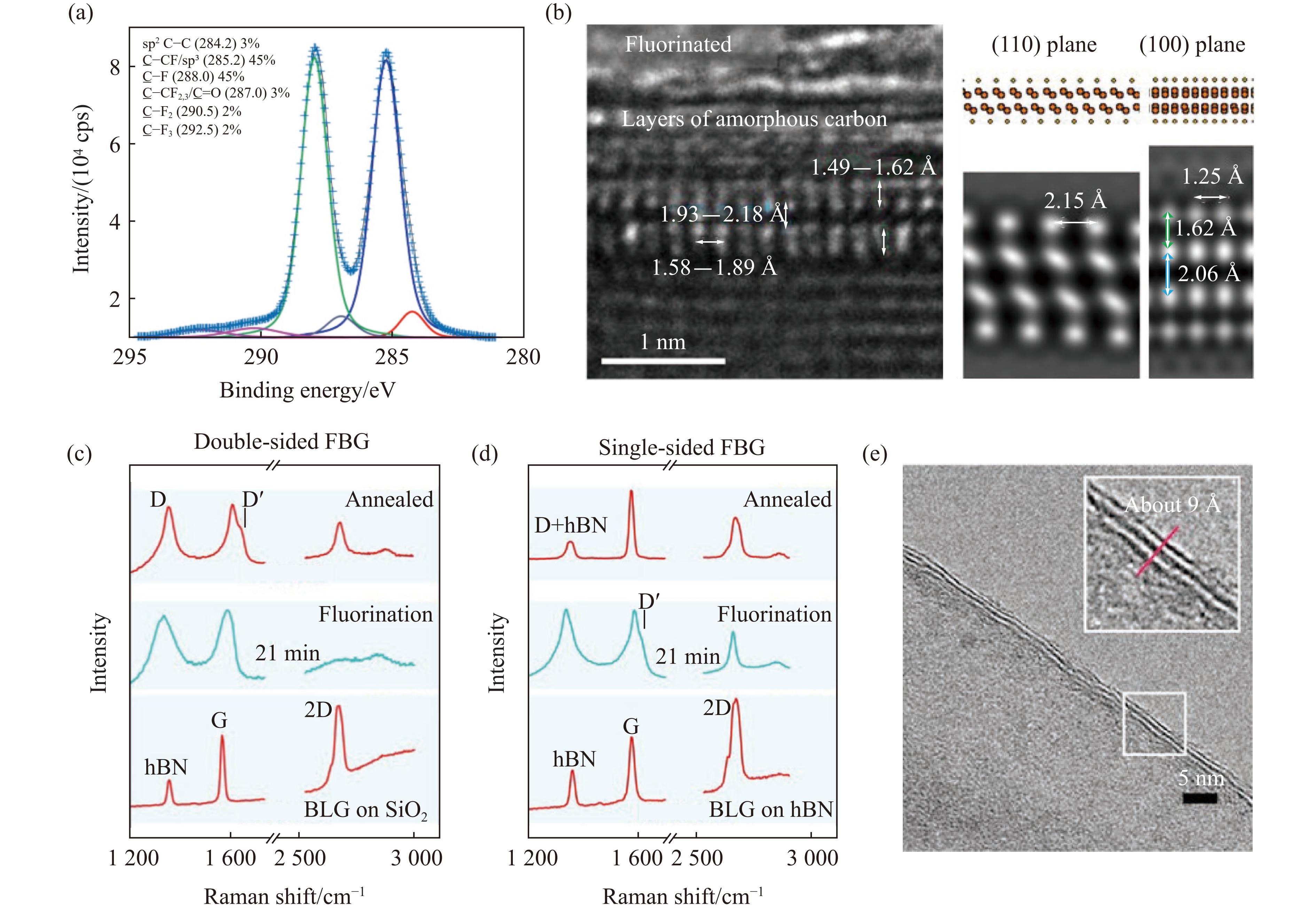
图 4 氟化二维金刚石的实验研究:(a) 氟化二维金刚石C1s的XPS光谱[22];(b) CuNi (111)基底上双层石墨烯氟化后的截面HRTEM图像及其DFT模拟结果[22];(c)~(d) 基底效应及不同基底表面双层石墨烯氟化过程的原位拉曼光谱,即 SiO2基底上的双面氟化和 hBN基底上的单面氟化[54];(e) 液相剥离得到的(C2F)n薄片TEM图像(插图为其边缘结构放大图,层间距约为0.9 nm)[55]
Figure 4. Experimental characterization of fluorinated 2D diamond: (a) XPS C1s spectrum of BLG after fluorination[22]; (b) cross-sectional HRTEM result of fluorinated BLG on the CuNi (111) and the corresponding DFT-simulated TEM images[22]; (c)−(d) in-situ Raman spectra of BLG during the fluorination on different substrates, showing double-sided fluorination on SiO2 and single-sided fluorination on hBN[54]; (e) TEM image of (C2F)n nanosheets obtained via liquid-phase exfoliation (The inset reveals the interlayer spacing is approximately 0.9 nm.)[55]
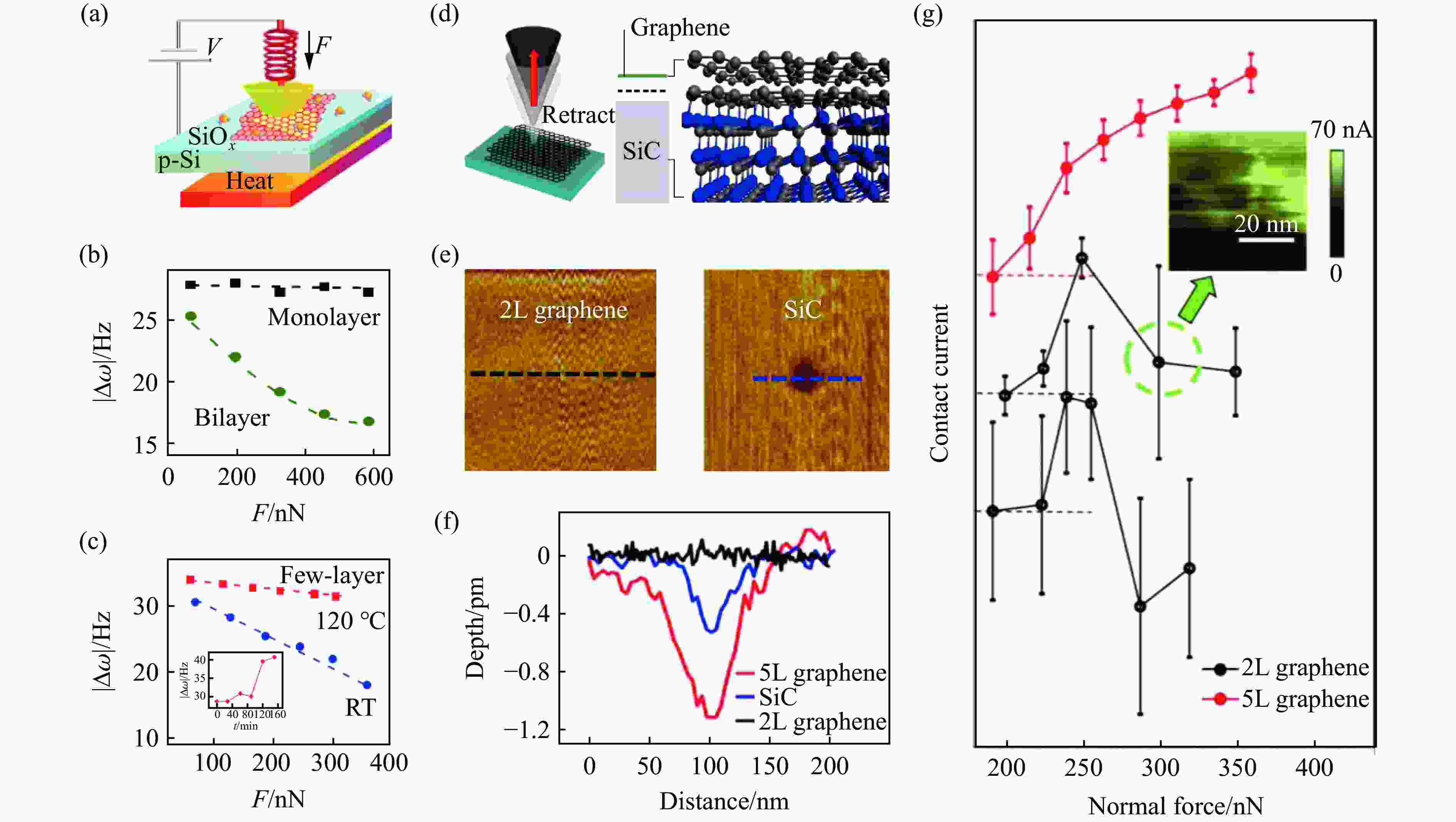
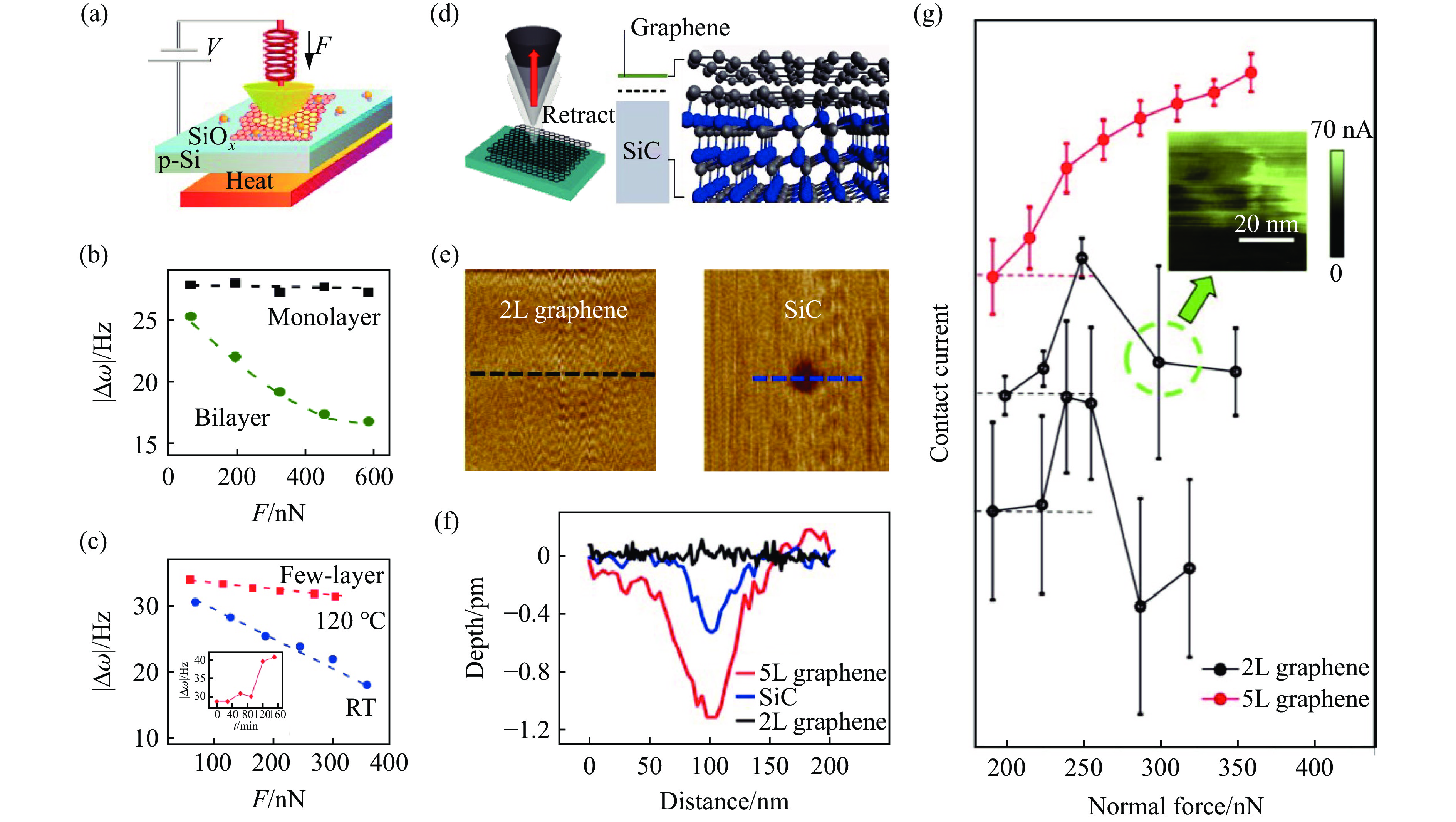
图 5 局部压力诱导的石墨烯向二维金刚石转变:(a) EFM实验技术示意图[21],(b) SiOx基底上单层(方形)和双层(圆圈)石墨烯的EFM响应|Δω|随压力F的变化[21],(c) FLG在不同温度下的EFM响应(插图为EFM响应随加热时间的变化)[21],(d)双层石墨烯在SiC基底上的纳米压痕示意图及压力诱导的二维金刚石结构模型[40],(e) 纳米压痕后双层石墨烯和SiC基底的残余压痕形貌[40],(f) 双层、5层石墨烯和SiC基底中残余压痕的横截面轮廓[40],(g) C-AFM测得的双层与5层石墨烯的平均电流随法向载荷的依赖关系[40]
Figure 5. Localized pressure induced graphene to 2D diamond: (a) schematic illustration of the EFM experimental technique[21]; (b) EFM responses |Δω| of monolayer (square) and bilayer (circle) graphene on a SiOₓ substrate as a function of the applied force F[21]; (c) EFM responses of FLG at different temperatures (The inset shows the EFM response of FLG as a function of duration time.)[21]; (d) schematic of the AFM tip indenting the epitaxial BLG on SiC surface and the corresponding pressure-induced 2D diamond formation[40]; (e) AFM topographical images of residual indentation morphologies of 2L graphene and SiC[40]; (f) cross-sectional profiles of residual indentations in 2L, 5L graphene and SiC[40]; (g) average current as a function of normal load measured by C-AFM on 2L, 5L graphene films[40]
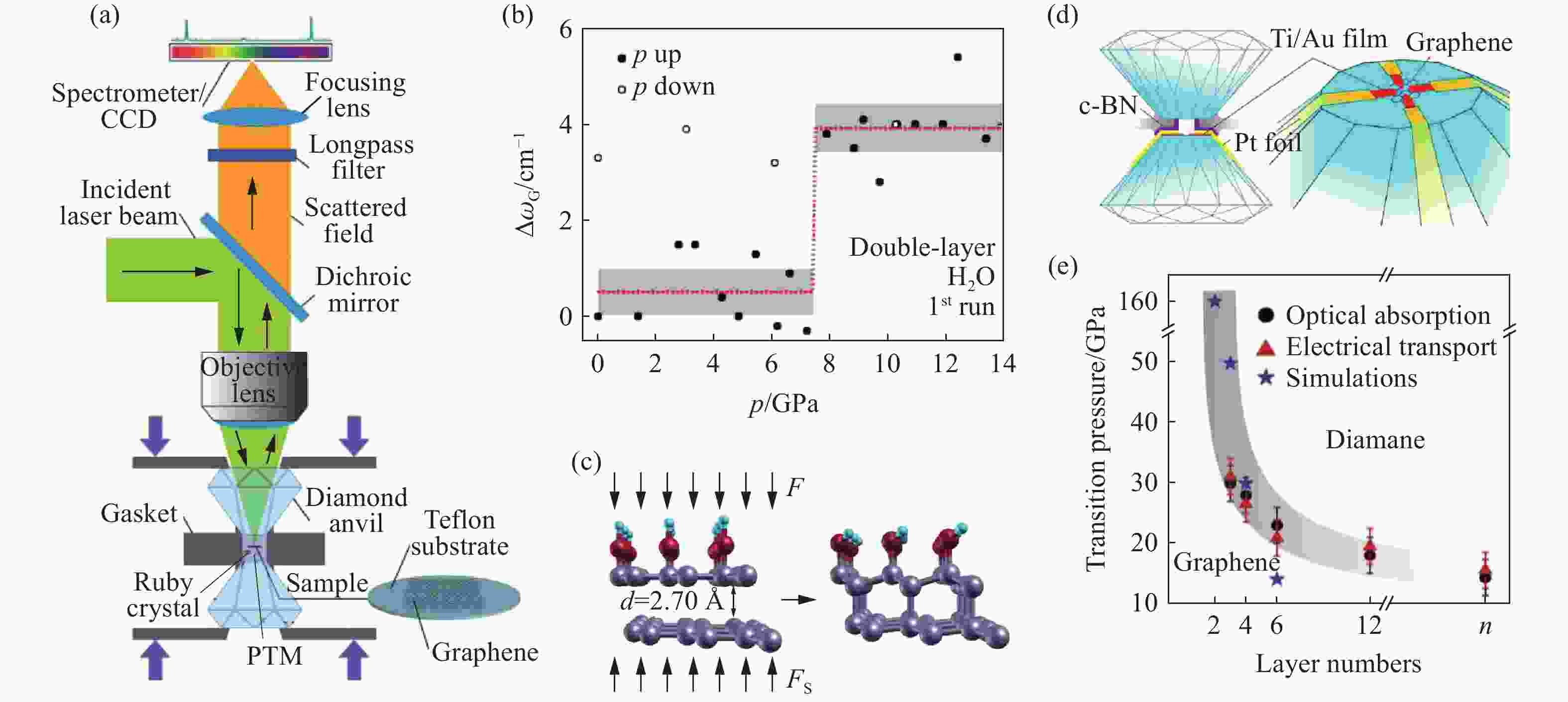
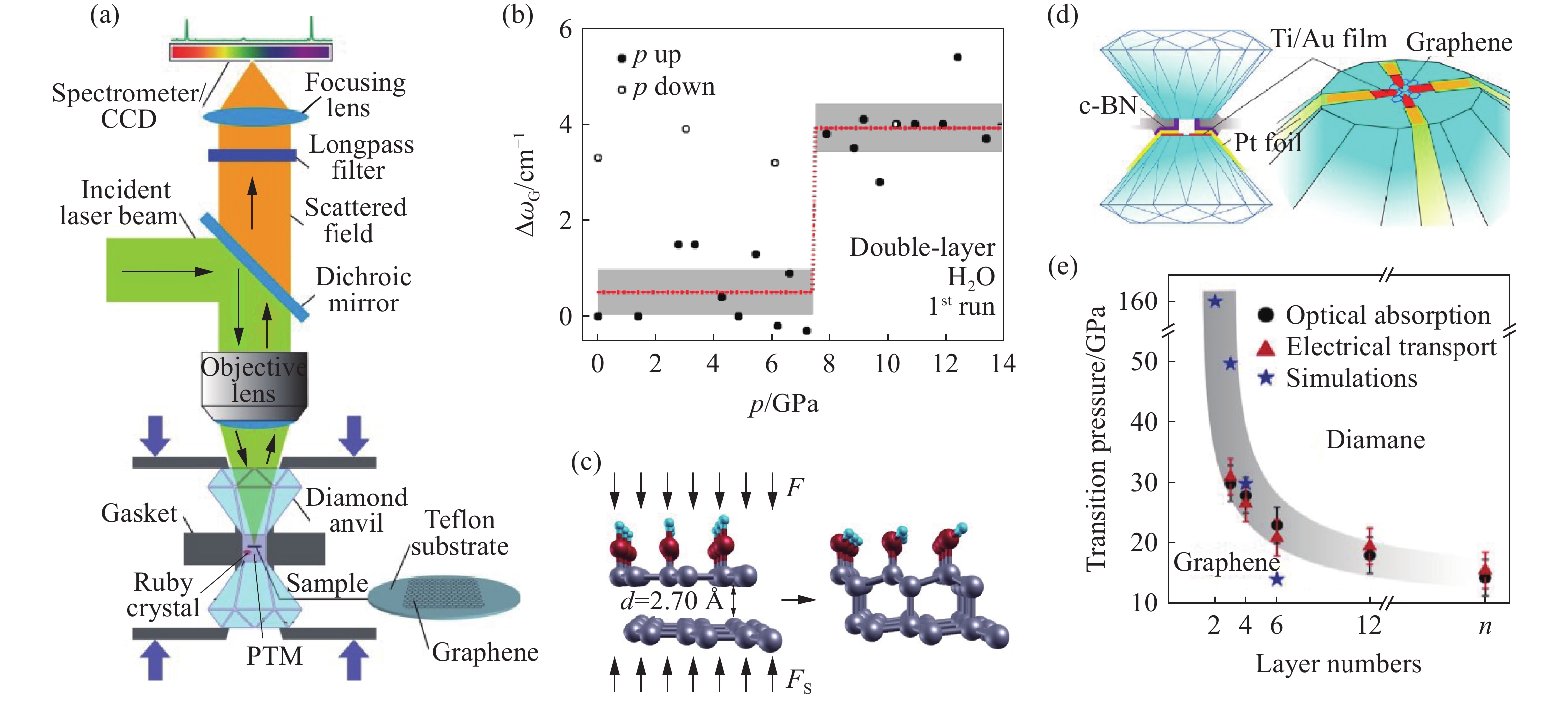
图 6 DAC极端高压诱导的石墨烯向二维金刚石转变:(a) DAC高压原位拉曼实验技术示意图[23];(b) 双层石墨烯的G峰频率差值ΔωG随压力的变化(ΔωG = ωG(EL=2.54 eV)– ωG(EL=2.33 eV))[23];(c)羟基化二维金刚石的形成过程示意图(蓝、红、灰球分别代表H、O和C原子)[23];(d) DAC中四端电学器件示意图[68];(e)石墨烯向二维金刚石的转变压力随层数的变化趋势[69]
Figure 6. Hydrostatic pressure induced transformation of graphene into 2D diamond in DAC; (a) schematic illustration of the in-situ high pressure Raman experimental technique in a DAC[23]; (b) pressure dependence of the G-band frequency difference (ΔωG=ωG(EL=2.54 eV)– ωG(EL=2.33 eV)) for BLG[23]; (c) schematic illustration of the formation of hydroxyl functionalized 2D diamond. (The blue, red, and gray spheres represent H, O, and C atoms, respectively)[23]; (d) schematic diagram of the four-terminal graphene nanodevice of graphene in the DAC[68]; (e) dependence of the transformation pressure from graphene to 2D diamond on layer number[69]
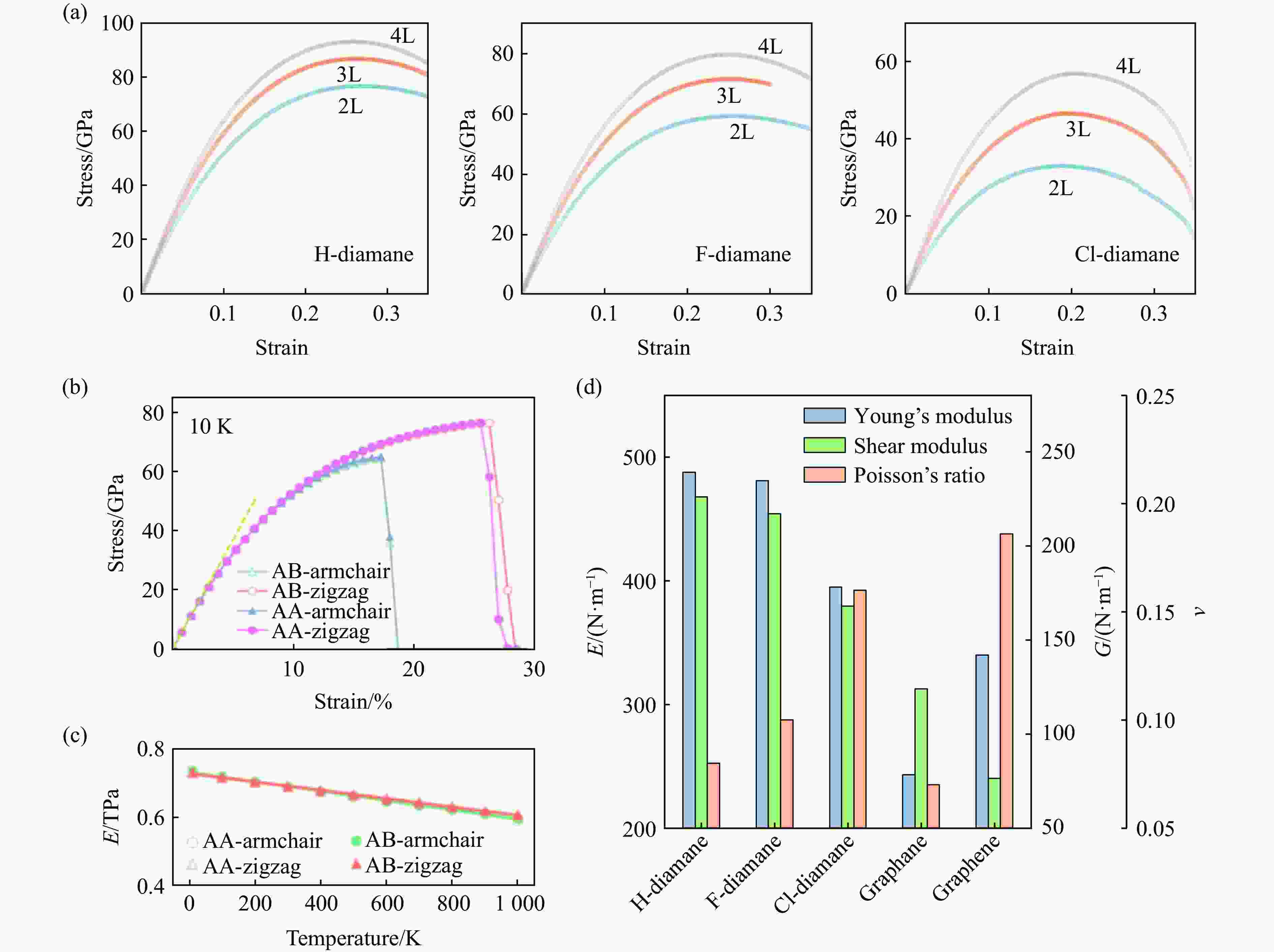
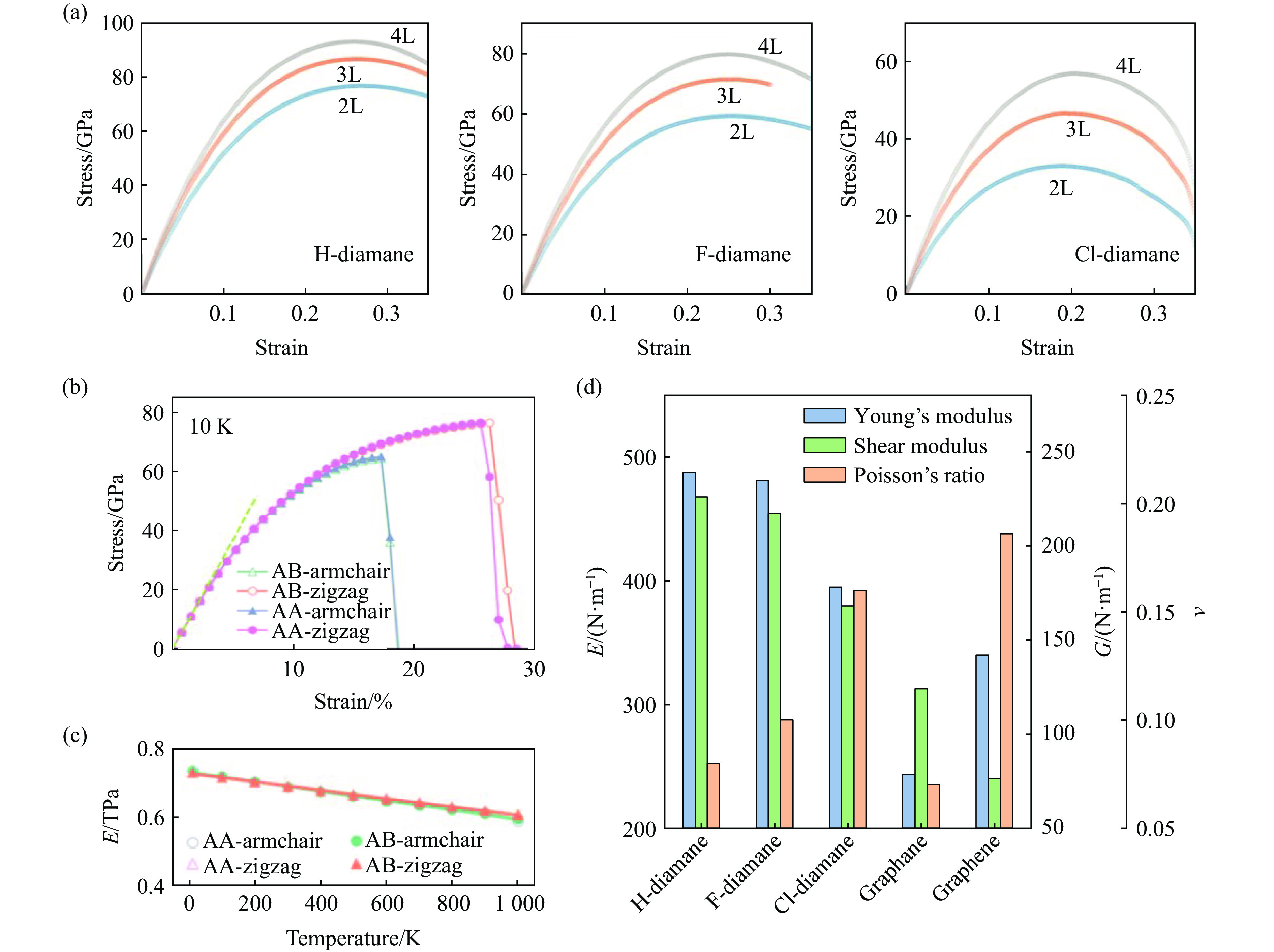
图 7 二维金刚石的力学性质:(a)不同层数的氢化、氟化和氯化二维金刚石的应力-应变曲线[73],(b) AB与AA堆垛氢化二维金刚石在10 K下的应力-应变曲线[75],(c)不同晶向氢化二维金刚石的杨氏模量随温度的变化关系[75],(d) 不同二维碳材料在面内杨氏模量(E)、剪切模量(G)和泊松比(ν)等力学性能方面的对比分析[73, 77–80]
Figure 7. Mechanical properties of diamane: (a) stress-strain curves of H-, F-, and Cl-diamane with different layer numbers[73]; (b) stress-strain curves of AB- and AA-stacked H-diamane at 10 K[75]; (c) temperature dependence of the Young’s modulus of hydrogenated 2D diamond[75]; (d) comparison of the in-plane Young’s modulus (E), shear modulus (G) and Poisson’s ratio (ν) among different 2D carbon nanomaterials[73, 77–80]
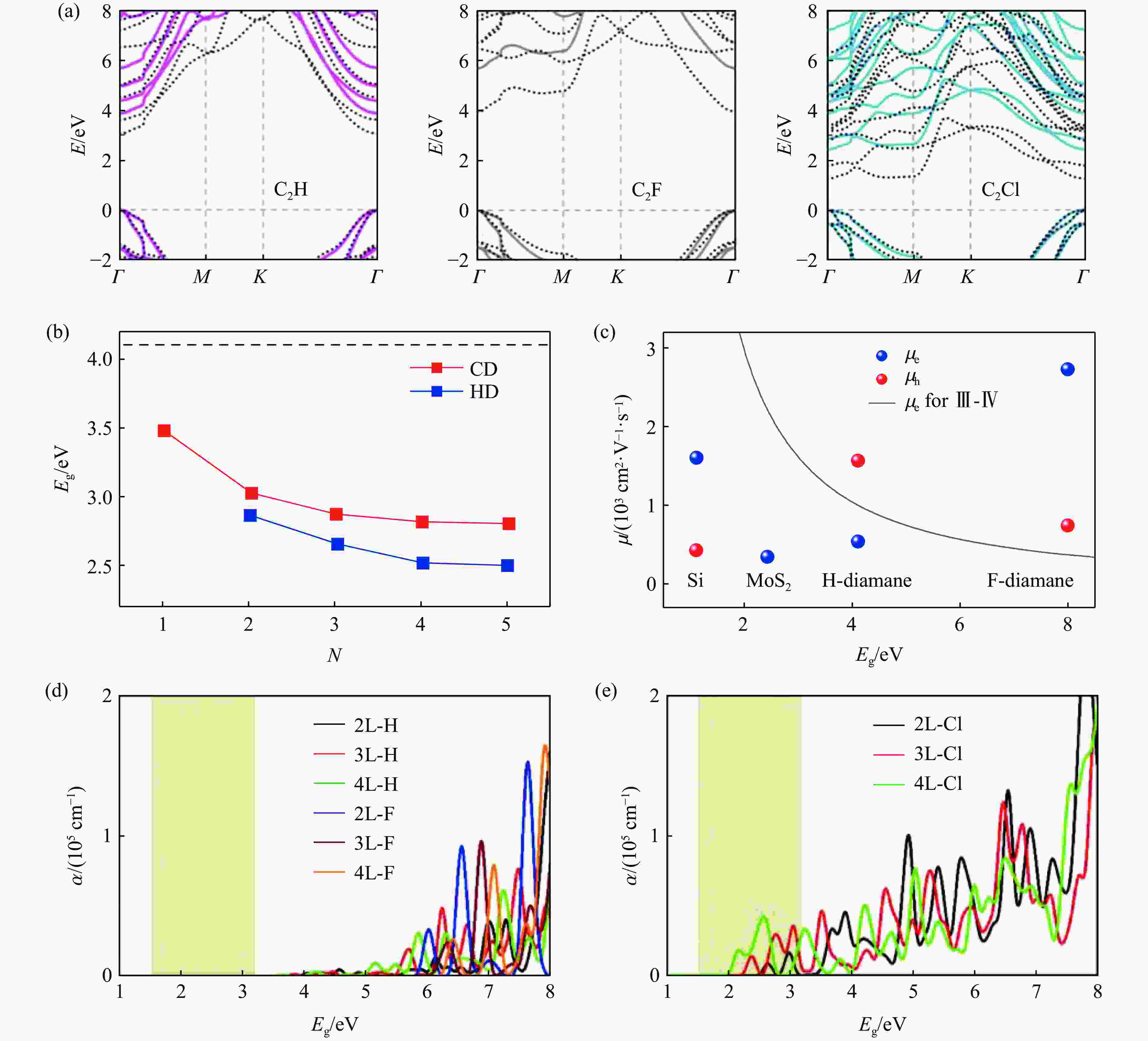
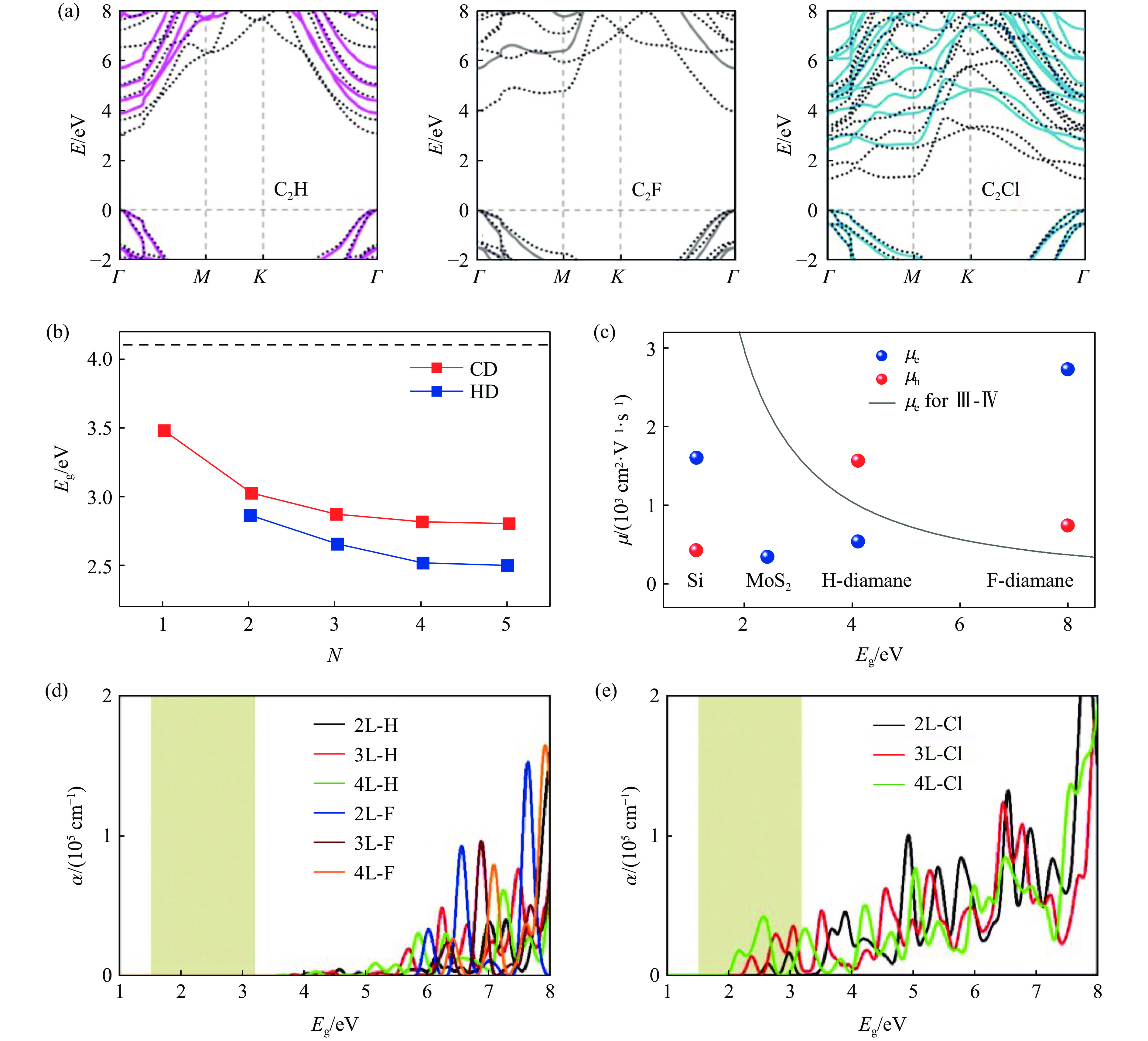
图 8 二维金刚石的电学与光学性质:(a) 氢化(左)、氟化(中)和氯化(右)二维金刚石的能带结构[30];(b) DFT计算的氢化二维金刚石带隙Eg随层数N的变化(虚线表示计算所得的体相金刚石带隙,红色与蓝色分别对应立方和六方金刚石相);(c) 氟化和氢化二维金刚石中载流子迁移率μ与带隙Eg的关系,与传统Ⅲ-Ⅳ族半导体进行对比(实线表示经验关系$ \mu=0.83\times10^4E_{\mathrm{g}}^{-3/2} $。电子与空穴迁移率(μe、μh)分别为红色与蓝色符号)[78];基于HSE06方法预测的氢化、氟化(d)和氯化(e)二维金刚石的光吸收特性[73]
Figure 8. Electronic and optical properties of diamane: (a) band structures of H-, F-, and Cl-diamane[30]; (b) bandgap of H-diamane as a function of layer number N obtained by DFT (The dashed line represents the bandgap of bulk diamond. The red and blue symbols represent cubic and hexagonal diamond, respectively.); (c) relationship between carrier mobility (μ) and bandgap (Eg) of diamane, compared with bulk Ⅲ-Ⅳ semiconductors (The solid line follows the empirical relation $ \mu=0.83\times10^4E_{\mathrm{g}}^{-3/2} $. Electron (μe) and hole mobilities (μh) correspond to the red and blue symbols, respectively.)[78]; optical absorption spectra of H-, F-diamane (d) and Cl-diamane (e) predicted using the HSE06 method[73]
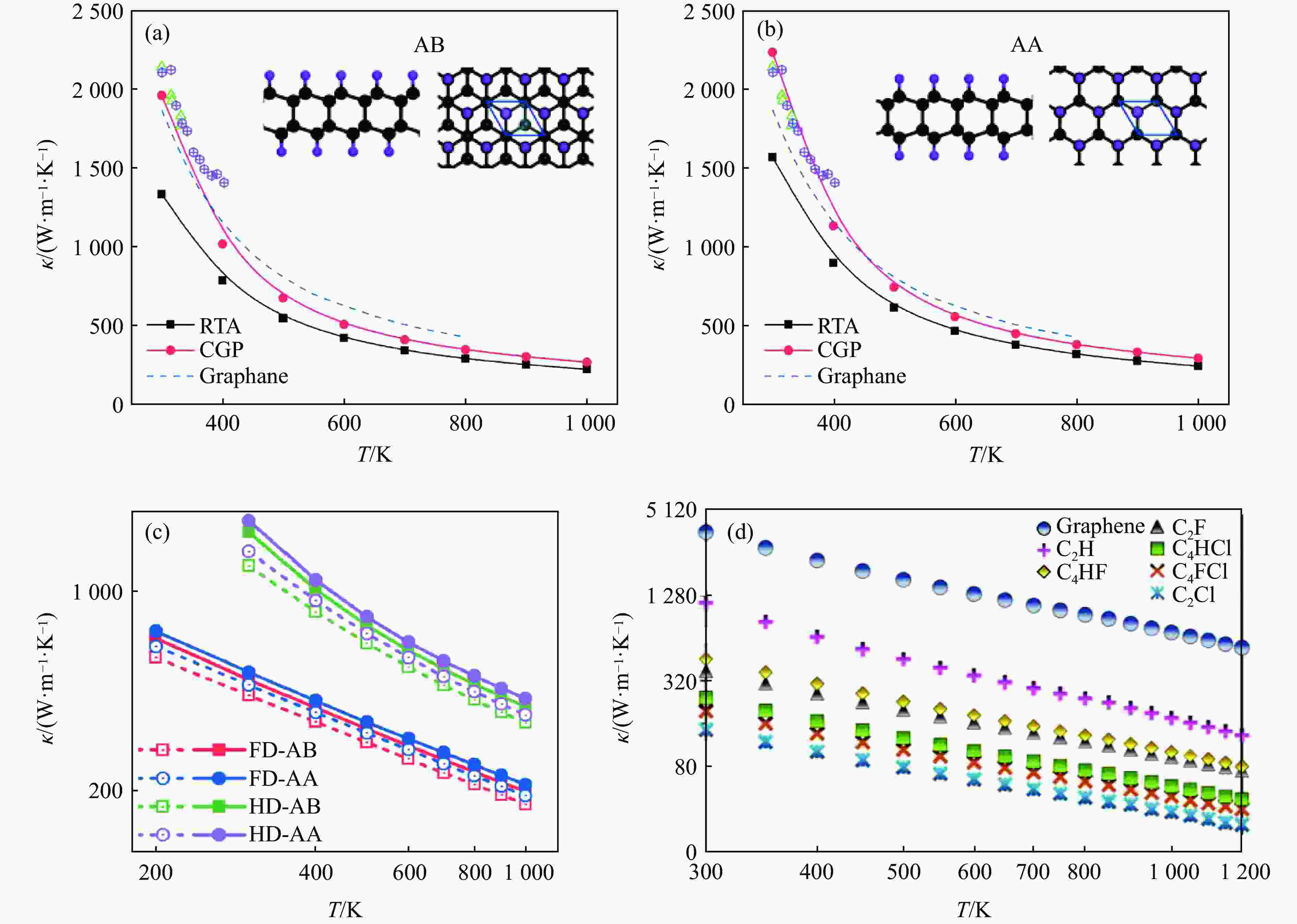
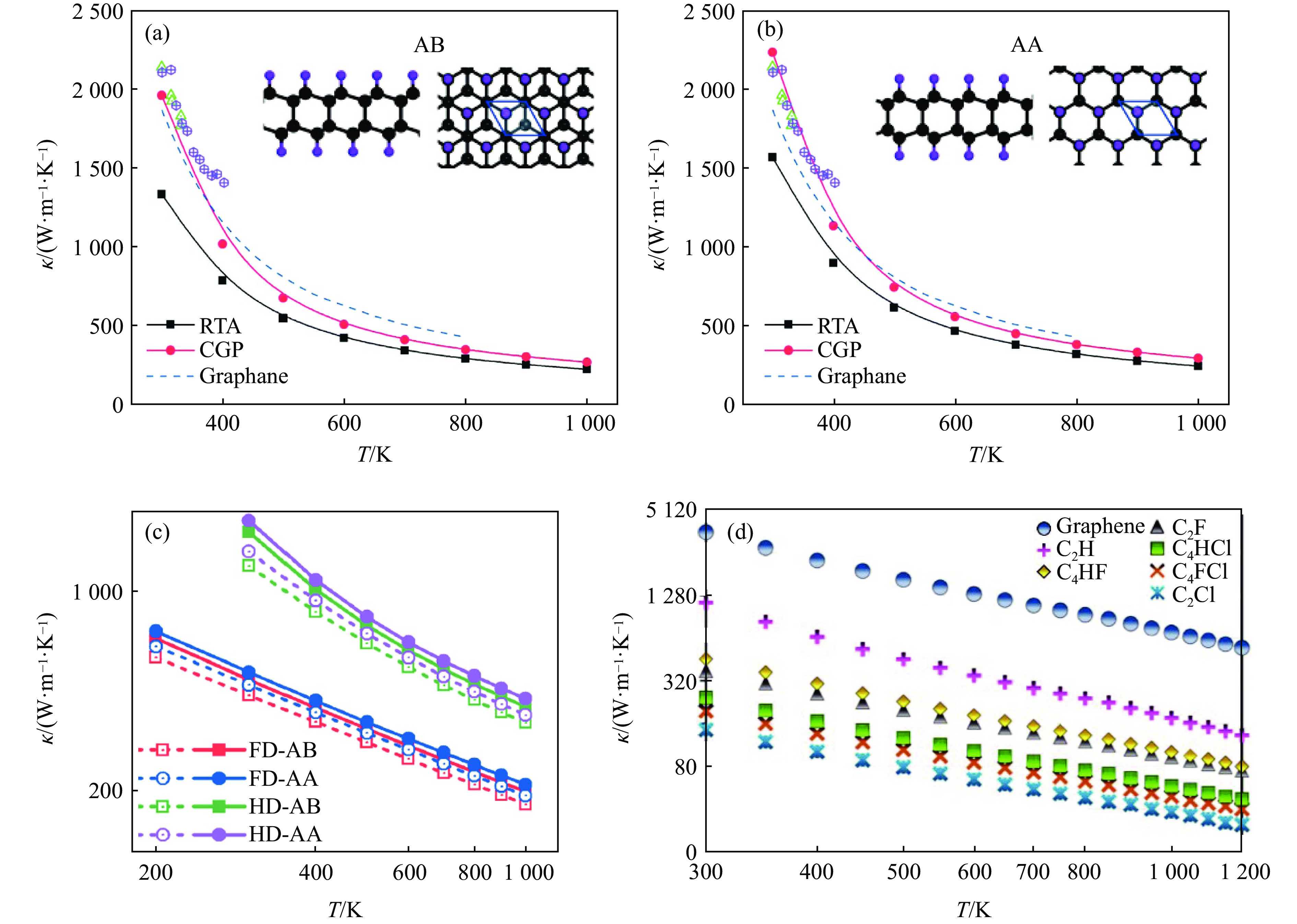
图 9 二维金刚石的热导率:理论计算得到的AB堆垛(a) 与AA堆垛(b) 氢化二维金刚石热导率随温度的变化曲线(蓝色虚线为石墨烷热导率,三角形与六边形为实验测得的体相金刚石热导率)[90];(c) 不同堆垛氟化与氢化二维金刚石的热导率与温度的关系,并与RTA(虚线)与CGP(实线)计算结果作对比[91];(d) 基于MTP方法计算的非Janus与Janus二维金刚石热导率随温度变化关系[30]
Figure 9. Thermal conductivity of diamane: temperature-dependent thermal conductivity of H-diamane with AB (a) and AA (b) stacking configurations (The blue dashed line indicates the thermal conductivity of graphane, while the triangles and hexagons represent the experimentally measured values of bulk diamond.)[90]; (c) thermal conductivities of H- and F-diamane obtained based on the RTA (dashed lines) and the CGP (solid lines) methods[91]; (d) thermal conductivities of non-Janus and Janus diamanes as a function of temperature using MTP method[30]
-
[1] NOVOSELOV K S, GEIM A K, MOROZOV S V, et al. Electric field effect in atomically thin carbon films [J]. Science, 2004, 306(5696): 666–669. doi: 10.1126/science.1102896 [2] MIRÓ P, AUDIFFRED M, HEINE T. An atlas of two-dimensional materials [J]. Chemical Society Reviews, 2014, 43(18): 6537–6554. doi: 10.1039/C4CS00102H [3] XIA F N, WANG H, XIAO D, et al. Two-dimensional material nanophotonics [J]. Nature Photonics, 2014, 8(12): 899–907. doi: 10.1038/nphoton.2014.271 [4] BUTLER S Z, HOLLEN S M, CAO L Y, et al. Progress, challenges, and opportunities in two-dimensional materials beyond graphene [J]. ACS Nano, 2013, 7(4): 2898–2926. doi: 10.1021/nn400280c [5] DU G S, ZHAO L L, LI S C, et al. Interlayer engineering of lattice dynamics and elastic constants of 2D layered nanomaterials under pressure [J]. Nature Communications, 2025, 16(1): 4901. doi: 10.1038/s41467-025-60211-8 [6] HAN W X, FENG J J, DONG H L, et al. Pressure-modulated structural and magnetic phase transitions in two-dimensional FeTe: tetragonal and hexagonal polymorphs [J]. Nano Letters, 2024, 24(3): 966–974. doi: 10.1021/acs.nanolett.3c04384 [7] GEIM A K. Graphene: status and prospects [J]. Science, 2009, 324(5934): 1530–1534. doi: 10.1126/science.1158877 [8] BOLOTIN K I, GHAHARI F, SHULMAN M D, et al. Observation of the fractional quantum Hall effect in graphene [J]. Nature, 2009, 462(7270): 196–199. doi: 10.1038/nature08582 [9] CAO Y, FATEMI V, FANG S A, et al. Unconventional superconductivity in magic-angle graphene superlattices [J]. Nature, 2018, 556(7699): 43–50. doi: 10.1038/nature26160 [10] ZHANG Y B, TAN Y W, STORMER H L, et al. Experimental observation of the quantum Hall effect and Berry’s phase in graphene [J]. Nature, 2005, 438(7065): 201–204. doi: 10.1038/nature04235 [11] NOVOSELOV K S, JIANG Z, ZHANG Y, et al. Room-temperature quantum Hall effect in graphene [J]. Science, 2007, 315(5817): 1379–1379. doi: 10.1126/science.1137201 [12] CARBERY W P, FARFAN C A, ULBRICHT R, et al. The phonon-modulated Jahn-Teller distortion of the nitrogen vacancy center in diamond [J]. Nature Communications, 2024, 15(1): 8646. doi: 10.1038/s41467-024-52712-9 [13] PRAWER S, GREENTREE A D. Diamond for quantum computing [J]. Science, 2008, 320(5883): 1601–1602. doi: 10.1126/science.1158340 [14] TANIGAKI K, OGI H, SUMIYA H, et al. Observation of higher stiffness in nanopolycrystal diamond than monocrystal diamond [J]. Nature Communications, 2013, 4(1): 2343. doi: 10.1038/ncomms3343 [15] MOCHALIN V N, SHENDEROVA O, HO D, et al. The properties and applications of nanodiamonds [J]. Nature Nanotechnology, 2012, 7(1): 11–23. doi: 10.1038/nnano.2011.209 [16] MING J X, TIAN J Y, ZHAO L M, et al. Dimensionality effect of nanocarbon precursors on diamond synthesis under extreme conditions [J]. Advanced Materials, 2025, 37(42): e11137. doi: 10.1002/adma.202511137 [17] KVASHNIN A G, CHERNOZATONSKII L A, YAKOBSON B I, et al. Phase diagram of quasi-two-dimensional carbon, from graphene to diamond [J]. Nano Letters, 2014, 14(2): 676–681. doi: 10.1021/nl403938g [18] SOROKIN P B, YAKOBSON B I. Two-dimensional diamond—diamane: current state and further prospects [J]. Nano Letters, 2021, 21(13): 5475–5484. doi: 10.1021/acs.nanolett.1c01557 [19] PETIT T, ARNAULT J C, GIRARD H A, et al. Early stages of surface graphitization on nanodiamond probed by X-ray photoelectron spectroscopy [J]. Physical Review B, 2011, 84(23): 233407. doi: 10.1103/PhysRevB.84.233407 [20] SHANG N G, PAPAKONSTANTINOU P, WANG P, et al. Self-assembled growth, microstructure, and field-emission high-performance of ultrathin diamond nanorods [J]. ACS Nano, 2009, 3(4): 1032–1038. doi: 10.1021/nn900167p [21] BARBOZA A P M, GUIMARAES M H D, MASSOTE D V P, et al. Room-temperature compression-induced diamondization of few-layer graphene [J]. Advanced Materials, 2011, 23(27): 3014–3017. doi: 10.1002/adma.201101061 [22] BAKHAREV P V, HUANG M, SAXENA M, et al. Chemically induced transformation of chemical vapour deposition grown bilayer graphene into fluorinated single-layer diamond [J]. Nature Nanotechnology, 2020, 15(1): 59–66. doi: 10.1038/s41565-019-0582-z [23] MARTINS L G P, MATOS M J S, PASCHOAL A R, et al. Raman evidence for pressure-induced formation of diamondene [J]. Nature Communications, 2017, 8(1): 96. doi: 10.1038/s41467-017-00149-8 [24] TOMILIN L F, EROHIN S V, NEBOGATIKOVA N A, et al. 2D diamond structures in multilayer graphene: simulation and experimental observation [J]. Carbon, 2024, 220: 118832. doi: 10.1016/j.carbon.2024.118832 [25] EMELIN E V, CHO H D, KOREPANOV V I, et al. Formation of diamane nanostructures in bilayer graphene on langasite under irradiation with a focused electron beam [J]. Nanomaterials, 2022, 12(24): 4408. doi: 10.3390/nano12244408 [26] CHERNOZATONSKII L A, SOROKIN P B, KVASHNIN A G, et al. Diamond-like C2H nanolayer, diamane: simulation of the structure and properties [J]. JETP Letters, 2009, 90(2): 134–138. doi: 10.1134/S0021364009140112 [27] SOFO J O, CHAUDHARI A S, BARBER G D. Graphane: a two-dimensional hydrocarbon [J]. Physical Review B, 2007, 75(15): 153401. doi: 10.1103/PhysRevB.75.153401 [28] CELLINI F, LAVINI F, CAO T F, et al. Epitaxial two-layer graphene under pressure: diamene stiffer than diamond [J]. FlatChem, 2018, 10: 8–13. doi: 10.1016/j.flatc.2018.08.001 [29] PIAZZA F, MONTHIOUX M, PUECH P, et al. Towards a better understanding of the structure of diamanoïds and diamanoïd/graphene hybrids [J]. Carbon, 2020, 156: 234–241. doi: 10.1016/j.carbon.2019.09.057 [30] RAEISI M, MORTAZAVI B, PODRYABINKIN E V, et al. High thermal conductivity in semiconducting Janus and non-Janus diamanes [J]. Carbon, 2020, 167: 51–61. doi: 10.1016/j.carbon.2020.06.007 [31] ELIAS D C, NAIR R R, MOHIUDDIN T M G, et al. Control of graphene’s properties by reversible hydrogenation: evidence for graphane [J]. Science, 2009, 323(5914): 610–613. doi: 10.1126/science.1167130 [32] KVASHNIN A G, AVRAMOV P V, KVASHNIN D G, et al. Features of electronic, mechanical, and electromechanical properties of fluorinated diamond films of nanometer thickness [J]. The Journal of Physical Chemistry C, 2017, 121(51): 28484–28489. doi: 10.1021/acs.jpcc.7b07946 [33] QIU D C, ZHANG Z L, LI J, et al. Structural and electronic properties of two-dimensional (110) diamond nanofilms by first-principles calculations [J]. Diamond and Related Materials, 2018, 84: 55–61. doi: 10.1016/j.diamond.2018.03.003 [34] SUN Z L, QIU D C, GAO N, et al. Structural and electronic properties of two-dimensional atomically thick (100) diamond nanofilms by first-principles calculations [J]. Journal of Applied Physics, 2019, 125(21): 215301. doi: 10.1063/1.5094717 [35] ANTIPINA L Y, SOROKIN P B. Converting chemically functionalized few-layer graphene to diamond films: a computational study [J]. The Journal of Physical Chemistry C, 2015, 119(5): 2828–2836. doi: 10.1021/jp510390b [36] VARLAMOVA L A, EROHIN S V, LARIONOV K V, et al. Diamane oxide. two-dimensional film with mixed coverage and a variety of electronic properties [J]. The Journal of Physical Chemistry Letters, 2022, 13(49): 11383–11390. doi: 10.1021/acs.jpclett.2c02943 [37] EROHIN S V, RUAN Q Y, SOROKIN P B, et al. Nano-thermodynamics of chemically induced graphene-diamond transformation [J]. Small, 2020, 16(47): 2004782. doi: 10.1002/smll.202004782 [38] ODKHUU D, SHIN D, RUOFF R S, et al. Conversion of multilayer graphene into continuous ultrathin sp3-bonded carbon films on metal surfaces [J]. Scientific Reports, 2013, 3(1): 3276. doi: 10.1038/srep03276 [39] RAJASEKARAN S, ABILD-PEDERSEN F, OGASAWARA H, et al. Interlayer carbon bond formation induced by hydrogen adsorption in few-layer supported graphene [J]. Physical Review Letters, 2013, 111(8): 085503. doi: 10.1103/PhysRevLett.111.085503 [40] GAO Y, CAO T F, CELLINI F, et al. Ultrahard carbon film from epitaxial two-layer graphene [J]. Nature Nanotechnology, 2018, 13(2): 133–138. doi: 10.1038/s41565-017-0023-9 [41] 高楠, 刘亚宁, 李红东. 二维金刚石的结构与性质若干进展 [J]. 半导体光电, 2022, 43(3): 472–478. doi: 10.16818/j.issn1001-5868.2022061201GAO N, LIU Y N, LI H D. Recent progresses on structure and properties of two-dimensional diamond [J]. Semiconductor Optoelectronics, 2022, 43(3): 472–478. doi: 10.16818/j.issn1001-5868.2022061201 [42] LEENAERTS O, PARTOENS B, PEETERS F M. Hydrogenation of bilayer graphene and the formation of bilayer graphane from first principles [J]. Physical Review B, 2009, 80(24): 245422. doi: 10.1103/PhysRevB.80.245422 [43] LAVINI F, REJHON M, RIEDO E. Two-dimensional diamonds from sp2-to-sp3 phase transitions [J]. Nature Reviews Materials, 2022, 7(10): 814–832. doi: 10.1038/s41578-022-00451-y [44] BOUKHVALOV D W, KATSNELSON M I, LICHTENSTEIN A I. Hydrogen on graphene: electronic structure, total energy, structural distortions and magnetism from first-principles calculations [J]. Physical Review B, 2008, 77(3): 035427. doi: 10.1103/PhysRevB.77.035427 [45] DUPLOCK E J, SCHEFFLER M, LINDAN P J D. Hallmark of perfect graphene [J]. Physical Review Letters, 2004, 92(22): 225502. doi: 10.1103/PhysRevLett.92.225502 [46] LUO Z Q, YU T, KIM K J, et al. Thickness-dependent reversible hydrogenation of graphene layers [J]. ACS Nano, 2009, 3(7): 1781–1788. doi: 10.1021/nn900371t [47] PIAZZA F, GOUGH K, MONTHIOUX M, et al. Low temperature, pressureless sp2 to sp3 transformation of ultrathin, crystalline carbon films [J]. Carbon, 2019, 145: 10–22. doi: 10.1016/j.carbon.2019.01.017 [48] PIAZZA F, CRUZ K, MONTHIOUX M, et al. Raman evidence for the successful synthesis of diamane [J]. Carbon, 2020, 169: 129–133. doi: 10.1016/j.carbon.2020.07.068 [49] PUMERA M, WONG C H A. Graphane and hydrogenated graphene [J]. Chemical Society Reviews, 2013, 42(14): 5987–5995. doi: 10.1039/c3cs60132c [50] ROBINSON J T, BURGESS J S, JUNKERMEIER C E, et al. Properties of fluorinated graphene films [J]. Nano Letters, 2010, 10(8): 3001–3005. doi: 10.1021/nl101437p [51] JEON K J, LEE Z, POLLAK E, et al. Fluorographene: a wide bandgap semiconductor with ultraviolet luminescence [J]. ACS Nano, 2011, 5(2): 1042–1046. doi: 10.1021/nn1025274 [52] GRAYFER E D, MAKOTCHENKO V G, KIBIS L S, et al. Synthesis, properties, and dispersion of few-layer graphene fluoride [J]. Chemistry-An Asian Journal, 2013, 8(9): 2015–2022. doi: 10.1002/asia.201300401 [53] SIVEK J, LEENAERTS O, PARTOENS B, et al. First-principles investigation of bilayer fluorographene [J]. The Journal of Physical Chemistry C, 2012, 116(36): 19240–19245. doi: 10.1021/jp3027012 [54] SON J, RYU H, KWON J, et al. Tailoring single- and double-sided fluorination of bilayer graphene via substrate interactions [J]. Nano Letters, 2021, 21(2): 891–898. doi: 10.1021/acs.nanolett.0c03237 [55] CHEN X J, DUBOIS M, RADESCU S, et al. Liquid-phase exfoliation of F-diamane-like nanosheets [J]. Carbon, 2021, 175: 124–130. doi: 10.1016/j.carbon.2020.12.081 [56] FELTEN A, FLAVEL B S, BRITNELL L, et al. Single- and double-sided chemical functionalization of bilayer graphene [J]. Small, 2013, 9(4): 631–639. doi: 10.1002/smll.201202214 [57] FENG W, LONG P, FENG Y Y, et al. Two-dimensional fluorinated graphene: synthesis, structures, properties and applications [J]. Advanced Science, 2016, 3(7): 1500413. doi: 10.1002/advs.201500413 [58] ZBOŘIL R, KARLICKÝ F, BOURLINOS A B, et al. Graphene fluoride: a stable stoichiometric graphene derivative and its chemical conversion to graphene [J]. Small, 2010, 6(24): 2885–2891. doi: 10.1002/smll.201001401 [59] HERNANDEZ Y, NICOLOSI V, LOTYA M, et al. High-yield production of graphene by liquid-phase exfoliation of graphite [J]. Nature Nanotechnology, 2008, 3(9): 563–568. doi: 10.1038/nnano.2008.215 [60] BUNDY F P, BASSETT W A, WEATHERS M S, et al. The pressure-temperature phase and transformation diagram for carbon; updated through 1994 [J]. Carbon, 1996, 34(2): 141–153. doi: 10.1016/0008-6223(96)00170-4 [61] YANG L X, LAU K C, ZENG Z D, et al. Synthesis of bulk hexagonal diamond [J]. Nature, 2025, 644(8076): 370–375. doi: 10.1038/s41586-025-09343-x [62] BUNDY F P, HALL H T, STRONG H M, et al. Man-made diamonds [J]. Nature, 1955, 176(4471): 51–55. doi: 10.1038/176051a0 [63] ZHANG L J, WANG Y C, LV J, et al. Materials discovery at high pressures [J]. Nature Reviews Materials, 2017, 2(4): 17005. doi: 10.1038/natrevmats.2017.5 [64] LIN K X, LI D S, SONG S L, et al. Enhanced mechanical properties of 4H-SiC by epitaxial carbon films obtained from bilayer graphene [J]. Nanotechnology, 2020, 31(19): 195702. doi: 10.1088/1361-6528/ab6d9e [65] 赵亮, 吴楠楠, 陈慧轩, 等. 静态超高压装置研究进展 [J]. 高压物理学报, 2025, 39(9): 090203. doi: 10.11858/gywlxb.20251065ZHAO L, WU N N, CHEN H X, et al. Research progress of static ultra-high pressure device [J]. Chinese Journal of High Pressure Physics, 2025, 39(9): 090203. doi: 10.11858/gywlxb.20251065 [66] FEDOTENKO T, DUBROVINSKY L, APRILIS G, et al. Laser heating setup for diamond anvil cells for in situ synchrotron and in house high and ultra-high pressure studies [J]. Review of Scientific Instruments, 2019, 90(10): 104501. doi: 10.1063/1.5117786 [67] JAYARAMAN A. Diamond anvil cell and high-pressure physical investigations [J]. Reviews of Modern Physics, 1983, 55(1): 65–108. doi: 10.1103/RevModPhys.55.65 [68] KE F, CHEN Y B, YIN K T, et al. Large bandgap of pressurized trilayer graphene [J]. Proceedings of the National Academy of Sciences of the United States of America, 2019, 116(19): 9186–9190. doi: 10.1073/pnas.1820890116 [69] KE F, ZHANG L K, CHEN Y B, et al. Synthesis of atomically thin hexagonal diamond with compression [J]. Nano Letters, 2020, 20(8): 5916–5921. doi: 10.1021/acs.nanolett.0c01872 [70] FERRARI A C, ROBERTSON J. Resonant Raman spectroscopy of disordered, amorphous, and diamondlike carbon [J]. Physical Review B, 2001, 64(7): 075414. doi: 10.1103/PhysRevB.64.075414 [71] MARTINS L G P, SILVA D L, SMITH J S, et al. Hard, transparent, sp3-containing 2D phase formed from few-layer graphene under compression [J]. Carbon, 2021, 173: 744–757. doi: 10.1016/j.carbon.2020.11.038 [72] TAO Z C, DU J X, QI Z K, et al. Raman spectroscopy study of sp2 to sp3 transition in bilayer graphene under high pressures [J]. Applied Physics Letters, 2020, 116(13): 133101. doi: 10.1063/1.5135027 [73] MORTAZAVI B, SHOJAEI F, JAVVAJI B, et al. First-principles investigation of mechanical, electronic and optical properties of H-, F- and Cl-diamane [J]. Applied Surface Science, 2020, 528: 147035. doi: 10.1016/j.apsusc.2020.147035 [74] POLYAKOVA P V, MURZAEV R T, BAIMOVA J A. Mechanical properties of diamane: orientation dependence of strength and fracture strain [J]. Applied Surface Science, 2025, 681: 161441. doi: 10.1016/j.apsusc.2024.161441 [75] WU Y C, SHAO J L, ZHENG Z Q, et al. Mechanical properties of a single-layer diamane under tension and bending [J]. The Journal of Physical Chemistry C, 2021, 125(1): 915–922. doi: 10.1021/acs.jpcc.0c08172 [76] YIN H Q, QI H J, FAN F F, et al. Griffith criterion for brittle fracture in graphene [J]. Nano Letters, 2015, 15(3): 1918–1924. doi: 10.1021/nl5047686 [77] PHAM K D. Tunable structural and electronic properties of C4XY (X≠Y=H, Cl and F) monolayers by functionalization, electric field and strain engineering [J]. New Journal of Chemistry, 2022, 46(19): 9383–9388. doi: 10.1039/D2NJ01076C [78] CHENG T, LIU Z F, LIU Z R. High elastic moduli, controllable bandgap and extraordinary carrier mobility in single-layer diamond [J]. Journal of Materials Chemistry C, 2020, 8(39): 13819–13826. doi: 10.1039/D0TC03253K [79] LEE C, WEI X D, KYSAR J W, et al. Measurement of the elastic properties and intrinsic strength of monolayer graphene [J]. Science, 2008, 321(5887): 385–388. doi: 10.1126/science.1157996 [80] TOPSAKAL M, CAHANGIROV S, CIRACI S. The response of mechanical and electronic properties of graphane to the elastic strain [J]. Applied Physics Letters, 2010, 96(9): 091912. doi: 10.1063/1.3353968 [81] REJHON M, ZHOU X L, LAVINI F, et al. Giant increase of hardness in silicon carbide by metastable single layer diamond-like coating [J]. Advanced Science, 2023, 10(6): 2204562. doi: 10.1002/advs.202204562 [82] GONZÁLEZ R I, VALENCIA F J, ROGAN J, et al. Bending energy of 2D materials: graphene, MoS2 and imogolite [J]. RSC Advances, 2018, 8(9): 4577–4583. doi: 10.1039/C7RA10983K [83] GE L B, LIU H, WANG J L, et al. Properties of diamane anchored with different groups [J]. Physical Chemistry Chemical Physics, 2021, 23(26): 14195–14204. doi: 10.1039/D1CP01747K [84] ZHU L Y, HU H, CHEN Q, et al. Formation and electronic properties of hydrogenated few layer graphene [J]. Nanotechnology, 2011, 22(18): 185202. doi: 10.1088/0957-4484/22/18/185202 [85] CHERNOZATONSKII L A, SOROKIN P B, KUZUBOV A A, et al. Influence of size effect on the electronic and elastic properties of diamond films with nanometer thickness [J]. The Journal of Physical Chemistry C, 2011, 115(1): 132–136. doi: 10.1021/jp1080687 [86] KVASHNIN A G, SOROKIN P B. Lonsdaleite films with nanometer thickness [J]. The Journal of Physical Chemistry Letters, 2014, 5(3): 541–548. doi: 10.1021/jz402528q [87] SAMARAKOON D K, WANG X Q. Tunable band gap in hydrogenated bilayer graphene [J]. ACS Nano, 2010, 4(7): 4126–4130. doi: 10.1021/nn1007868 [88] WANG J Y, ZHAO R Q, YANG M M, et al. Inverse relationship between carrier mobility and bandgap in graphene [J]. The Journal of Chemical Physics, 2013, 138(8): 084701. doi: 10.1063/1.4792142 [89] BOUZIDI S, BARHOUMI M, SAID M. Optical properties of Janus and non-Janus diamanes monolayers using ab-initio calculations [J]. Optik, 2021, 235: 166642. doi: 10.1016/j.ijleo.2021.166642 [90] ZHU L Y, LI W, DING F. Giant thermal conductivity in diamane and the influence of horizontal reflection symmetry on phonon scattering [J]. Nanoscale, 2019, 11(10): 4248–4257. doi: 10.1039/C8NR08493A [91] ZHU L Y, ZHANG T T. Suppressed thermal conductivity in fluorinated diamane: optical phonon dominant thermal transport [J]. Applied Physics Letters, 2019, 115(15): 151904. doi: 10.1063/1.5123195 [92] ZHANG T T, ZHU L Y. Sensitively tuning the thermal conductivity of diamane via engineering the mass of functional groups [J]. Nanotechnology, 2020, 31(43): 435409. doi: 10.1088/1361-6528/aba5b8 [93] HU Y X, LI D F, YIN Y, et al. The important role of strain on phonon hydrodynamics in diamond-like bi-layer graphene [J]. Nanotechnology, 2020, 31(33): 335711. doi: 10.1088/1361-6528/ab8ee1 -

 下载:
下载:

计量
- 文章访问数: 1846
- HTML全文浏览量: 722
- PDF下载量: 115
