




Effect of Torpedo Guidance Nose on Lethality of Shaped Charge Warhead
-
摘要: 为了研究鱼雷制导头段结构对水下聚能战斗部毁伤威力的影响,采用AUTODYN有限元分析软件,对不同模拟头段结构条件下聚能侵彻体的毁伤性能进行了数值仿真,分析了不同模拟头段结构下冲击波绕射、靶后载荷传播和毁伤靶板的全过程。研究表明:侵彻体头部速度和后效靶扩孔半径随模拟头段总长度和模拟头段层数的增加而整体呈上升趋势;在一定范围内,增加模拟头段层数可以有效地优化爆炸成型弹丸(explosively formed projectile,EFP)的成型形态,从而提升其后续侵彻能力;在不同模拟头段总长度条件下,存在一个最佳总长度,使侵彻体保持较高头部速度的同时不发生颈缩断裂。Abstract: To investigate the influence of torpedo guidance nose configuration on the lethality of an underwater shaped charge warhead, a series of numerical simulations were performed using the AUTODYN finite element code. The damage performance of the shaped penetrator under different simulated nose structures was studied, and the complete process including shock wave diffraction, behind-target load propagation, and target damage were analyzed. The results indicate that both the penetrator head velocity and the diameter of hole in after-effect target generally increase with the total length and number of layers of the simulated nose. Within a certain range, increasing the number of nose layers effectively optimizes the formation of the explosively formed projectile (EFP), thereby enhancing its penetration capability. Furthermore, there exists an optimal total nose length that maximizes the head velocity while preventing necking and fracture of the penetrator.
-
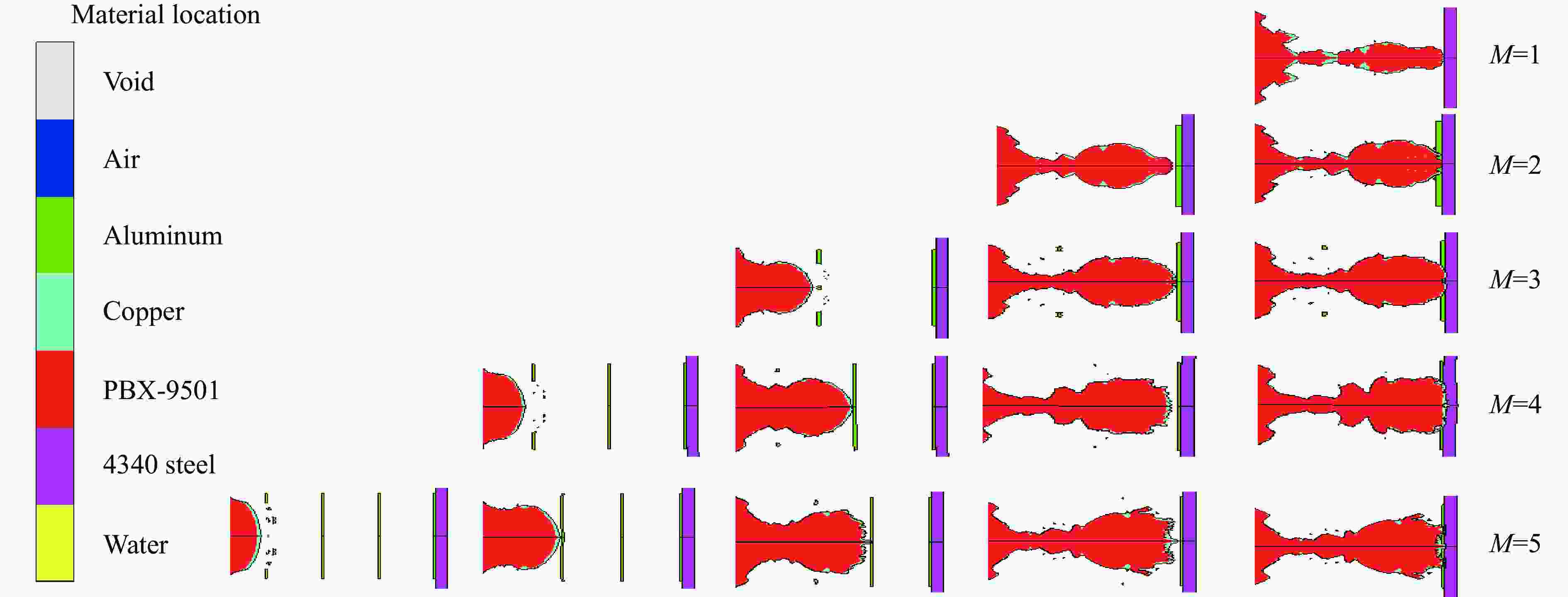
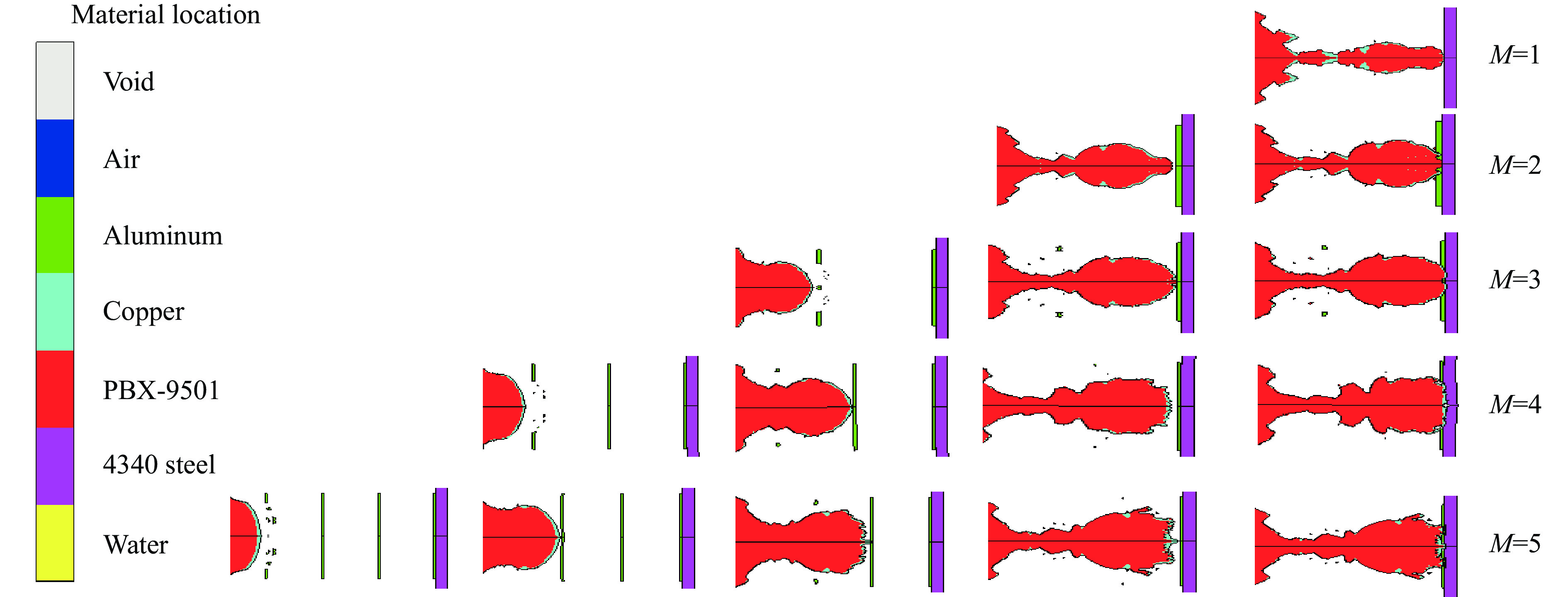
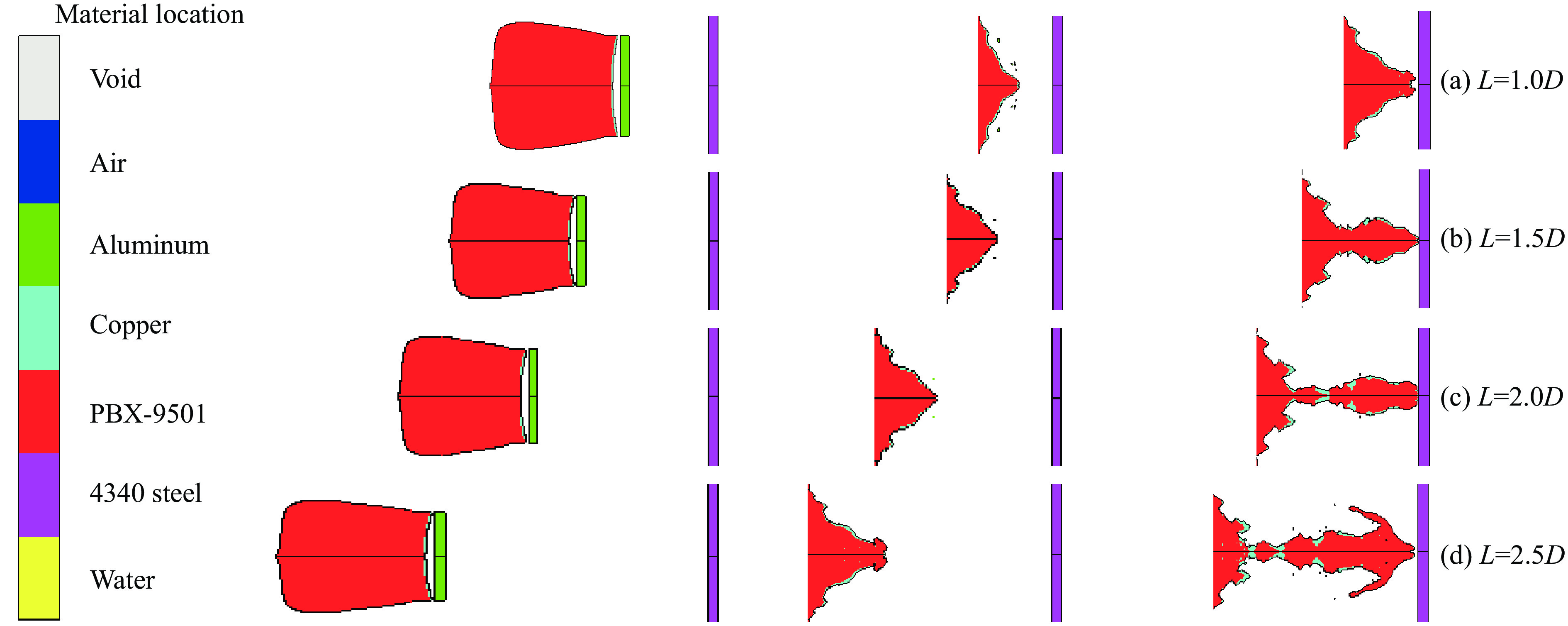
图 8 不同模拟头段层数下EFP侵彻体成型
Figure 8. Formation of EFP penetrators with different nose layer numbers
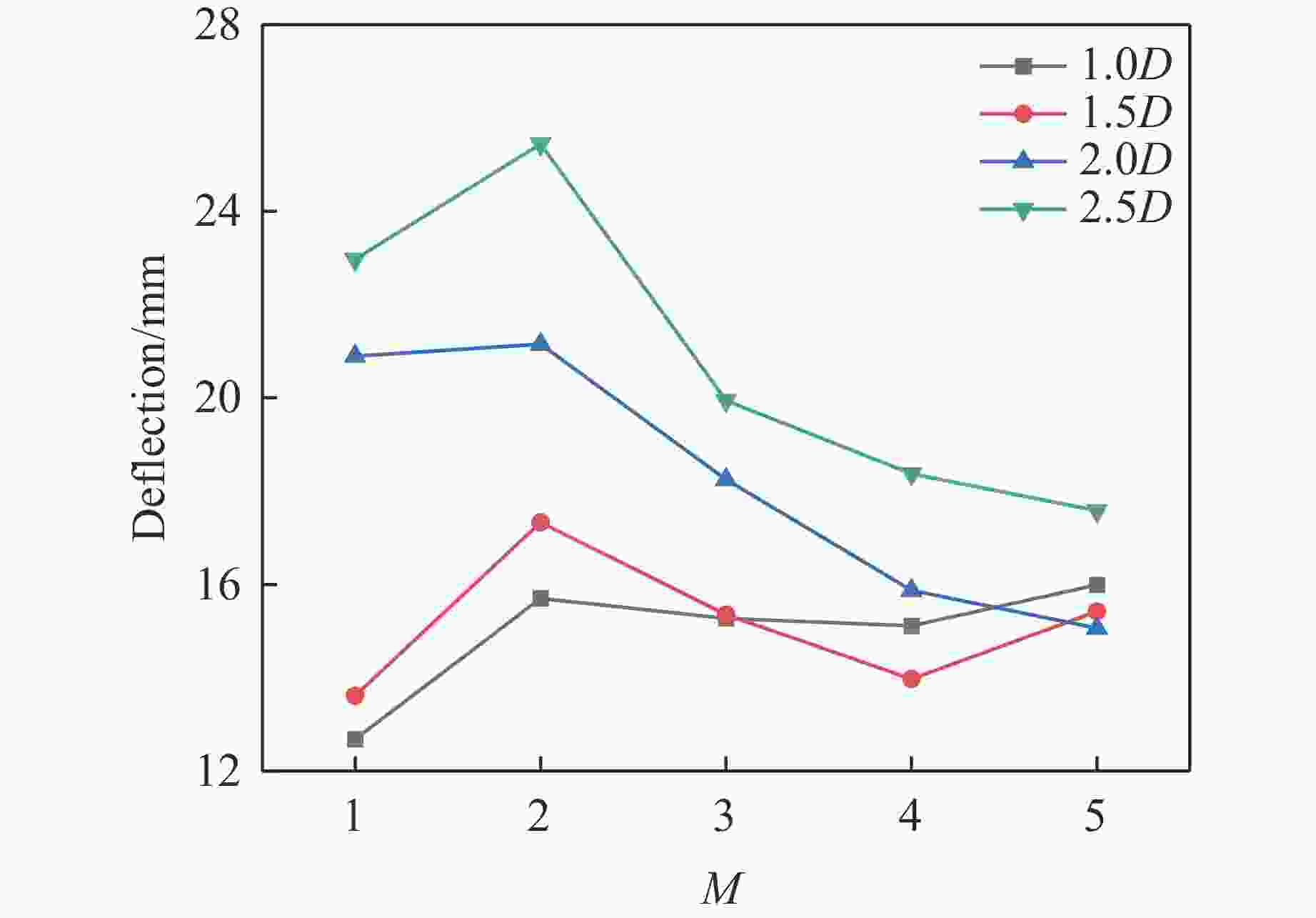
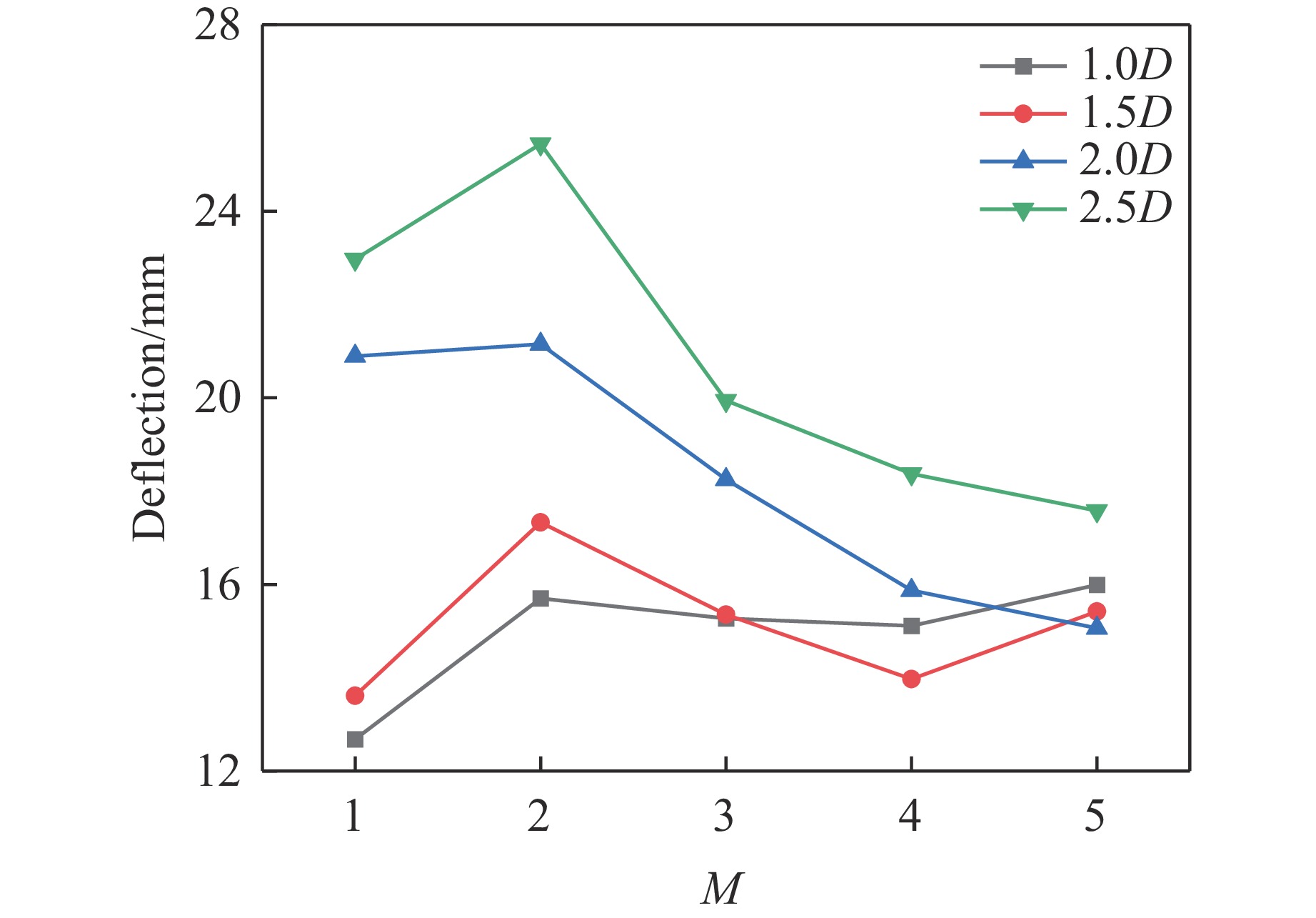
图 9 模拟头段层数对后效靶挠度的影响
Figure 9. Effect of number of nose layers on deflection of residual target

图 10 模拟头段层数对聚能战斗部毁伤威力的影响
Figure 10. Effect of number of nose layers on lethality of shaped charge warhead
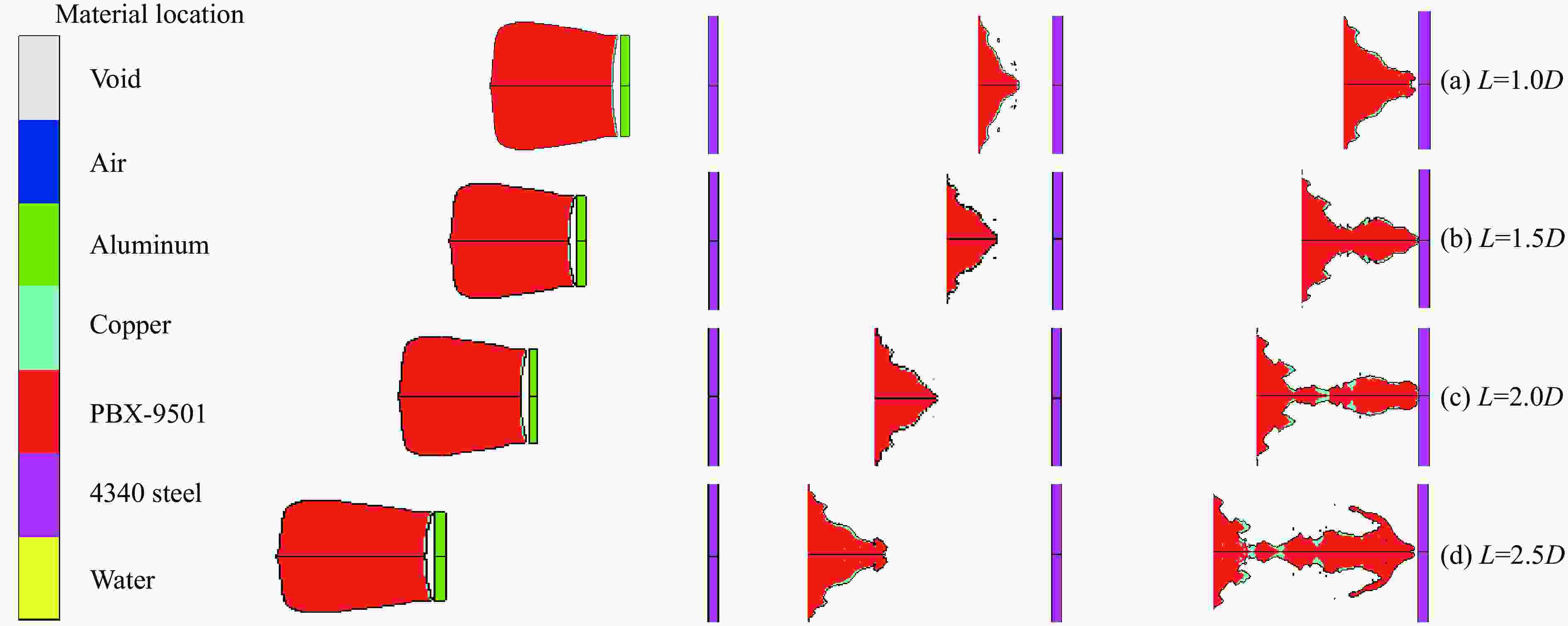
图 11 不同模拟头段总长度条件下形成的EFP侵彻体
Figure 11. EFP penetrators formed by nose sections with different total lengths

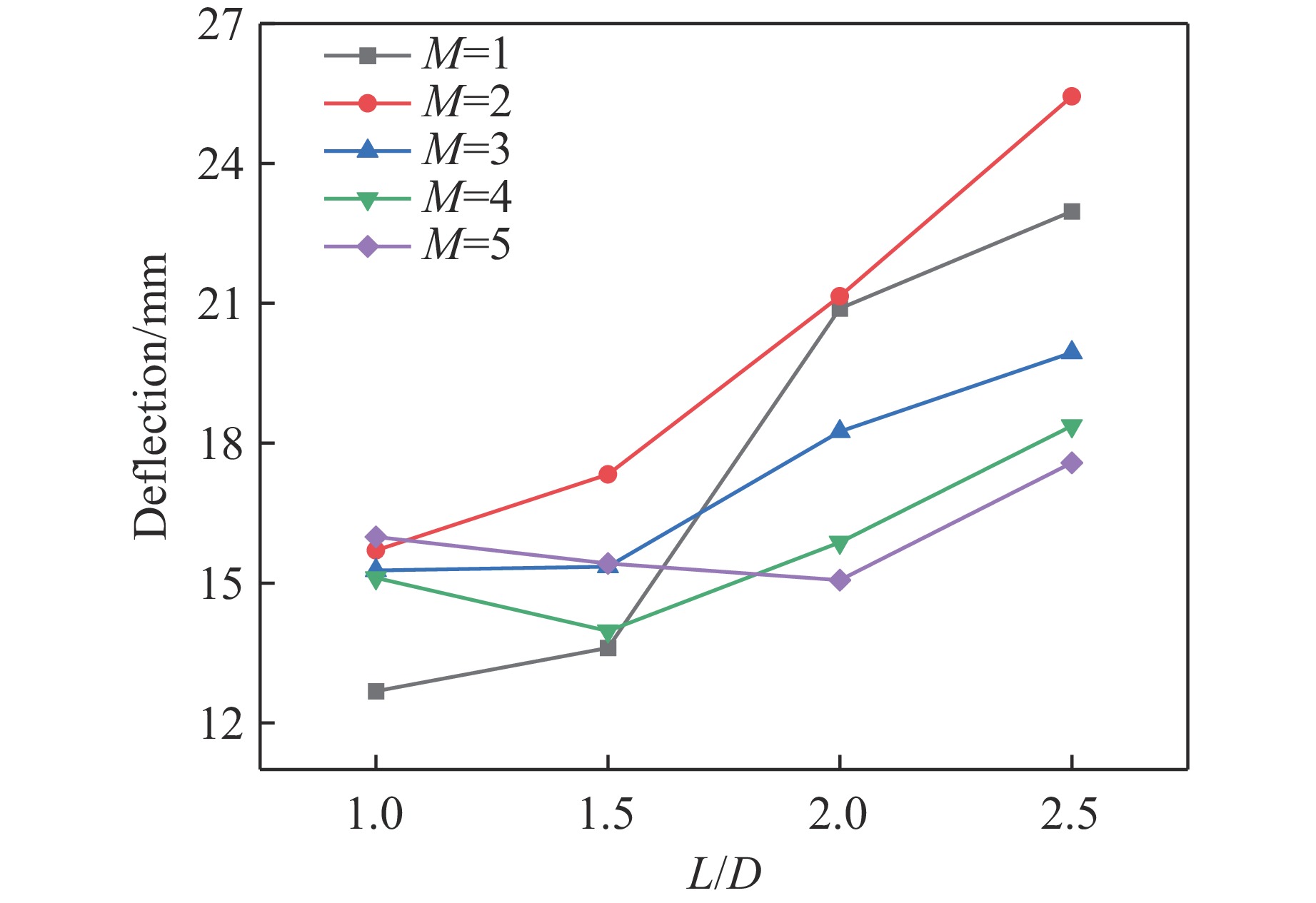
图 13 模拟头段总长度对聚能战斗部毁伤威力的影响
Figure 13. Effect of total nose length on lethality of shaped charge warhead
表 1 模拟头段层数与单层铝靶板厚度的关系
Table 1. Relationship between the number of nose layers and the thickness of a single aluminum target plate
M h/mm M h/mm 1 10.0 4 2.5 2 5.0 5 2.0 3 3.3  下载: 导出CSV
表 2 PBX-9501炸药的材料参数
Table 2. Material parameters of PBX-9501 explosive
ρ/(g·cm−3) De/(m·s−1) Ae/GPa Be/GPa R1 R2 ω E/(J·mm−3) 1.84 8800 85.24 1.802 4.55 1.3 0.38 10.2
下载: 导出CSV
表 3 紫铜的材料参数
Table 3. Material parameters of copper
ρ/(g·cm−3) C1/(m·s−1) C2/(m·s−1) S1 S2 Г 8.9 3958 0 1.497 0 2.0
下载: 导出CSV
表 4 4340钢的材料参数
Table 4. Material parameters of 4340 steel
ρ/(g·cm−3) A/GPa B/GPa n C 7.83 0.792 0.51 0.26 0.014
下载: 导出CSV
表 5 水的材料参数
Table 5. Material parameters of water
ρ/(g·cm−3) A1/GPa A2/GPa A3/GPa B0 B1 1.0 2.2 9.54 14.57 0.28 0.28
下载: 导出CSV
-
[1] 郭雁潮. 聚能装药对舰船典型靶板的毁伤特性研究 [D]. 太原: 中北大学, 2020.GUO Y C. Research on the damage efficiency of shaped charge to warship typical target plates [D]. Taiyuan: North University of China, 2020. [2] 李昊. 爆破型鱼雷对潜艇毁伤效能评估 [D]. 太原: 中北大学, 2022.LI H. Damage effectiveness evaluation of blasting torpedo on submarine [D]. Taiyuan: North University of China, 2022. [3] CHEN Z Q, WU H, CHENG Y H. Dynamic behaviors of concrete gravity dam against combined blast wave and bubble pulsation of underwater explosion [J]. Ocean Engineering, 2024, 302: 117677. doi: 10.1016/j.oceaneng.2024.117677 [4] 胡亮亮, 黄瑞源, 李世超, 等. 水下爆炸冲击波数值仿真研究 [J]. 高压物理学报, 2020, 34(1): 015102. doi: 10.11858/gywlxb.20190773HU L L, HUANG R Y, LI S C, et al. Shock wave simulation of underwater explosion [J]. Chinese Journal of High Pressure Physics, 2020, 34(1): 015102. doi: 10.11858/gywlxb.20190773 [5] 蔡泽喆, 朱小龙, 王鹤然, 等. 水下冲击波载荷作用下复合材料层合板的动态失效机理 [J]. 火炸药学报, 2024, 47(8): 730–737. doi: 10.14077/j.issn.1007-7812.202405017CAI Z Z, ZHU X L, WANG H R, et al. Dynamic failure mechanism of composite laminates under underwater shock wave load [J]. Chinese Journal of Explosives & Propellants, 2024, 47(8): 730–737. doi: 10.14077/j.issn.1007-7812.202405017 [6] DE CAMARGO F V. Survey on experimental and numerical approaches to model underwater explosions [J]. Journal of Marine Science and Engineering, 2019, 7(1): 15. doi: 10.3390/jmse7010015 [7] WU H, CHEN Z Q, CHENG Y H. Influence of explosion position on blast resistance of concrete gravity dam against underwater explosion blast wave and bubble pulsation [J]. Engineering Failure Analysis, 2025, 169: 109188. doi: 10.1016/j.engfailanal.2024.109188 [8] 严侃. 典型水下航行器爆炸毁伤动力学特性研究 [J]. 水下无人系统学报, 2024, 32(6): 1108–1116. doi: 10.11993/j.issn.2096-3920.2024-0139YAN K. Dynamic characteristics of explosive damage to typical undersea vehicles [J]. Journal of Unmanned Undersea Systems, 2024, 32(6): 1108–1116. doi: 10.11993/j.issn.2096-3920.2024-0139 [9] YIN C Y, YU H T, JIN Z Y, et al. Investigation of shock wave propagation and water cavitation in a water-filled double plate subjected to underwater blast [J]. International Journal of Mechanical Sciences, 2023, 253: 108400. doi: 10.1016/j.ijmecsci.2023.108400 [10] 古滨, 李炳南, 姚熊亮, 等. 水下冲击波作用下双层壳结构响应特征研究 [J]. 兵器装备工程学报, 2019, 40(11): 11–18. doi: 10.11809/bqzbgcxb2019.11.003GU B, LI B N, YAO X L, et al. Research of impact response of double-shell based on underwater explosion shock wave [J]. Journal of Ordnance Equipment Engineering, 2019, 40(11): 11–18. doi: 10.11809/bqzbgcxb2019.11.003 [11] 李海龙. 聚能装药水下爆炸对结构多模式破坏与防护机理研究 [D]. 大连: 大连理工大学, 2024.LI H L. Research on multi-models structural damage and protection mechanisms subjected to shaped charge associated with underwater explosion [D]. Dalian: Dalian University of Technology, 2024. [12] 黄贤智, 陈艺, 王彬谕, 等. 水下爆破冲击波特性及其对水下墩柱作用的影响分析 [J]. 西部交通科技, 2024(12): 211–215. doi: 10.13282/j.cnki.wccst.2024.12.063HUANG X Z, CHEN Y, WANG B Y, et al. Analysis of underwater blasting shock wave characteristics and their effects on underwater piers [J]. Western China Communications Science & Technology, 2024(12): 211–215. doi: 10.13282/j.cnki.wccst.2024.12.063 [13] 张晓伟, 张浩, 杨茂林, 等. 隔爆墙后爆炸冲击波绕射与超压分布规律 [J]. 北京理工大学学报, 2021, 41(4): 372–379. doi: 10.15918/j.tbit1001-0645.2020.069ZHANG X W, ZHANG H, YANG M L, et al. Diffraction and overpressure distribution of blast wave behind explosion isolation wall [J]. Transactions of Beijing Institute of Technology, 2021, 41(4): 372–379. doi: 10.15918/j.tbit1001-0645.2020.069 [14] 张迪洲, 何镇宏, 何心怡, 等. 水下爆炸冲击波在圆柱壳结构表面绕射衰减分布 [J]. 水下无人系统学报, 2022, 30(3): 371–377. doi: 10.11993/j.issn.2096-3920.2022.03.013ZHANG D Z, HE Z H, HE X Y, et al. Diffraction attenuation distribution of underwater explosion shock waves on the surface of a cylindrical structure [J]. Journal of Unmanned Undersea Systems, 2022, 30(3): 371–377. doi: 10.11993/j.issn.2096-3920.2022.03.013 [15] 屈子悦. 水下爆炸作用下圆柱壳绕射特性及压力分布特征研究 [D]. 哈尔滨: 哈尔滨工程大学, 2019.QU Z Y. Study on diffraction characteristics and pressure distribution of cylindrical shell under underwater shock wave [D]. Harbin: Harbin Engineering University, 2019. [16] 张之凡, 李海龙, 张桂勇, 等. 聚能装药水下爆炸冲击波和侵彻体载荷作用时序研究 [J]. 爆炸与冲击, 2023, 43(10): 102201. doi: 10.11883/bzycj-2022-0397ZHANG Z F, LI H L, ZHANG G Y, et al. Action time sequence of underwater explosion shock waves and shaped charge projectiles [J]. Explosion and Shock Waves, 2023, 43(10): 102201. doi: 10.11883/bzycj-2022-0397 [17] 蒋文灿, 程祥珍, 梁斌, 等. 一种组合药型罩聚能装药战斗部对含水复合结构毁伤的数值模拟及试验研究 [J]. 爆炸与冲击, 2022, 42(8): 083303. doi: 10.11883/bzycj-2021-0389JIANG W C, CHENG X Z, LIANG B, et al. Numerical simulation and experimental study on the damage of water partitioned structure by a shaped charge warhead with a combined charge liner [J]. Explosion and Shock Waves, 2022, 42(8): 083303. doi: 10.11883/bzycj-2021-0389 [18] 潘乾坤, 袁浩, 任凯, 等. 不同组合式聚能战斗部对水下目标的毁伤研究 [J]. 兵器装备工程学报, 2024, 45(5): 173–179. doi: 10.11809/bqzbgcxb2024.05.025PAN Q K, YUAN H, REN K, et al. Research on damage to underwater targets by different combined shaped charge warhead [J]. Journal of Ordnance Equipment Engineering, 2024, 45(5): 173–179. doi: 10.11809/bqzbgcxb2024.05.025 [19] 王长利, 周刚, 马坤, 等. 典型含水复合结构在聚能装药水下爆炸作用下的毁伤 [J]. 船舶力学, 2018, 22(8): 1001–1010. doi: 10.3969/j.issn.1007-7294.2018.08.010WANG C L, ZHOU G, MA K, et al. Damage anlysis of typical water partitioned structure under shaped charge underwater explosion [J]. Journal of Ship Mechanics, 2018, 22(8): 1001–1010. doi: 10.3969/j.issn.1007-7294.2018.08.010 [20] 戴君全, 叶本治, 冯民贤, 等. 射弹在水介质中的运动规律的测试研究 [J]. 测试技术学报, 1995(1): 33–39.DAI J Q, YE B Z, FENG M X, et al. Study and tests on the movment of projectile in water medium [J]. Journal of Test and Measurement Technology, 1995(1): 33–39. [21] 凌荣辉, 钱立新, 唐平, 等. 聚能型鱼雷战斗部对潜艇目标毁伤研究 [J]. 弹道学报, 2001, 13(2): 23–27. doi: 10.3969/j.issn.1004-499X.2001.02.005LING R H, QIAN L X, TANG P, et al. Target damage study of shaped-charge warhead of antisubmarine torpedo [J]. Journal of Ballistics, 2001, 13(2): 23–27. doi: 10.3969/j.issn.1004-499X.2001.02.005 [22] 陈冬梅, 陈智刚, 侯秀成, 等. 三类聚能侵彻体鱼雷战斗部对目标毁伤数值模拟 [J]. 弹箭与制导学报, 2012, 32(2): 110–113. doi: 10.3969/j.issn.1673-9728.2012.02.030CHEN D M, CHEN Z G, HOU X C, et al. The simulation on target damage of three shaped-charge penetrators torpedo warheads [J]. Journal of Projectiles, Rockets, Missiles and Guidance, 2012, 32(2): 110–113. doi: 10.3969/j.issn.1673-9728.2012.02.030 [23] 朱奇峰, 黎勤, 王团盟, 等. 鱼雷聚能战斗部侵彻含水复合装甲理论与试验 [J]. 水下无人系统学报, 2024, 32(6): 1100–1107. doi: 10.11993/j.issn.2096-3920.2023-0148ZHU Q F, LI Q, WANG T M, et al. Theories and experiments of torpedo shaped charge warhead penetration into water-partitioned armor [J]. Journal of Unmanned Undersea Systems, 2024, 32(6): 1100–1107. doi: 10.11993/j.issn.2096-3920.2023-0148 [24] 刘晓波. 聚能射流载荷及气泡载荷联合作用下结构毁伤特性研究 [D]. 哈尔滨: 哈尔滨工程大学, 2022.LIU X B. Study on the damage performance of structure under the combined action of the shaped charge jet and the explosive bubble [D]. Harbin: Harbin Engineering University, 2022. [25] ANSYS. AUTODYN user’s manual: release 12.1 [M]. ANSYS, 2009. [26] 黄洪. 聚能装药水下爆炸对目标的毁伤特性研究 [D]. 沈阳: 沈阳理工大学, 2021.HUANG H. Damage characteristics of shaped charge underwater explosion to target [D]. Shenyang: Shenyang Ligong University, 2021. [27] 李翼祺, 马素贞. 爆炸力学 [M]. 北京: 科学出版社, 1992.LI Y Q, MA S Z. Explosion mechanics [M]. Beijing: Science Press, 1992. [28] 付海清. 前向空腔对装药水下爆炸威力的影响规律研究 [D]. 沈阳: 沈阳理工大学, 2022.FU H Q. Study on the influence law of forward cavity on the underwater explosive power [D]. Shenyang: Shenyang Ligong University, 2022. -

 下载:
下载:






计量
- 文章访问数: 1236
- HTML全文浏览量: 436
- PDF下载量: 85
